


The save that immortalised Banks

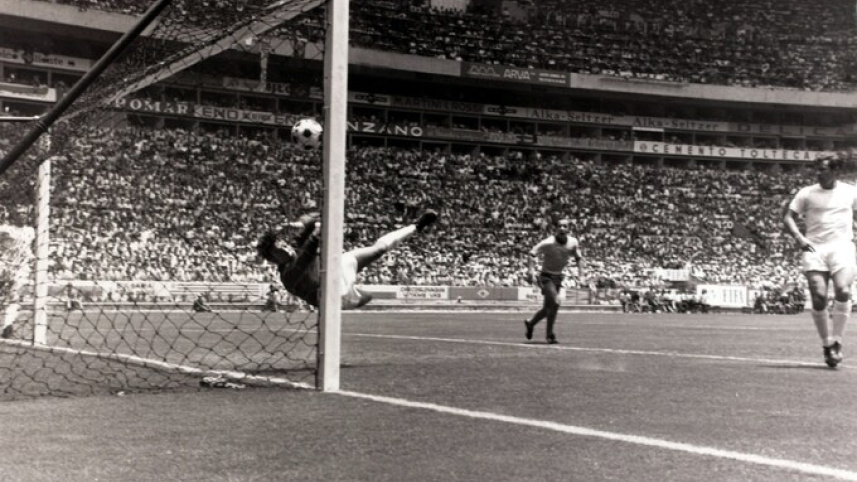
The year was 1970, and the setting was the Jalisco Stadium in Guadalajara, Mexico. The midday sun blazed overhead, casting a searing heat upon the emerald turf below, where two clashing philosophies of football prepared for a monumental confrontation. On one side stood Brazil, the high priests of Jogo Bonito -- the beautiful game -- led by their sorcerers of skill. On the other, the reigning world champions, England: the very embodiment of defensive grit and disciplined structure.
Yet, rising above the sweltering Mexican heat, England’s goalkeeper Gordon Banks produced a moment so defying of logic that it remains the ultimate benchmark for his craft.

The match was barely midway through the first half. The Brazilian captain, Carlos Alberto, clipped a ball from midfield out to the right wing for Jairzinho. Known as the “Hurricane” of the Mexico World Cup, Jairzinho scorched past the English left-back Terry Cooper, driving toward the box. at the very last moment, near the byline, he floated a cross precisely into the heart of the penalty area.
There, waiting in ambush, was Pele -- a man for whom football was an art form, each touch weaving a new narrative. Pele’s leap seemed as though, by some conjurer’s trick, he was hanging in the air. Tensing his neck muscles, he met the ball with the meat of his forehead, powering it downward. The ball struck the turf with ferocious pace, bouncing just in front of the goal line as it arrowed toward the bottom right-hand corner of the English net.
Pele’s mind, his instincts, and a lifetime of experience told him one thing: this was a goal. A perfect, unstoppable goal. Even before the ball could ripple the netting, he had screamed “Goal!” in triumph, throwing his arms skyward in celebration.
Science dictates that every object on Earth is a slave to gravity. But the man standing between the posts was Gordon Banks.
When Jairzinho delivered the cross, Banks was positioned near the left-hand upright. As Pele connected, Banks realised the ball was heading for the diametrically opposite corner. Between him and the ball lay a vast ocean of distance. To make matters worse, the bounce off the turf had altered the ball's trajectory, making it even more elusive. Any ordinary goalkeeper would have remained rooted to the spot, a mere spectator to Pele’s joy.
But in that fractured second, Banks performed an act that defied the ultimate boundaries of human reflex. With the agility of a cheetah, he flung himself to the right. His body was entirely airborne, severed from the ground. It appeared as though he had torn through the invisible shackles of gravity.
With the ball just inches from crossing the line, Banks’s outstretched right hand appeared like a magician’s wand. Neither the immense speed nor the momentum of the ball could budge his iron-clad wrist. With an incredible, almost superhuman flick of his thumb and palm, he scooped the ball upward from the base of the post. The ball clipped over the crossbar as if hitting an invisible wall, spiralling out of play.
A decision in a fraction of a second, a flawless reaction, was made at the very edge of human capability.
The stadium fell silent. Then, an explosion of sound. Pele clutched his head, disbelief in his eyes.
England’s legendary captain, Bobby Moore, strolled toward Banks. Even in this moment of extreme tension, he wore his trademark calm smile. He simply remarked, “You should have caught that, Gordon!”
Clambering up from the turf, a breathless Banks replied with a grin, “Sorry, Bobby.”
After the whistle, Pele embraced Banks and admitted, “I thought that was a goal.”
Banks’s immortal reply was, ‘You thought so, and I thought so too.’
Later, Pele would reflect: “I have scored thousands of goals in my life, but people always remember me for the one I didn't score.”
The goal never happened, yet it remains as memorable as the greatest goal ever scored.
 For all latest news, follow The Daily Star's Google News channel.
Comments