


The king’s farewell

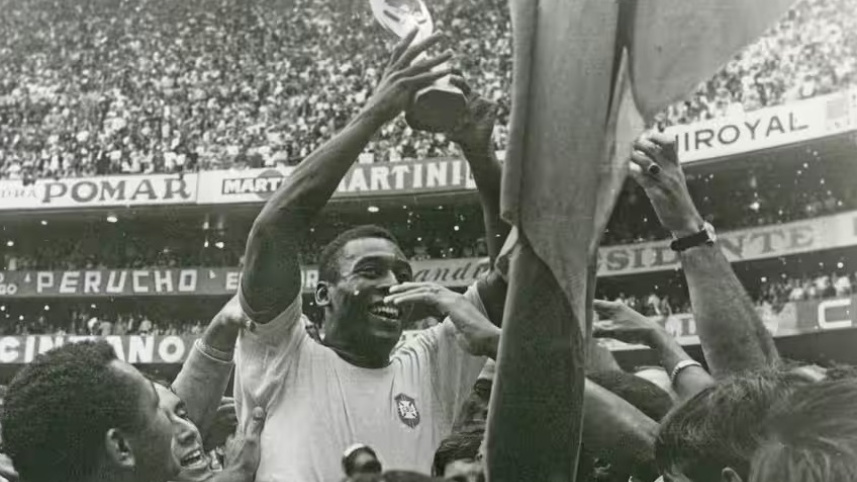
The referee’s whistle hadn’t even blown when the crowd flooded the field. Tens of thousands. Yellow-and-green jerseys, white shirts, bare-chested bodies -- all rushing in the same direction. Cameras swiveled. Flashes lit up the stadium. Azteca had one sound at that moment: untamed, ecstatic, unbearably beautiful screaming.
And in the midst of that wave, one man stood still; eyes closed, head slightly bowed -- Pele, with the corners of his eyes wet. Around all the commotion, there was a bubble of silence surrounding him, as if everyone knew he needed a moment alone.

Then came Carlos Alberto.
No words. No signals. Just two hands -- captain’s hands -- reaching toward Pele. And in an instant, Pele left the ground. On the shoulders. Of his teammates. The man who had carried others his entire life was carried for once.
June 21, 1970. The FIFA World Cup final between Brazil and Italy. The score was 4-1, in favour of the former. But these numbers were only a small part of the story. The real story was elsewhere: a man at 30 saying goodbye to the greatest chapter of his life.
His story began in 1958. A 17-year-old stormed the fields of Sweden in a way that stunned the world. Goals in the final, dazzling skill, the euphoria of a World Cup victory -- overnight, that boy became football’s new prince.
Four years later, Brazil won the trophy in Chile. But injuries kept him from playing in the tournament. In 1966, in England, the story took another turn. Pele was repeatedly floored by the brutal fouls of defenders. In those days, player safety wasn’t what it is today. The easiest way to stop the world’s best player was to kick him.
After that World Cup, angry, exhausted, and injured, Pele said he would never play in a World Cup again. Many believed him. Perhaps they were right. But football and the love of the people eventually brought him to Mexico for one last time.
But this time, he was no longer that boy. Now he was mature, wiser, a complete footballer. His speed may have been slightly less, but his understanding of the game had reached a level where he saw what others could not.
The 1970 Brazilian team is still considered by many the greatest national team of all time. Every line of that team sparkled with stars. Jairzinho was unstoppable, scoring in every match of the tournament. Rivellino’s left foot seemed touched by magic. Tostao was an extraordinary, intelligent forward. And from the back, captain Carlos Alberto led.
Yet the center of this constellation was only one man -- Pele.
Throughout the World Cup, he seemed to redefine football itself. Sometimes scoring, sometimes assisting, sometimes creating moments that couldn’t be measured by statistics.
The incredible shot from midfield against Czechoslovakia that barely missed. The legendary move against Uruguay, dribbling past the goalkeeper without the ball. Every match, he left something for fans to cherish for years.
Finally, the final arrived.
At the 18th minute came the first goal. A cross floated from the right. Pele leapt over the Italian defenders. His jump seemed more than human. For a few seconds, it felt as though he hovered in the air. Then, with a thunderous header -- the ball was in the net. The goalkeeper could only watch.
The smile that spread across Pele’s face after that goal held confidence, relief, and a hint of dreams fulfilled. Italy did not give up; they equalised once. But Brazil’s football that day was unstoppable. Attack after attack, creative play after creative play.
Then came the moment many consider the greatest team goal in World Cup history. Late in the match, Brazil circulated the ball patiently. Each pass was part of a story. The ball reached Pele. He looked up. Carlos Alberto was running on the right.
Pele didn’t hesitate. A perfect pass. Alberto struck at the first touch. Goal. 4-1. The game was over. The World Cup was over. And so ended Pele’s World Cup journey.
The Jules Rimet trophy. The golden trophy. Forever given to Brazil. The prize for three World Cups. Pele held it up, looking once at the sky. Then he lowered his eyes. What was in that gaze? Relief at the end? Or sadness at leaving? He never fully revealed it.
As he walked off the field, Roberto Rosato of Italy approached. He reached out for Peles jersey. The Brazilian legend stopped, pulled it off. He, with a smile on his face, handed it over Rosato, who had tears in his eyes.
 For all latest news, follow The Daily Star's Google News channel.
 Yet, Pele, standing bare-chested, still carried the thrill of victory in his eyes. In the eyes of Jairzinho, Tostao, Rivellino, Carlos Alberto, there were tears of triumph. In a surge of emotion, teammates and frenzied fans suddenly lifted the living soul of the team onto their shoulders.
Floating in the air, Pele was no longer just a player; on the shoulders of his teammates, he was enthroned in an unseen throne. If this scene were frozen in time, you’d see Pele’s famous, world-embracing smile. In his primitive, sincere satisfaction, his eyes smiled too. Raising his right fist toward the sky, he seemed to want to touch the heavens.
From the crowd, someone placed the iconic Mexican sombrero on his head. Cameras clicked nonstop, police and wild fans pressed in, but at the center was only him. Like a victorious general welcomed by loyal soldiers after a bloody war.
Later, in an interview, Pele was asked how he felt at that moment. He said, “I thought, what’s left after this?”
What is left after that? The question may sound melancholic, but it is actually the language of completeness. A man who has given everything, received everything, and knows it. Nothing more honest can be said.
Carlos Alberto lifted Pele onto his shoulders that day. But in truth, Pele had carried them all, year after year. That day, he just took a short rest.
This is how kings bid farewell.
Comments