


The day football died

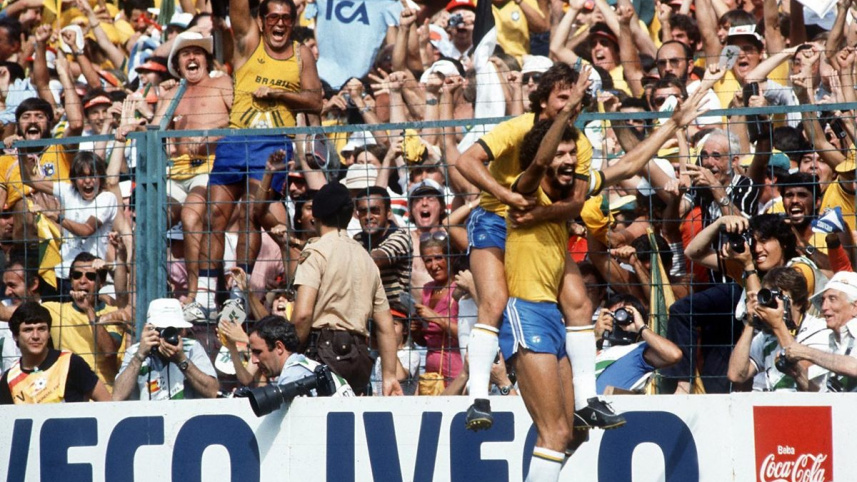
July 5, 1982.
The stands were a sea of yellow spring, thousands of souls swaying to the wild rhythm of samba. Onto the pitch walked a team for whom football was not merely a leather ball -- it was an elusive, intangible art. Tele Santana’s Brazil, widely regarded as the most beautiful, most romantic, and yet most heartbreaking chapter in football history. They did not come to the field to win wars; they came to write poetry with their feet on a canvas of green.

Nobody could have known that afternoon at Sarriá would not simply decide a match — it would witness the brutal, premature death of the most beautiful dream the game had ever produced.
Every player in that squad was a master sculptor. The philosophy of Jogo Bonito -- beautiful football -- that Pele and Garrincha had bequeathed to the world found its last and most perfect expression in this team.
Zico, whom the world affectionately called the “White Pele,” turned the ball into a magician’s wand come to life. The most resolute defensive lines crumbled like houses of cards under his gaze. It was said he did not find space -- he created it.
Then there was Socrates -- white headband, untidy beard, a physician by profession and a philosopher to his very core. He did not run on the pitch; he strolled with regal composure, claiming the entire field as his domain. When the ball rolled off his heel to a teammate, the crowd momentarily forgot to breathe.
The other emperor of midfield was Falcao, known as the “King of Rome” -- a poet whose every touch hummed with music. He played like a poet -- every touch melodic, every decision unhurried. He seemed to slow time itself. When chaos swirled around him, the ball at his feet brought a strange calm. Yet when he pulled the trigger, that quiet poet turned to thunder.
Eder, Cerezo -- each was an inseparable movement in a grand symphony. They believed that scoring goals may be the purpose of football, but true beauty lay in the artistic journey toward that goal. They did not merely want to beat opponents; they wanted to bewitch them into submission.
But fate, as ever, is strange and merciless. Standing between them and the semifinals was Italy -- on one side, the devotees of art; on the other, a team of compact defence and calculated football.
Brazil needed only a draw. But in Italy’s blue jersey that day stood Paolo Rossi -- a cold, solitary assassin. Returning from a suspension clouded by a match-fixing scandal, Rossi had been a shadow of himself throughout the tournament. Yet on that scorching afternoon in Sarria, he materialised before Brazilian artistry like the angel of death.
Just five minutes in, a slight defensive error gifted the ball to Rossi. In a flash, with no regard for elegance, he buried it in the net. The yellow stands fell silent.
But Brazil do not surrender easily. Stung, they surged back -- not with brutality, but with artistic fury. In the 12th minute, Zico conjured an unforgettable moment, threading a pass through four Italian players to Socrates, who found an almost impossible angle past the Italian wall, Dino Zoff. 1–1. The samba roared again.
Yet this romantic team carried a fatal flaw: they did not understand defensive football. They only knew how to make flowers bloom. In the 25th minute, Rossi struck again -- another unforgivable Brazilian error, another cold finish. 2–1 at half-time.
In the second half, Brazil launched what felt like their final artistic exhibition. Wave after wave crashed against the Italian box. In the 68th minute, Falcao delivered the moment they craved -- a bullet strike from just outside the area that tore through Italy's net. His wild celebration, arms outstretched like a bird in flight, veins throbbing, a primal roar -- it remains an immortal sculpture in the hearts of every football romantic.
2–2. Hold this, and Brazil go through.
But of course, they had not come to the field to survive by calculation. Instead of consolidating, they pushed for more beauty, more goals. And this excess of romanticism summoned their eternal sorrow.
In the 74th minute, from a scramble at a corner, the ball fell to Rossi once more. The solitary hunter completed his hat-trick, and drove the final nail into Brazil's dream of immortality.
Trailing 3–2, Brazil threw everything forward -- but the reliable hands of 40-year-old Zoff and Italy's massed defence ensured that beauty, that day, would lose.
When the final whistle blew, the green grass of Sarria seemed to grow heavy with grief. In the dressing room, the Brazilians were speechless -- empty stares, total silence. It was Socrates who finally broke it, exhaling deeply: “Today, football died.”
Yes. On that afternoon in Sarriá, football truly did die. The defeat of Zico, Socrates, and Falcao taught the world a brutal truth -- that beauty alone is not enough to win; that survival demands something harder, more calculating. After that match, football slowly became a game of tactics and muscle.
 For all latest news, follow The Daily Star's Google News channel.
 But that 1982 Brazil team, though they never lifted the golden trophy, won the hearts of football lovers for eternity. When a modern fan closes their eyes and recalls that match, they see no shame in the defeat -- only a breathtaking canvas of art, erased before its time, yet leaving behind perhaps the most beautiful, most poetic tragedy in the entire history of the sport.
Comments