


Schillaci: He came, saw, won, and disappeared
“If you think about it, my international career lasted only three weeks.”
The words belong to none other than Salvatore “Toto” Schillaci, the unforgettable and enigmatic hero of the 1990 FIFA World Cup in Italy.

Football history is filled with fairy tales that continue to inspire generations. Yet Schillaci's story seems to surpass even the most improbable of them. He was like a comet that blazed across the Italian summer sky before disappearing just as suddenly into darkness.
For football romantics, Italy in the 1990 remains an evergreen emotion, and at the very heart of that nostalgia stands Schillaci. Just months before the tournament, he was an unknown striker. By the time the World Cup ended, he had claimed both the Golden Boot and the Golden Ball on home soil. Behind that astonishing rise, however, lies a story of sharp contrasts and one of football’s shortest-lived peaks.
In many ways, Schillaci’s entire career can be defined by a single magical season. It was that remarkable campaign that earned him a place in the Italian national team, and the rest, as they say, is history.
“When my career started, nobody knew who I was,” Schillaci once reflected. “When the World Cup ended, I was the most talked-about man in the world. But that intense spotlight faded very quickly.”
Yet the hero of Italia ’90 did not simply fall from the sky. The opening chapter of his career was a long and lonely struggle in the lower tiers of Italian football.
From 1982 to 1989, Schillaci spent seven seasons battling in the obscurity of Serie C and Serie B. Representing Messina, the Sicilian club, he toiled year after year in Italy’s second and third divisions, far away from the glamour and attention of the top flight.
His early goal returns were modest. Gradually, however, he began to reveal his talent. Then came a remarkable transformation during the 1988-89 season. Schillaci emerged as Serie B’s top scorer, netting 23 goals for Messina. That eye-catching campaign attracted the attention of Juventus scouts.
After seven years climbing out of the lower divisions, he finally secured a move to Italy’s most prestigious footballing stage in the summer of 1989.
For a player who had spent so long outside the spotlight, adapting to a giant like Juventus represented the greatest challenge of his career. Instead, Schillaci produced the only truly world-class season of his life.
In his debut Serie A campaign of 1989-90, he tore through opposition defences and scored 15 league goals. Across all competitions, he found the net 21 times for Juventus. Those 15 Serie A goals were enough to convince Italy coach Azeglio Vicini to include him in the squad for the upcoming World Cup.
When the tournament began in June 1990, Schillaci was little more than a reserve striker. Before the World Cup, he had made just one appearance for the national team. With stars such as Gianluca Vialli and Andrea Carnevale ahead of him, a place on the bench seemed inevitable. Then everything changed.
In Italy’s opening match against Austria, the hosts were struggling to break through. Schillaci was introduced as a substitute. Four minutes later, he headed home the winning goal.
Recalling that moment years later in an interview with Al Jazeera, Schillaci said, “After that goal against Austria, it felt like I was in a trance. Everything I touched turned into a goal. It was a God-given three weeks.”
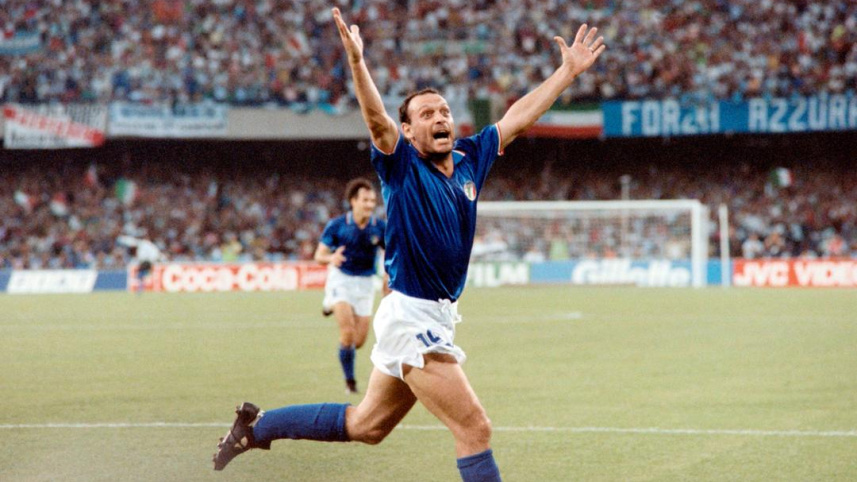
There was no looking back. Schillaci continued scoring throughout the tournament. He netted the winner against Ireland in the quarter-finals, scored against Argentina in the semi-finals, and converted a penalty against England in the third-place playoff. He became Italy’s undisputed saviour.
With six goals, he finished as the tournament’s top scorer, winning the Golden Boot. He was also named the best player of the World Cup and received the Golden Ball.
Italian fans would never forget those wide, intense eyes during his goal celebrations. After the World Cup, the football world believed a new superstar had arrived.
Fate had other plans. Schillaci’s magical World Cup performance was followed by only one more year with the Italian national team.
After 1990, he played just eight more matches for Italy and scored only once. By 1991, the doors of the national team had effectively closed forever. His international career ended with just 16 appearances and seven goals -- six of which came during those extraordinary three weeks in the summer of 1990. His decline at club level proved equally dramatic. The brutal reality of the statistics is that after that dream debut season with Juventus, Schillaci never again scored more than six goals in a Serie A campaign. Across spells with Juventus and later Inter Milan, he spent only five seasons in Italy’s top division.
 For all latest news, follow The Daily Star's Google News channel.
 His final two seasons at Juventus yielded five and six league goals respectively. At Inter Milan, he managed six goals in one season and five in the next. The sparkle had vanished. His club career became evidence that he truly was a one-season wonder.
The reasons behind that sudden decline extended beyond a simple loss of form.
Before the World Cup, Schillaci had been an unknown quantity, an unexpected surprise for defenders. After Italia ’90, however, opponents had studied his game in detail. Serie A’s tactically astute defenders quickly learned how to neutralise his strengths.
At the same time, a series of muscle and knee injuries robbed him of the explosive pace and energy that had made him so dangerous inside the penalty area.
There was also the psychological burden of overnight fame. The pressure of living up to impossible expectations, combined with being overshadowed at Juventus by superstars such as Roberto Baggio, gradually eroded his confidence.
In essence, the man who rode a wave of fortune and supreme self-belief to football’s summit in June 1990 found himself brought back to earth by injuries and the unforgiving realities of elite football.
Europe never again witnessed the Schillaci of Italia ’90.
Eventually, he left Italian football and joined Japanese J.League club Jubilo Iwata. In Japan, he rediscovered some of his scoring touch, netting 56 goals before retiring from football in 1997.
Football history is filled with great players who dominated the sport for a decade or more. Salvatore Toto Schillaci ruled for only three weeks.
Yet in those three weeks, he reached heights that many legends fail to achieve over entire careers.
In September 2024, the Italian star passed away at the age of 59.
But the summer nights of 1990, those unforgettable goals, and his place as perhaps the most captivating one-season wonder in football history ensure that Toto Schillaci will live on in the hearts of football lovers forever.
He truly came, he saw, he conquered, and vanished almost in a single breath.
Comments