


‘Must look at consistency across all skill sets’

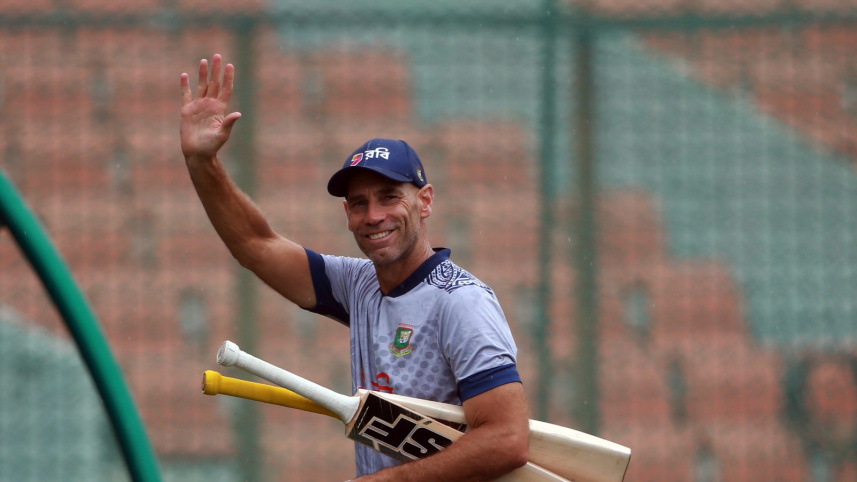
Former Bermuda international David Hemp is back in Bangladesh’s coaching set-up as the women’s team’s head coach on a two-year contract. Having previously worked with the men’s team and High Performance programme, and served as the women’s batting coach in two recent qualifying events, the 55-year-old spoke to The Daily Star’s Samsul Arefin Khan about consistency, batting struggles, pace options and the Australia series. Excerpts follow:
The Daily Star (DS): What is your main priority as you start your tenure?

David Hemp (DH): The big thing we have to look at is consistency across all skill sets, not just batting. For me, the skill is there, and I don't think the current ICC rankings do the team justice -- they are a better team than what they are showing. When I arrive, the key is to have a discussion with the players about what they are thinking at the moment, where we can improve, and why that inconsistency exists. Playing with consistency brings wins, which brings confidence, allowing individuals and the team to grow a lot quicker. The goal is to reach a stage where players demonstrate their skill regularly and don't play within themselves.
DS: You are joining amid reports of an unsettled dressing room. How will you approach team culture?
DH: When you work with a team, you will look at the outcome you can achieve. My approach is to focus on establishing a high-performance environment centered on clear communication, clarity of purpose, maximizing practice efficiency, and putting the team first.
With a series against Australia starting immediately, the initial focus is preparing the players as best as possible. Afterward, we will sit down as a group to define our goals and internal operations. From my previous experience with this group, the players worked well together, had good camaraderie and were eager to improve.
I really enjoyed working with the players during the two qualifying tournaments. They play some good cricket, so I am looking forward to making those connections again, helping them evolve as a team, and helping individuals get better. The ingredients for consistent performance are present if we maintain that mentality every single day.
DS: The team often comes close to winning and dominates phases of the game, but fails at the crucial moment. Is this just losing, or is there a mental block?
DH: What I saw in the T20 tournament in Nepal in January was that they played consistently well across every game. They remained patient and competed for longer periods, even in tight situations. When put under pressure by strong teams, controlling and managing your emotions is crucial. We need to sit down with the players, understand why those situations happen, and learn what to do differently. Consistency of performance comes from how you mentally approach pressure situations and stay disciplined when you are under pressure.
DS: Bangladesh often dominate phases but struggle to finish against stronger teams. Why is this pattern so difficult to break?`
DH: That’s the key question. Against weaker teams, being in a strong position for a shorter time can still earn a win, but against top teams, you have to maintain pressure and dominance for longer periods. Players from teams like England, Australia, India, and South Africa get regular exposure to top international and franchise competitions such as the Women's IPL, Big Bash, and The Hundred, putting them in a stronger position. Our key requirement is maintaining pressure for longer periods -- staying calm, composed, and skillful under pressure whether with bat or ball.
DS: Individual players like Nigar Sultana Joty, Shorna Akter, Marufa Akter, Rabeya, Nahida Akter, and Sobhana Mostary show brilliant individual performances, but overall team results remain inconsistent. Furthermore, there is no domestic franchise league or regular domestic cricket running currently. How do you view this situation?
DH: I don’t know about the current situation what’s happening underneath. National players benefit greatly when exposed to franchise leagues, both in individual performance and the overall positivity brought to the squad. Since our players do not currently have that franchise exposure, the job of the support staff is to develop them within the national setup so they perform consistently in international cricket. Obviously, Shakib Al Hasan and Fizz (Mustafizur Rahman) brought a lot of benefits for the team by playing in the franchise leagues. We are not at this position at the moment with the women’s team. Strong international performances will eventually earn them franchise opportunities.
DS: Heading to Australia with only one experienced frontline fast bowler in Marufa Akter, two uncapped pacers (Disha and Habiba), and Ritu Moni bowling medium pace. How do you assess the quicks?
DH: The squad is what it is, and sometimes there is a shortage of a specific skill set. Since these players were selected by the selectors, it means they can play, so the fact that they haven't played internationally yet is irrelevant -- they have to start at some stage… You can argue that that was the case for Bangladesh men’s team 15-20 years back.
DS: Over your two-year contract, do you plan to build a culture of developing fast bowlers for pace-friendly conditions abroad?
DH: You always have to evaluate your skill sets and develop fringe options. We currently have five seam options in and around the setup. By giving fringe players good exposure and time around the national squad, there is no reason why we cannot build a core group of decent seam bowlers over the next two years.
DS: How do you plan to change the team’s defensive batting mindset?
DH: In a T20 game, you have 120 scoring opportunities and 300 in 50-over games, and every ball must be viewed as a scoring opportunity. My batting philosophy is to maximise every ball faced. It is not just about boundary striking, but about strike rotation, field placement awareness and aggressive running between the wickets, which alone can add 10 to 15 runs. Even on low, slow Asian surfaces, having a positive mindset helps your body move better into scoring positions rather than playing defensively.
DS: You planned to come to Dhaka first and then go to Brisbane with the team. What did you need to come to Dhaka for while still in Australia?
 For all latest news, follow The Daily Star's Google News channel.
 DH: Unfortunately, my flight got cancelled yesterday [Wednesday]. I was supposed to arrive in Dhaka today [Thursday], but after the cancellation, I couldn't get on another flight, so I am going straight to Brisbane on Sunday.
I wanted to see everybody before we arrived, but now I just have to rejig the schedule. I wanted to watch the practice game today, and tomorrow I was going to hold staff and player meetings. I will just hold those meetings on Sunday in Brisbane now.
Comments