Why folk artists remain invisible in a culture that celebrates their art
If we open our social media, we would not have to look hard to find a folk-inspired song that has been trending on TikTok or YouTube. Even a polished folk-inspired performance from Coke Studio also gains millions of views. This phenomenon is not something uncommon for us; we often notice how we, Bangladeshis, take pride in a rich folk music heritage, from mystic Bauls and riverine Bhatiyali singers to village storytellers. This folk tradition has shaped our national culture and heritage. UNESCO has acknowledged the spiritual importance of folk music and inscribed Baul songs on the Intangible Heritage List in 2008. Nevertheless, even UNESCO noted that the people who have produced these songs have always been a marginalised group. Then again, we may hear the voices of folk artists almost everywhere, but the original singers are nowhere to be found.
In short, if we look at our country's villages, they are overflowing with folk music, but those who create this cultural treasure often remain financially poor and overlooked. Bangladesh always celebrates folk music with pride at desi festivals and cultural events but neglects the material lives of folk artists.
Visible Art but Invisible Artists
In Bangladesh's urban culture, these folk traditions are celebrated as cultural capital. National events like Pohela Boishakh (Bengali New Year), university cultural events, and Dhaka's urban cultural festivals proudly showcase folk songs that lend prestige and identity branding to organisers. Likewise, intellectuals and the media praise folk music as the soul of Bengal. In our country, folklore becomes aesthetic capital. However, the sad part is that the nation that claims ownership of this art is often unwilling to take responsibility for the artists.
This creates a paradox: urban elites gain symbolic honour by showcasing "authentic" folk art, while the actual artists receive little economic capital. This situation also illustrates a classic cultural-capital versus economic-capital paradox. Bangladesh's folk heritage generates strong national pride, or cultural capital, but the artists behind that art often receive little financial gain, or economic capital. In rural Bangladesh, songs are passed on communally and are often valued for tradition, but market intermediaries frequently commodify the arts and appropriate the profits. As a result, as Rabbani (2026) observes, folk songs carry immense cultural value even as their creators suffer from "under-recognition and unequal compensation". In other words, the music fills concert halls and social media feeds (cultural capital) but seldom supports the original musicians' livelihoods (economic capital).
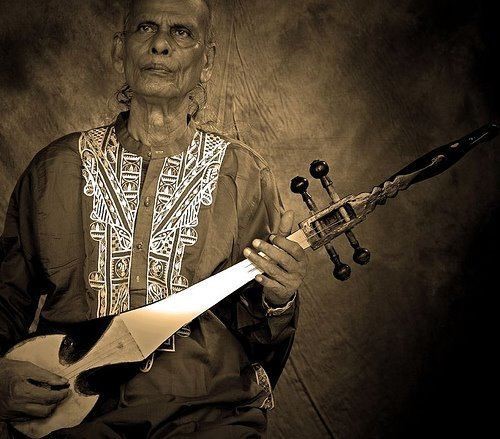
In such a societal structure, the folkloric performers themselves often remain invisible. Studies show that a few star musicians occasionally gain fame or government awards, but most rural folk artists struggle to earn a bare subsistence. For example, scholars document how urban singers have gained fame and money by remaking the songs of the legendary Baul Shah Abdul Karim, while his direct disciples and contemporaries like Sattar Mia, Ukil Munshi, and Rashid Uddin are hardly remembered.
Similarly, as one newspaper recalls, Shah Abdul Karim's 1,600 rural songs were very popular in the Bhati (lowland) region of Bangladesh, and they only reached national attention after modern artists reinterpreted them, but not while he and his community lived in poverty.
In this way, folk melodies are often used as urban commodities or film scores, but the village performers who taught those tunes to city musicians rarely see any economic reward. Villagers may cheer the folk singers for their performances, but once the applause dies down, folk singers return to subsistence farming or other jobs that are hardly enough for a decent living. Ultimately, their own livelihoods remain unaffected by the celebration of their art.
Cultural Appropriation and Economic Disparity
Folk music is no longer confined to rural areas; it is now reinvented in digital spaces such as TikTok, YouTube, and even Spotify. If we look at some urban reinventions of classical folk songs, we may notice their viral success on social media platforms across West Bengal and Bangladesh. Sometimes, the reinvention is not just an attempt to revive cultural heritage but also to repackage it for a global, urban audience. As a result, it has now become an aesthetic cultural symbol for most of us. Meanwhile, when a song goes viral on social platforms, we may cheer the cover artist of that song, but the name of its creator is often absent from that viral circulation. Even the creator may remain invisible in their own village.
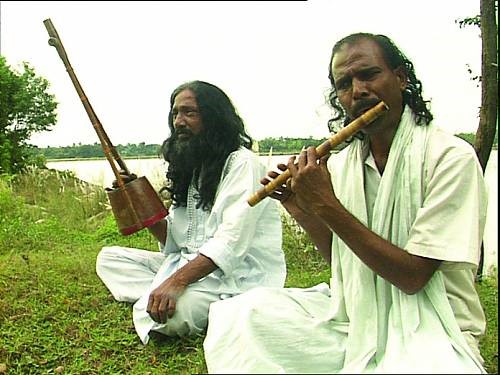
On top of that, we can ask ourselves an ethical question: "When folk music becomes content, who gets paid the most and who gets erased?" While folk artists produce most of the cultural value, studio producers and urban vocalists gain most of the fame through virality and enjoy economic advantages over rural artists. Sometimes, folk artists are paid little or even no royalties. This is not preservation; it is selective translation for urban consumption.
This is the main reason behind the persistence of the paradox between cultural and economic capital. There are a few key factors responsible for this economic and cultural disparity, such as the enduring rural-urban class division, the lack of policy support, and class hierarchy in cultural production. Our society prefers the idea of the folk artist, their arts and songs, more than the reality of their lives.
As UNESCO bluntly puts it, the preservation of Baul music "depends mainly on the social and economic situation of their practitioners". In other words, the cultural richness of folk heritage survives, but only as long as we do not starve the storytellers. In many folk songs, people even question this inequality (e.g. lamenting "small work" and unpaid labour), yet society has not answered those questions.
Toward Equity and Awareness:
This Pohela Boishakh, we should ask ourselves a question: what good is our pride in folk culture if we ignore the people who made it? The answer demands more than rhetoric. Experts now argue that integrating folk performers into a credible creative economy through fair pay, intellectual property rights, and supportive policies is essential, so that artists can remain the authors of their own cultural futures and secure a livelihood sufficient to sustain both their artistry and their lives.
In other words, Bangladesh must convert some of that revered cultural capital back into economic capital for its artists. Until then, the paradox endures: urban concerts and literary festivals may celebrate folk tradition, yet the real folk artists remain unseen and uncompensated. A truly celebratory society would not only honour its heritage in melodies but also ensure that its keepers share in the wealth it creates.
Reference:
1. Banglapedia. “Folk Music.” Banglapedia, 2021, en.banglapedia.org/index.php/Folk_Music.
2. Bourdieu, Pierre. “The Forms of Capital.” Handbook of Theory and Research for the Sociology of Education, edited by John G. Richardson, Greenwood Press, 1986, pp. 241–58.
3. BSSNEWS. “Songs of Baul Shah Abdul Karim Echo Fight Against Social Inequality.” BSSNEWS, 2025, www.bssnews.net/others/311424.
4. Dutta, Usha, and Mohan J. Dutta. “Songs of the Bauls: Voices from the Margins as Transformative Infrastructures.” Religions, vol. 10, no. 5, 2019, p. 335. MDPI, https://doi.org/10.3390/rel10050335.
5. Rabbani, Golam. “Weaver’s Music: Folk Songs and Creative Industries in Bangladesh.” Advances in Social Sciences Research Journal, vol. 13, no. 1, 2026, pp. 252–73, https://doi.org/10.14738/assrj.1301.19940.
6. UNESCO. “Baul Songs.” UNESCO Intangible Cultural Heritage, 2026, ich.unesco.org/en/RL/baul-songs-00107.
Saif Radoun is an independent writer and academic, whose work explores the intersections of media, politics, culture and philosophy.
Send your articles for Slow Reads to slowreads@thedailystar.net. Check out our submission guidelines for details.
Tajuddin Ahmad: A life for Bangladesh

Interactive / The haor crisis explained
Interactive: Bangladesh Labour History · 1881 - 2026 / Fight for Justice
Justice at work for all
The Price of Labour
Interactive / How many more lives before workplaces become safe?
The expansion of wage labour and the message of May Day
In conversation with Richard Wolff / Can workers seize the opportunity as Western capitalism declines?