Santal weddings: A vibrant display of tradition and ritual
“In a new guise, in a new life—
Today, my heart trembles as if it were the first day.
The inside flows with an unknown emotion,
I can no longer hold myself back.
To the call of this new life,
I am slowly getting entwined—
Swaying,
Towards an inevitable bond.”
While researching wedding songs, I am constantly gaining diverse experiences regarding wedding rituals, customs, and songs. There is a growing interest in this colourful diversity of weddings across different ethnicities, clans, religions, and regions. In that vein, driven by my interest in indigenous wedding songs, I often have to post on social media looking for information about wedding arrangements. One day, stage actor Nishir Soren shyly informed me that his wedding was being discussed. He promised to let me know the date once everything was finalised. Since then, I had been eagerly waiting to know the wedding date of Nishir Soren or Kajol. The wedding date was set for 21 April 2026, for the following three days. I started counting the days.
The thought of staying behind in the Santal village for wedding songs, leaving my elderly parents alone on Eid day, was already on my mind. But if I did not attend the wedding, I might never get to see the Santal wedding songs, dances, and rituals. So, with a heavy heart, I set off for Rangamati in Dinajpur. I left Dhaka around 10:00 PM on Chand Raat and reached Rangamati Bazar in Dinajpur at 3:45 AM. When I got off the bus, the Rangamati market was extremely silent, still, and shrouded in darkness. Whenever lightning flashed, I realised there was no one around. Just then, a heavy downpour began. To save myself from the rain, I stood on the veranda of a closed shop. A pitch-black dog came and took shelter near my feet. In the darkness, there was no sign of anyone else in the area besides me and the dog. Occasionally, long-distance buses sped towards Dinajpur town. I took my mobile phone out of my bag and started calling Kajol and his younger brother, Sajol. No one was picking up. I was standing in an unknown, unfamiliar place with a dog by my side. I surrendered myself to time and kept standing there with the black dog. Even in such a situation, my entire being was consumed with getting to know the Santal wedding culture. After about 30 minutes of heavy rain, the light of a torch moved around and fell on my face. The dog ran to the feet of the owner of that torch. A middle-aged man approached me. During the introduction, I learned that the middle-aged man's name was Piyush. For the past seven years, it has been Piyush's sleepless eyes that have been responsible for guarding this market. Arrangements were made for me to sit on a bench at a closed tea shop in the market. I, Piyush-da, and the black dog sat waiting for the morning. During this time, various stories emerged from Piyush-da's bag of tales. After the countless branches of stories had spread, he laughed when he heard I was researching wedding songs. I also laughed to keep Piyush-da company. After 5:30 AM, Piyush-da took me to Kajol's house. He called out to someone in the Santal language. Kajol's elder brother, Shishir, came out. Then, as I entered the house, the pungent, fermented aroma of haria (kind of rice beer) hung thick in the air.. I was given a place in Kajol's room. Within a few moments, my tired body fell asleep.
All the wedding arrangements were supposed to start from the morning. When I woke up, I saw the unrelenting downpour—it was raining incessantly. Because of the rain, the sequence of wedding rituals got stuck—yet I was ready with my camera and audio device. The rain could not be stopped in any way. People were coming and going. Helplessly, I finished breakfast and went back to sleep. A little later, when I woke up, I saw a few people drawing alpana (traditional motifs) on the walls. Drawing alpana is one of the most important rituals in a Santal wedding. Although the arrangements in the courtyard were postponed due to the rain, I started capturing the scene of the alpana drawing on camera. Every now and then, men, women, and children of different ages were coming to the wedding house. Conversations and introductions continued with them. The feeling afterwards was as if I were a long-known relative of theirs. The storytelling session continued with them. I was learning about their own wedding stories and songs. Some expressed regret, saying that the joy of weddings in the past is no longer there; many things have changed. Previously, weddings used to last 7-8 days. Now, due the practical constraints and pressures of modern life, wedding arrangements do not last more than 3-4 days.
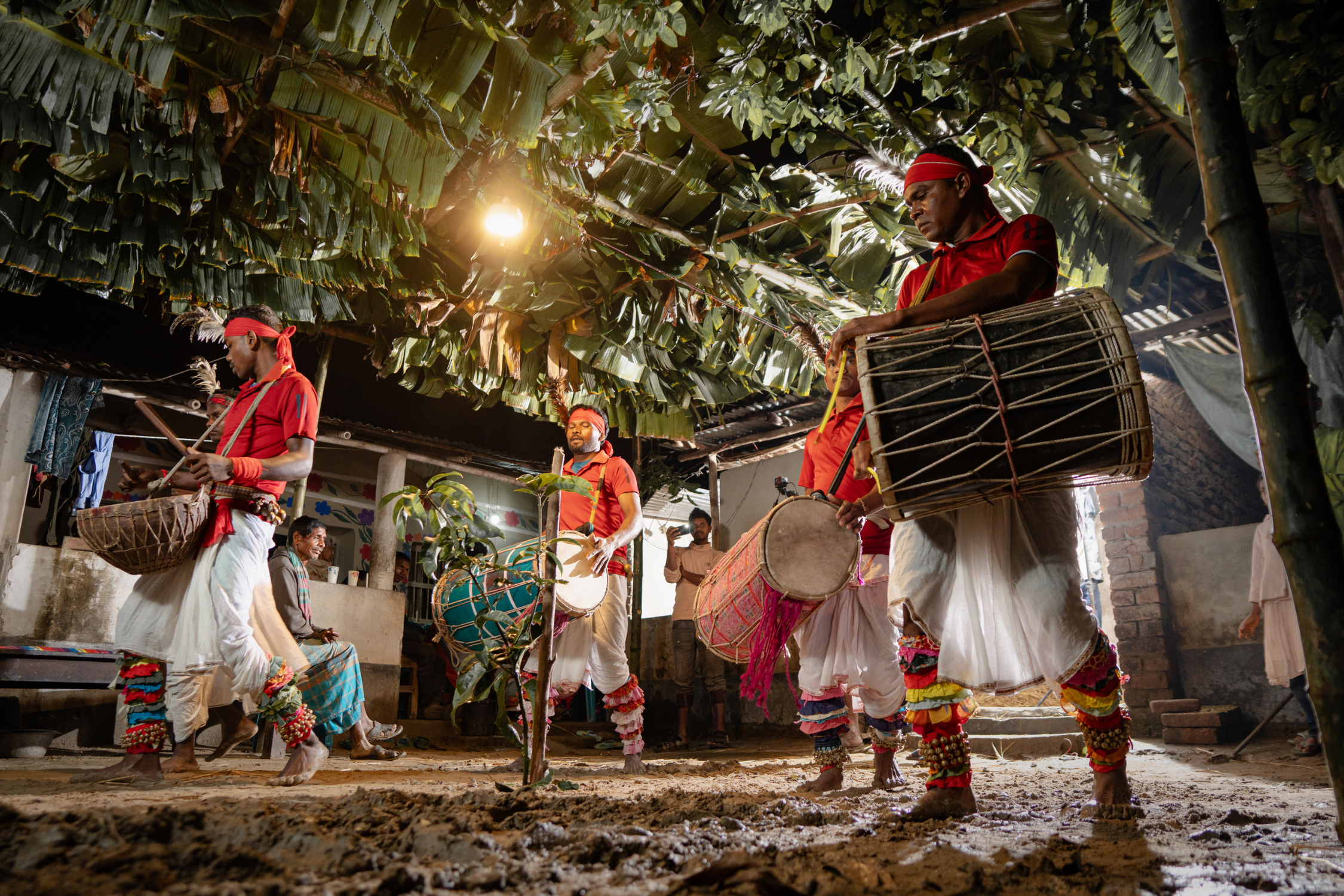
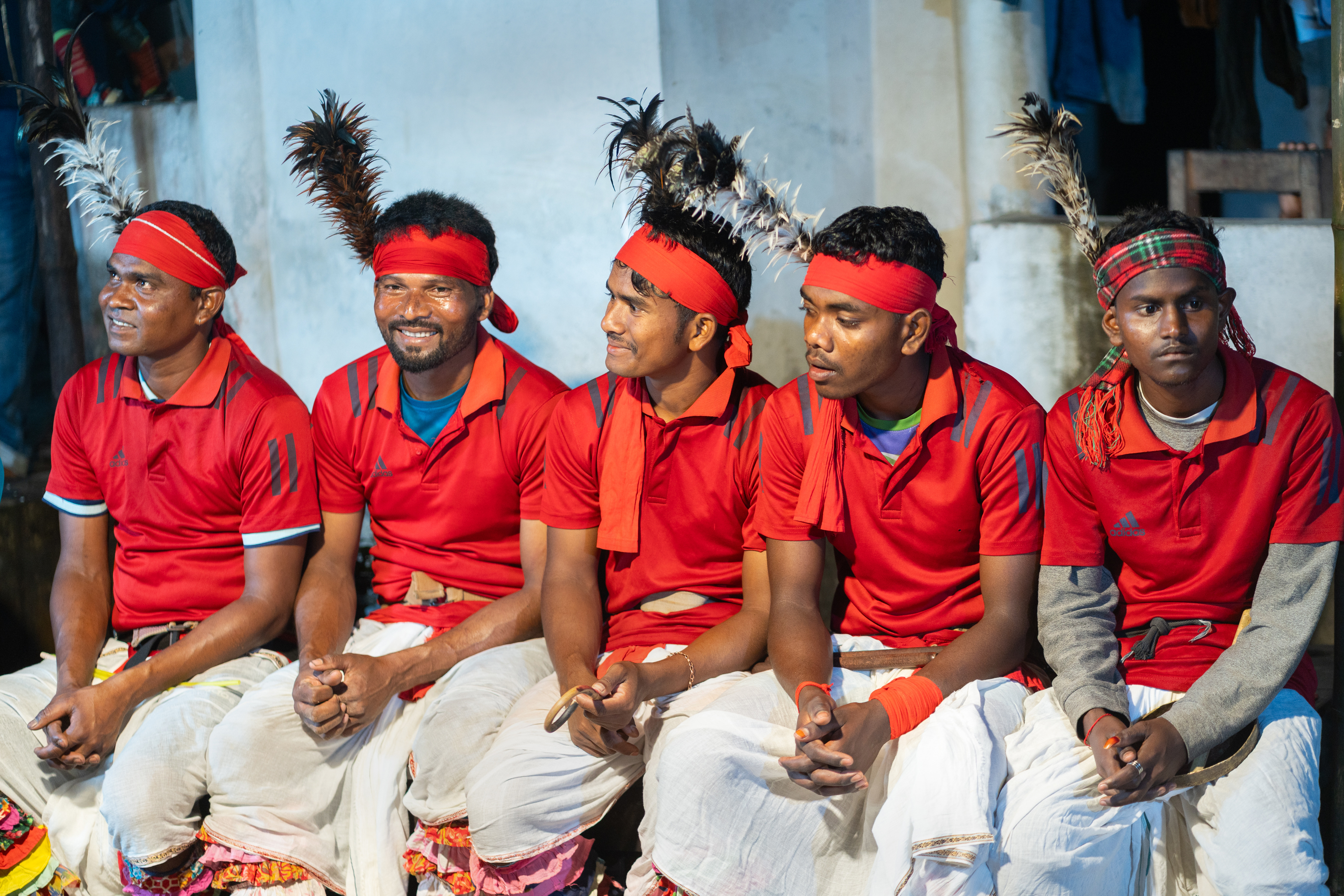
Afternoon turned into evening. The rain eased a little. But the courtyard was muddy. After making the courtyard suitable for the arrangements by spreading sand, the wedding formalities began. An altar was built in the courtyard. The drummers arrived. They had brass bells on their feet and waists. They made sounds in rhythm even as they walked. Men and women together began the sequence of various rituals and cultural performances to the beat of wedding songs and dances. Rituals like Pindi-dan(offering to ancestors) and repaying the mother's debt continued. The Gaye Holud(turmeric ceremony) phase began. According to the custom, the mother, brothers, sisters, and acquaintances started blessing the groom one by one by applying turmeric. I moved around capturing them on camera. This dance and music session, which started in the afternoon, continued until midnight.
Although seven to eight types of weddings are generally prevalent in Santal customs, the main steps of a formal wedding are completed in a specific sequence, and within these arrangements, I can understand that every step of a Santal wedding actually carries a distinct meaning.
First comes Raibaar—this is the matchmaking or initial discussion phase of the wedding. At this stage, a relationship begins between the two families. A kind of social consensus is built, which lays the foundation for a future bond.
The next step is Horoh Chinah—the blessing or engagement phase. In this phase, clothes are gifted to the bride. This is not just about giving gifts, but a symbolic arrangement to socially recognise the bride for her new life.
The visible form of wedding preparation is seen in the Chamda phase. Three days before the wedding, a wedding pavilion or canopy is made in the courtyards of the bride and groom's houses using Sal, Mango, or Neem branches. This Chamda, made of natural elements, seems to invite the blessings of nature.
A very joyous phase—the turmeric application. The groom's guardians instruct him to wear yellow-coloured clothes, and everyone in the house applies turmeric to him. A wonderful atmosphere of laughter, songs, and togetherness is created in this phase.
The next morning. Because I slept towards dawn, I realised I had missed many of the morning arrangements upon hearing the sounds of songs and dance performances. I quickly got myself ready and went down with my camera and audio device to the colourful festival of the Santal wedding. The performance of rituals continued to the rhythm of dance and music.
This event, which started in an open field with the participation of men, women, and children of various ages, lasted for more than 3 hours. In a Santal wedding, various types of rituals are mainly performed. Entering the colourful chapter of a Santal wedding, one realises that it is not just a social contract, but a cultural journey built step by step. Each phase has its own meaning, emotion, and social significance, which collectively form a reflection of the philosophy of life of this community.
After noon, I left with the borjatri (groom's procession) towards the bride's house. Men of various ages were dancing to the sound of drums on a pickup truck. The women were in a separate vehicle. The groom's side reached the bride's house with musical instruments, carrying clothes and other gifts in baskets. The whole environment became vibrant with the sounds of dhol, kara, and nakara. The groom's side was supposed to reach the bride's house at 8:00 AM, but we reached close to 3:00 PM. Because of the delay, the bride's side was angry and was not welcoming the groom. Meanwhile, the groom's side could not enter the bride's house without the groom being welcomed. After waiting, the groom was welcomed to the rhythm of dance, songs, and folk instruments including drums. The groom's feet were washed with water. After that, the presentation of various rituals of welcoming the groom continued until midnight. Especially, the various types of dances, songs, and techniques of playing musical instruments were quite fascinating.
In the meantime, food arrangements were going on. Local food for the locals, vegetables and lentils with beef for the Muslims, and mutton and other dishes for the Hindus. Since the coexistence of various communities including Hindus, Muslims, and Christians in this area of Dinajpur is quite friendly, everyone's presence was seen at the wedding.
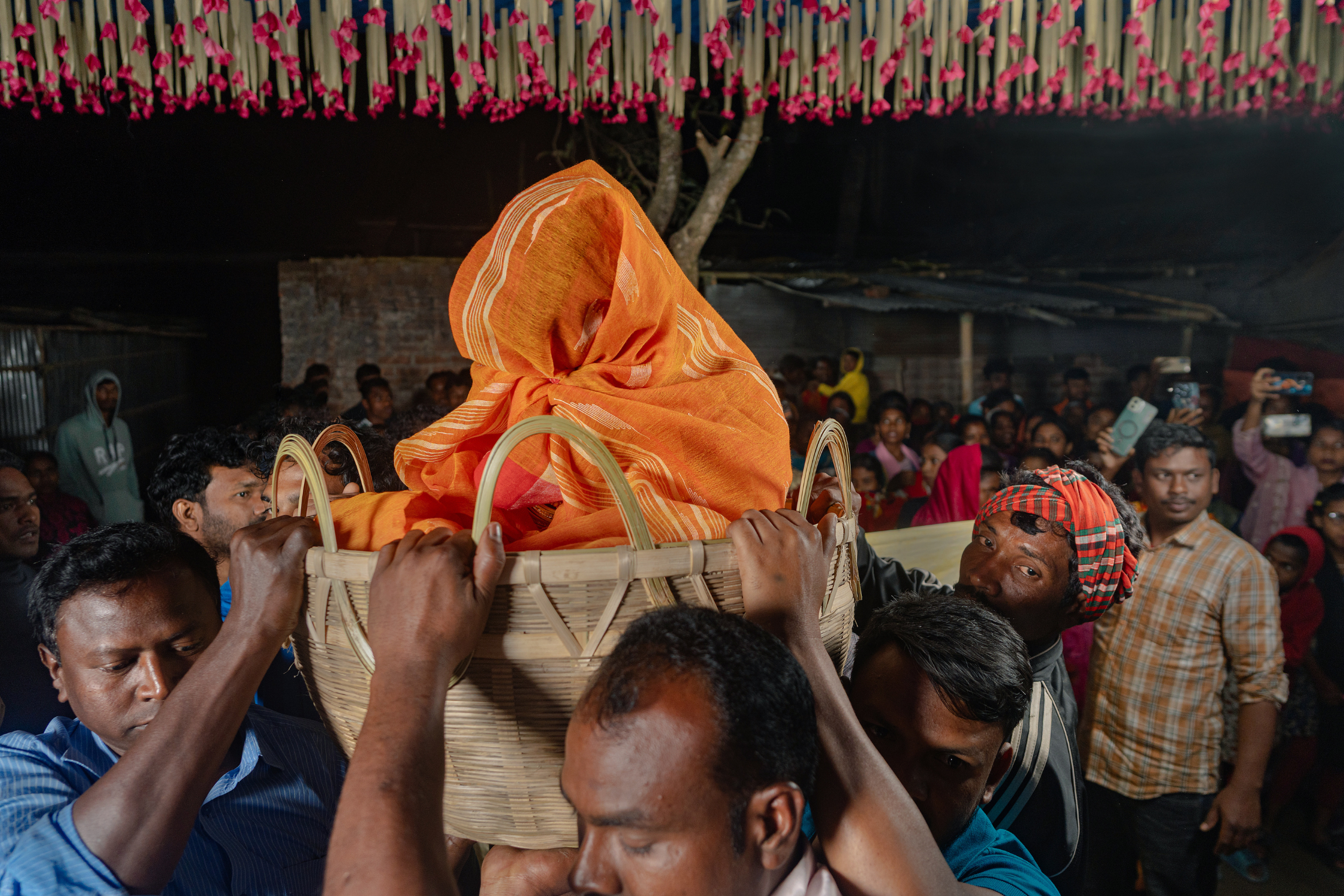
After various rituals until 3:00 AM, the most awaited and most important phase arrived—Sindur Dan (the application of vermilion). This phase is also rich in various rituals and customs. These rituals continued for quite some time. Meanwhile, the groom was waiting in the courtyard to apply vermilion to the bride. Seven people from the groom's side lifted the bride in a bamboo basket above their heads and brought her to the courtyard, while seven people from the bride's side lifted the groom above their heads. While above their heads, the groom applied vermilion to the bride's forehead five times with the thumb of his right hand. At this very moment, the main bond of the wedding was completed—which is socially and religiously recognised.
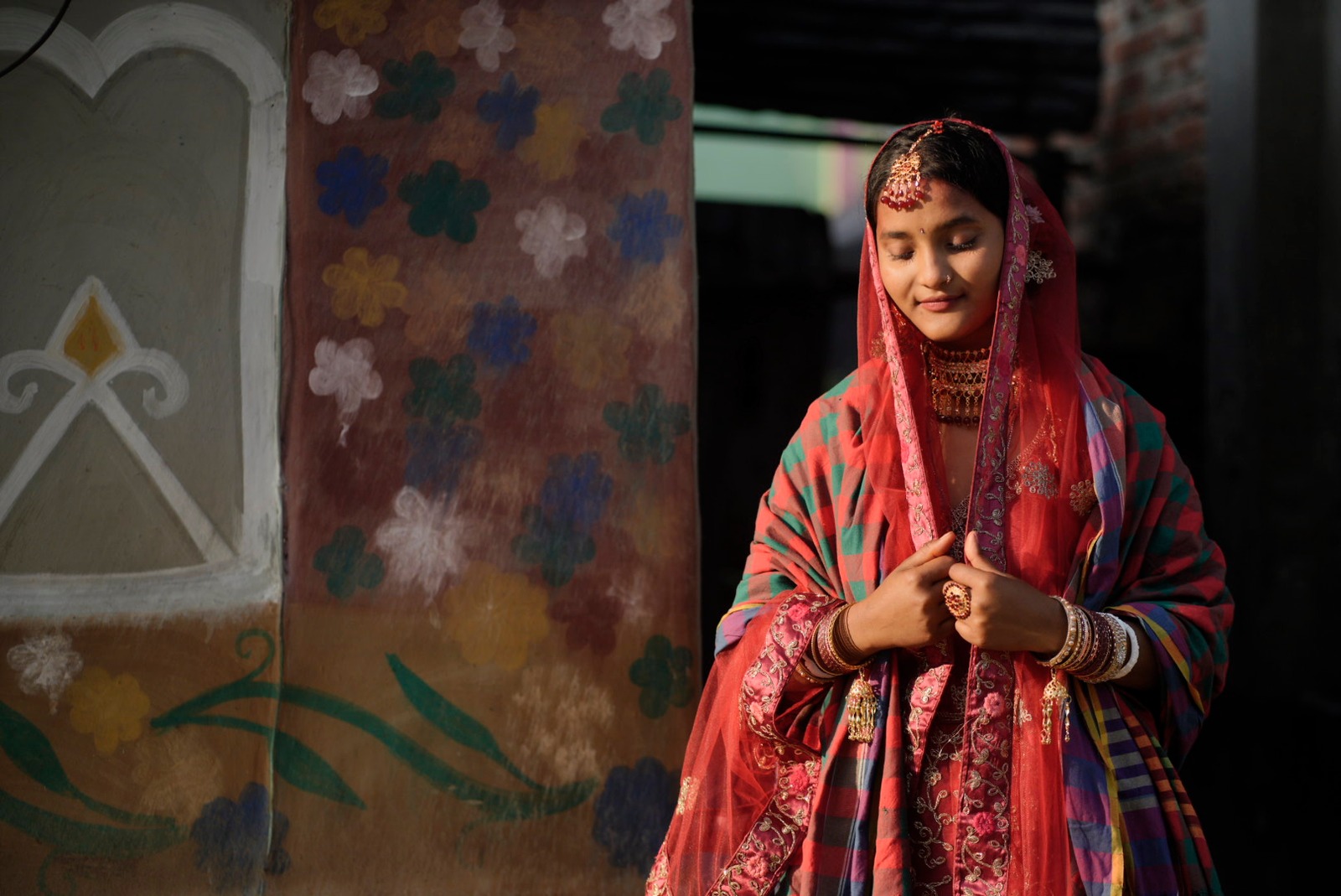
Afterwards, the groom, Kajol, and the bride, Jui, were seated on a stage. The photo session and gift-giving phase continued. Various relatives came and gave gifts according to their ability. They were blessing the newlyweds for a beautiful future.
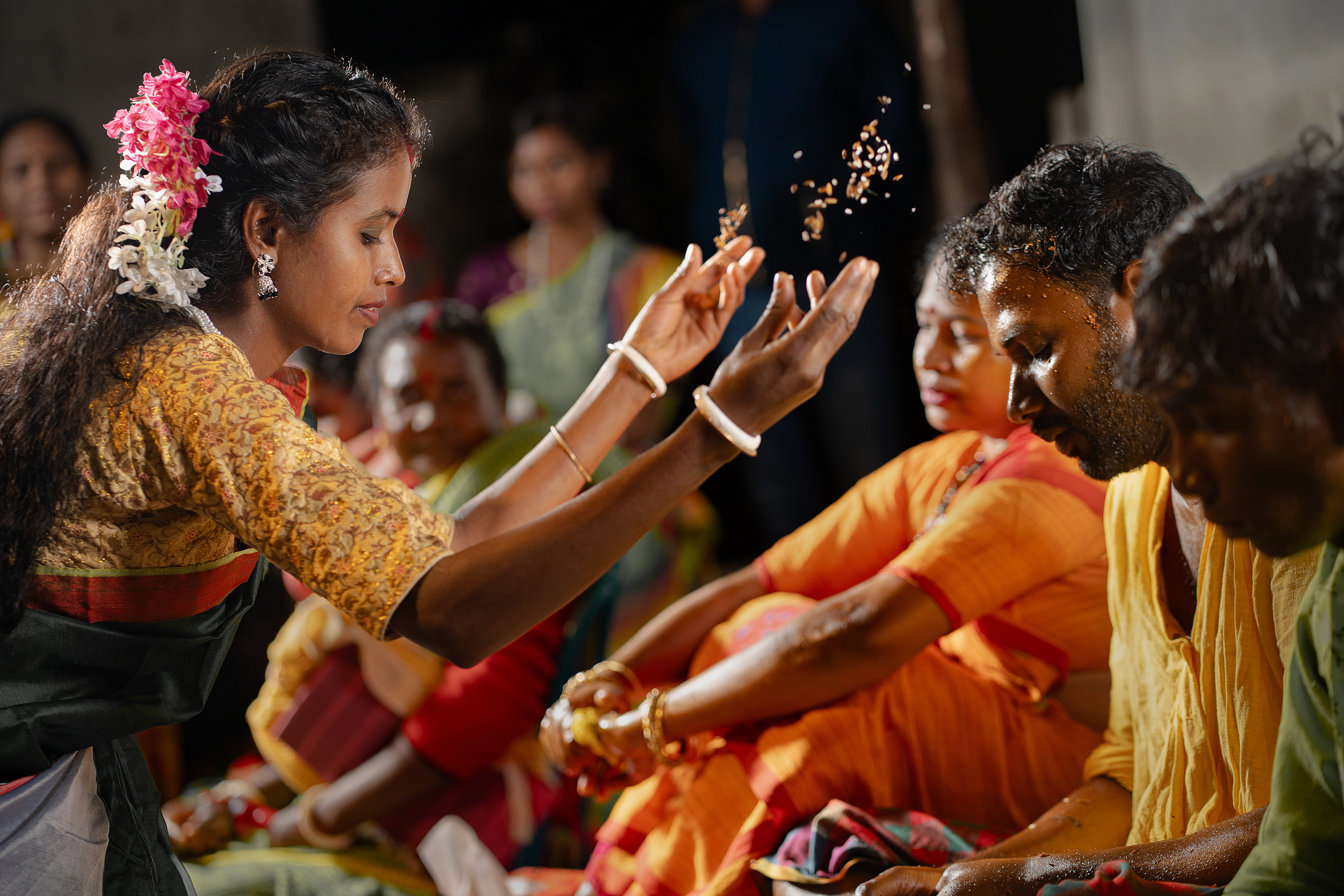
The most emotional part of a Santal wedding is the farewell phase. After the wedding, the bride's mother decorates the bride with vermilion, oil, and turmeric. Through songs, tears, and silence, the bride leaves her childhood home. But there was no sign of the bride's departure. Even at 5:00 AM, dances, songs, and various performances by the musicians were going on. Upon inquiry, it was learned that the girl would not be sent off until the logno or auspicious moment arrived. Finally, waiting until morning. The morning sun began to rise, smeared with red colour, as if it were the vermilion on the bride's parting. At such a moment, the group of musicians came forward to hide the tears of the parents. When the bride departed, I left with the groom's side for the groom's house. I thought the arrangements ended here, but no—various colourful arrangements were waiting at the groom's house to welcome the new bride, along with relatives and a dance and music troupe. Within this never-ending festival of the wedding, I understood—here, a wedding is not just of two people, but the name of an entire society living together.
Shamol Shishir is a filmmaker and cultural researcher at Concordia University’s COHDS, specialising in oral history and digital storytelling. The article has been translated by Khairul Hasan Jahin.
Send your articles for Slow Reads to slowreads@thedailystar.net. Check out our submission guidelines for details.

Tajuddin Ahmad: A life for Bangladesh

Interactive / The haor crisis explained
Interactive: Bangladesh Labour History · 1881 - 2026 / Fight for Justice
Justice at work for all
The Price of Labour
Interactive / How many more lives before workplaces become safe?

The expansion of wage labour and the message of May Day

In conversation with Richard Wolff / Can workers seize the opportunity as Western capitalism declines?