Roots and rules: The folk games of Bangladesh
Let us picture a paddy field on a late, lazy afternoon in a village in Bangladesh. The harvesting season is here, the crops are cut, and the fields are now empty. The air is smelling of earth and damp grass, and somewhere nearby, a group of children is screaming with laughter and joyfulness. No mobile, no gadgets, just some children enjoying, running, and singing in unison in a game, the games that their ancestors played too. Did it take you back to the time of your childhood? Well, this was Bangladesh, for centuries, before modernity tried to rewrite the idea of play and fun.
Do these games come only with rules and competition? Are they only the relics of Bangladesh? Folk games are living memories of this land. They carry the philosophy, history, social structure, traditions, and seasons within them. To understand these games is to understand the people who invented them.
Boli Khela
Every year, on the 12th day of Baishakh, the Laldighi Maidan in Chattogram fills with wrestlers who have trained all year for a single afternoon. These strong men come to take part in the century-old tradition called “Jabbarer Boli Khela”.
‘Boli Khela’ literally means the “game of strong men” or a wrestlers’ contest. It is Bangladesh's oldest recorded wrestling tradition, believed to date back to the fifteenth century during the Mughal period, when it was patronised by local zamindars. Abdul Jabbar, a merchant, is credited with formalising the modern tournament in 1909. His main goal was to prepare young people to fight against British rule at the time. A step taken against colonial rule transformed this neighbourhood contest into an annual civic festival that continues today.
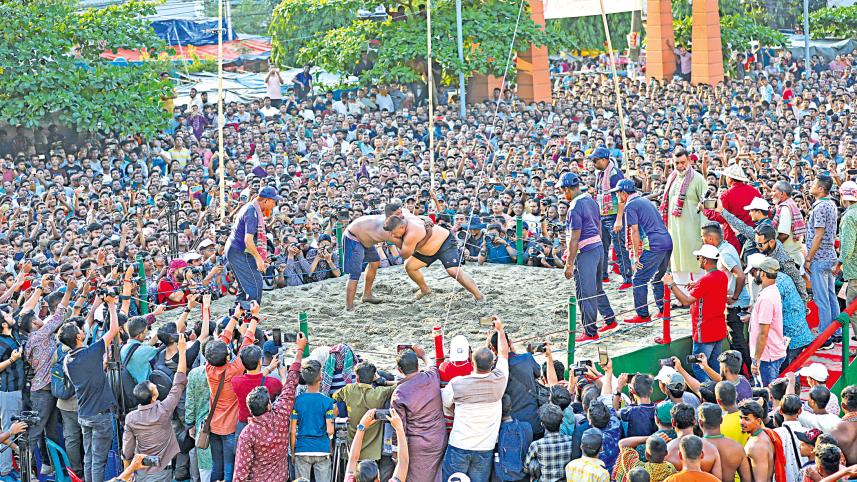
The rules are elemental: bring your opponent to the ground. There are no rounds and no weight classes in the traditional format. It is an exciting combat sport that features a variety of grappling techniques, such as clinch fighting, throws and takedowns, joint locks, pins, and other engaging holds. Wrestlers are prohibited from punching, kicking, or pushing their opponents. The game is defined by physical strength, muscular power, and strategies to overpower the opponent.
Lathi Khela
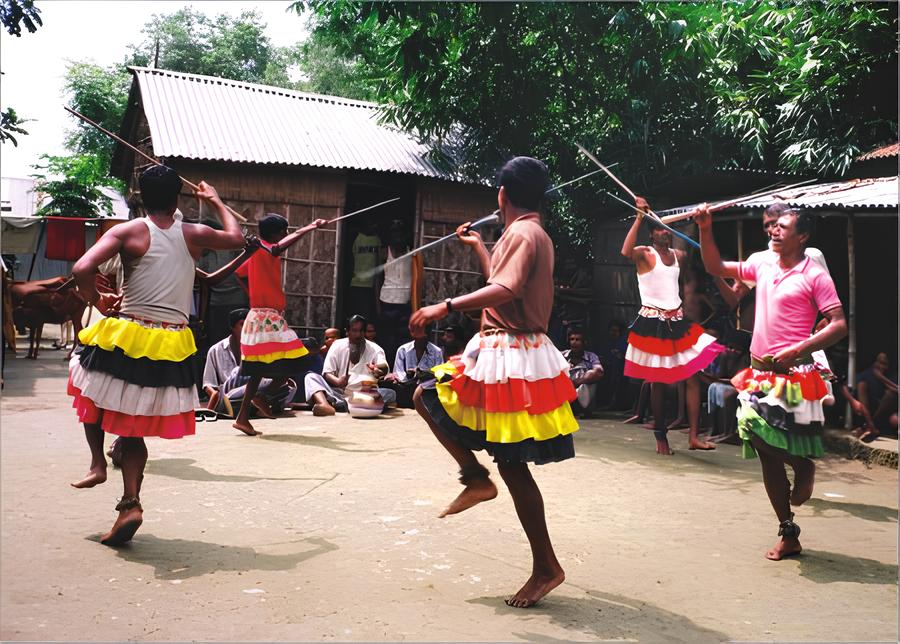
Boli Khela is a game of strength, whereas Lathi Khela is a form of martial art. This traditional martial art, practised with a bamboo staff—often six feet long and sometimes iron-tipped—is not merely considered entertainment. It has been part of rural Bengali life for at least three centuries. It served as martial arts training, and the practitioners are called lathials. Historical records suggest that zamindars maintained trained lathials both for protection and as status symbols. There is no doubt that once their necessity on the battlefield diminished, the arenas of social and religious ceremonies became the primary spaces for demonstrating valour and technique with the stick.
There are no fixed rules and regulations for this game. The styles, rules, and characteristics vary across the country. Depending on the region, players and groups create their own rules. Today, the game mostly survives in a performative form, where two practitioners spar in choreographed sequences, striking and deflecting in rhythms that resemble dance. But every movement has a purpose. Every step has a consequence. A player’s skill is proven by their ability to spin the stick with extreme agility through different exercises. Watching Lathi Khela is like watching someone speak with a stick. Today, it is a form of social and secular entertainment, but in the past, it was associated with ‘Ashura’, Eid, Sankranti, and wedding ceremonies.
Dariabandha
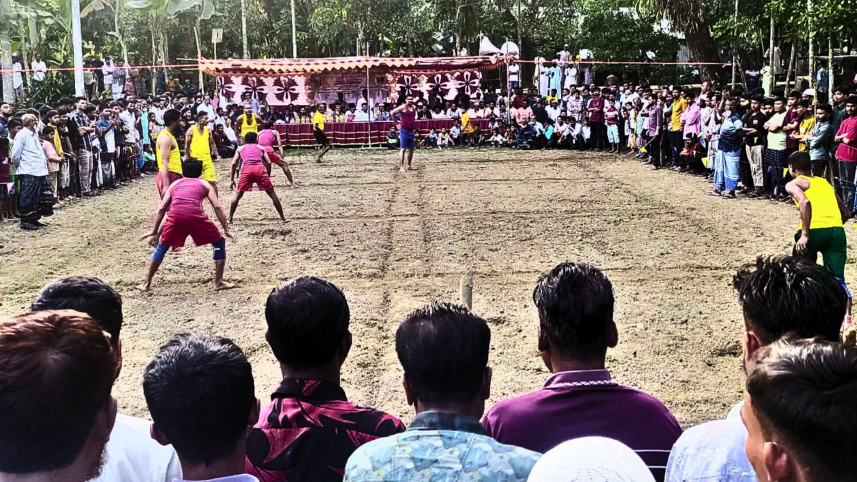
Across rural Bangladesh, Dariabandha was a staple of the dry season, when fields lay empty and the earth was firm enough to draw proper lines. This is another physio-tactical game mostly played in rural areas of Bangladesh. It is played on open ground after crops are cut, in a rural courtyard, or in any other open space.
The word ‘Daria’ means someone who rows a boat, and ‘Bandha’ means barriers or obstacles. The name is linked to an interesting story from this region. According to some sources, when merchants transported salt by river in the southern part of Bangladesh, robbers used to hijack these vessels. As Ashim Das has stated, the game of Gadikhela (another name for Dariabandha) was created centring around the illicit salt trade. In 1780 AD, the British took exclusive control (a monopoly) of the salt trade in Bengal. As a result, the merchants of Bengal fell into extreme hardship. For their livelihood, they were forced to engage in smuggling.
In this game, one team represents the salt smugglers, creating obstacles for the salt traders, while the other team represents the salt traders trying to continue trading salt. The playing field is divided into horizontal lanes. The defending team assigns one player per lane, who cannot leave their line, as their sole task is to tag any attacker who tries to pass. The attackers must cross all lanes and return. This game requires speed, agility, reflexes, anticipation, and balance when moving from one “room” (grid) to another while avoiding contact with opposing players.
Bouchhi
The name of this game alone tells a story. The word ‘Bou’ means a beautiful young bride, and ‘Chhi’ is a vocal sound made with one long breath. Put them together, and you already sense the tension embedded in this game, a tension that is both physical and deeply social.
As for its origins, no single historical document pins it down clearly. However, according to some scholars, the game originated from social conflicts surrounding marriage ceremonies, specifically from the practice of the groom's relatives abducting a bride. The clashes that used to take place between the bride's side and the groom's side after a bride was abducted have survived within this game. What was once a real, lived anxiety of rural Bengali women has been transformed, over generations, into play.
The court reflects that drama perfectly. Two courts are outlined on the ground, 25 to 30 feet apart—one rectangular and the other circular. There are two teams, each with 8–10 players. Think of the circle as the bride's home, and the rectangle as the groom's house. One player from the team winning the toss plays the “budi” (the old lady, or bride figure) and remains inside the circle. The remaining members of that team stay inside the rectangular court. Their role is to protect her. The goal is for an opposing player to bring the ‘old lady’ to the rectangle without being touched. If successful, their team scores a point, and the touched players are out. In different regions, this game is also known as ‘Buri-chhi’, ‘Burir Chu’, ‘Chhidhora’, etc.
Bagh Bondi Khela
Not all Bangladeshi folk games demanded sweat; some demanded silence and calculation. Bagh Bondi, or “trap the tiger”, is a predator-prey game played on a different kind of board. One player controls the tigers (usually two pieces), and the other controls the goats (twenty pieces). The tigers try to jump over and capture the goats, while the goats attempt to surround the tigers until they cannot move. It is a perfect metaphor: the powerful few against the numerous many, and either side can win.
Bagh Bondi has its origins in southern Bengal. Villagers who lived near forests were often victims of fierce tiger attacks. Tigers would sometimes carry away cattle and goats from households. These terrifying experiences are not uncommon even today. This game symbolises the primal survival struggles between humans and tigers.
There was no need for mass production of boards for this game. The board can be scratched into any surface, and the pieces can be pebbles. This accessibility is precisely why it has endured for centuries. The game rewards patience over aggression.
Elating Belating
Elating Belating is a game that hides a dark history. The name sounds like a greeting, and the rhymes used in the game at first feel like nonsense, but this is only a surface reading. When you look more closely at the words, something older and darker emerges.
According to scholars, slavery was widespread throughout the medieval period in Bengal. Portuguese pirates committed horrific atrocities against the people of rural Bengal, selling men, women, and children in foreign slave markets, as well as to nawabs and zamindars. In the harems of Nawabs, Sultans, and Emperors, thousands of such female slaves resided. Generally, these slaves were purchased from markets. They were often bought through verbal agreements after haggling over the price, though in certain cases, formal deeds or legal documents were also drawn up.
The rhyme's climax, “Niye jao balikake”, is not merely a game instruction. It is a social memory that records an era when a woman could be “taken away” by those with power. This is what makes the game extraordinary. The girls who play it today, shouting the rhyme and grabbing each other's arms in good sport, are unknowingly rehearsing a script written by history.
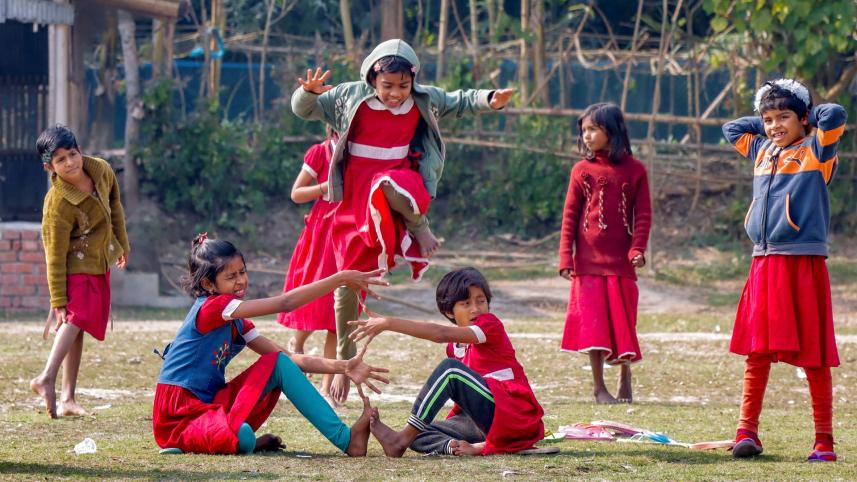
This game is mainly played among girls. Two teams, each with a minimum of 5–7 members, position themselves along a line drawn on the ground, facing each other. The game starts when one team advances two steps forward and recites “Elating Belating Soi Lo”, then steps back. After that, the opposing team comes two steps forward and replies, “Ki Khobor Ailo”. The exchange or bargain continues like this, verse by verse, until the second team says the final verse, “Niye Jao Balikake”. At that point, the team that recited the final verse comes forward and attempts to physically pull one player away from the opponent's side.
No classroom is needed. No app is required. Just a group of children, a rhyme older than anyone remembers, and an afternoon.
Agdum Bagdum
To the ear of a child, “Agdum Bagdum Ghoradum Shaje” sounds like a fun poem. Grandmothers have chanted it to grandchildren for generations. The rhythmic and bouncy verses are easy to clap to. It is among the most recognised nursery rhymes among Bengalis. However, it also holds a chapter of fear and vigour from Bengal’s past.
According to Rabindranath Tagore, the first verses of these rhymes describe a marriage procession. Other scholars have also remarked that Rabindranath was indeed correct. Historically, the groom’s side had to marry either by abducting the bride or by winning her in battle; there was no clear distinction between a military expedition and a wedding procession. As a remnant of that tradition, mock combat rehearsals are often observed within marriage rituals. The same phenomenon has occurred here as well.
The name’s origin refers to three types of Dom soldiers, as the Dom army used to protect the western borders of Bengal. The feudal lords of places like Bishnupur and Rajnagar maintained these Dom military units. ‘Agdum’ refers to the vanguard (frontline) Dom troops, ‘Bagdum’ refers to the flank or side-guard Dom troops, and ‘Ghoradum’ refers to the Dom cavalry. Therefore, through this game, one finds evidence of the influence and prestige once held by the Dom soldiers.
The game is rooted entirely in the rhyme and in touch. Players extend their legs in a circle, and a caller taps each player's knees to the syllables of the rhyme: Agdum Bagdum Ghoradum Shaje. The person on whose knee the final word of the rhyme lands must tuck in their knee. The individual who manages to tuck in both of their knees first secures first place. The last remaining players are considered defeated.
Bangladesh is urbanising, and with urbanisation come smaller living spaces, structured school schedules, and smartphones that offer an entire world within a six-inch screen. The open fields where these games were once played are now disappearing. People are also tucking themselves into digital screens. Children are missing out on the fun and history associated with these traditional games. These games are also pieces of the larger structure that we call “Bangladeshi culture”. Through fun and joy, we can revive and relive our culture. The real question is not whether these games are beautiful or historically significant. They clearly are. The question is whether beauty and history are enough to preserve something in the age of a six-inch screen.
Sayem Bin Rafiq is a contributor to Slow Reads, The Daily Star. He is a postgraduate of Population Sciences at the University of Dhaka. He can be reached at sayemshahin1961@gmail.com
Send your articles for Slow Reads to slowreads@thedailystar.net. Check out our submission guidelines for details.

Tajuddin Ahmad: A life for Bangladesh

Interactive / The haor crisis explained
Interactive: Bangladesh Labour History · 1881 - 2026 / Fight for Justice
Justice at work for all
The Price of Labour
Interactive / How many more lives before workplaces become safe?
The expansion of wage labour and the message of May Day
In conversation with Richard Wolff / Can workers seize the opportunity as Western capitalism declines?