


We cannot achieve development while children remain at work

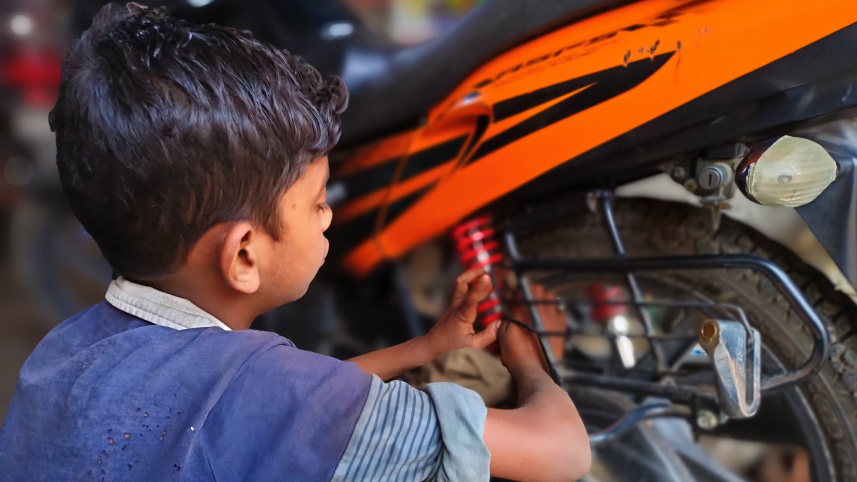
Despite progress in some parts of the world, child labour remains a stark reality for millions of children globally. According to the joint International Labour Organization (ILO) and Unicef report “Child Labour: Global estimates 2024, trends and the road forward,” an estimated 138 million children worldwide are engaged in child labour, including 54 million who are involved in hazardous work.
In terms of Bangladesh, preliminary findings from the 2025 Multiple Indicator Cluster Survey (MICS), conducted jointly by the Bangladesh Bureau of Statistics and Unicef, indicate that 9.2 percent of children aged five to 17 years are currently engaged in child labour, up from 6.8 percent in 2019.

Child labour in Bangladesh exists in both formal and informal sectors, and the consequences of it are profound. It deprives children of education, undermines their physical and mental development, and limits their future opportunities. Children engaged in labour are also vulnerable to abuse, exploitation, and violence.
Under the Bangladesh Labour Act, 2006 (amended in 2018), the minimum age for employment is 14. Children aged 12-14 may be engaged in “light work,” provided it does not interfere with their education or development. However, the law does not clearly define what constitutes “light work,” thus creating opportunities for misuse and allowing children to be employed for long hours and/or in inappropriate conditions.
The government has identified 43 categories of hazardous labour that are harmful to children’s physical and mental development and has prohibited the employment of anyone under 18 in these occupations. However, around 10.7 lakh children remain engaged in hazardous labour, out of a total of 17.8 lakh in child labour. Notably, domestic work is still not included in the hazardous labour list for children. The UN Committee on the Rights of the Child has expressed concern about the employment of children in sectors such as welding, road transport, machinery workshops, tobacco production, and battery recharging and recycling.
Poverty, limited access to quality education, and social normalisation of child labour continue to drive many families to send their children to work. Research consistently shows that legislation alone is insufficient to eliminate child labour. Effective enforcement of existing laws, social awareness, and family-centred support are equally critical.
One of the most overlooked forms of child labour in Bangladesh is domestic work performed by children. Domestic child workers spend their days caring for younger children, cooking, washing clothes, and performing a wide range of household chores. In return, they frequently receive little more than food, used clothing, and degrading treatment. They typically have no fixed working hours, no guaranteed rest, and little or no opportunity for education, recreation, or social interaction. Many child domestic workers also experience physical, psychological, and even sexual abuse. And because domestic child workers within private households, they remain largely invisible and their experiences often go unnoticed.
A 2024 report based on a survey conducted by Action for Social Development (ASD), titled “Situation of Child Domestic Workers in Dhaka City,” analysed data from 352 child domestic workers. The findings revealed that nearly half had experienced some form of abuse. More than 31 percent reported excessive workloads; 18.47 percent had suffered physical injuries; 8.23 percent had been beaten; 20.74 percent faced regular verbal abuse and psychological violence; and 1.7 percent reported sexual abuse. How can child domestic work not be recognised as “hazardous,” even when the children engaged in it face such cruelty?
Many people still believe they are doing a good deed by allowing a child from a poor family to live and eat in their home. In reality, this is often nothing more than opportunism disguised as charity—a way to secure cheap labour at the expense of a child’s future.
Although the Domestic Workers Protection and Welfare Policy, 2015 proposed mechanisms such as monitoring cells, complaint systems, and helplines, implementation has been weak. Many domestic workers, including children, remain unaware of their rights and the protections available to them.
If Bangladesh is serious about protecting children’s rights and achieving its commitments under the Sustainable Development Goals, stronger action to counter child labour is urgently needed. The minimum age for employment should be raised to 16 years, with work opportunities for adolescents aged 16-18 limited to safe occupations where they can acquire skills for transitioning to decent work in the future. The definition of “light work” must be clarified in laws, and the list of hazardous occupations should be updated to include domestic work performed by children.
Labour law violations involving children should see penalties, including strong sanctions against employers who engage children in hazardous work. Labour inspection systems should be strengthened, with specialised child labour inspection units empowered to monitor both formal and informal sectors. National and local child labour elimination committees must also be made more active and accountable.
Bangladesh has adopted one action plan after another to eliminate child labour. However, progress has fallen far short of expectations due to a lack of effective implementation. A thorough evaluation of previous projects is necessary before beginning new interventions. Social protection programmes should be expanded and better coordinated to reduce families’ economic dependence on children’s income. Access to quality education must be strengthened, with special support for children from low-income and working-class families. Full implementation of compulsory education provisions, alongside ensuring pathways to vocational and technical education are essential.
Government agencies, civil society organisations, teachers, community leaders, influential citizens, and the media all have roles to play in challenging the social acceptance of child labour and promoting every child’s right to education, health, social protection, and development.
Today, we look back with horror at practices such as slavery or satidaha. It is difficult for us to imagine that such inhumane customs were once socially accepted. And yet, aren’t there practices in our contemporary society that deserve similar condemnation? While many children are attending school and playing with their friends, others of the same age are working relentlessly in our homes. Is this not a form of modern-day slavery?
As long as children continue to work in conditions that deprive them of their childhood, education, and dignity, our commitment to justice and development will remain incomplete. The time has come to make the elimination of all forms of hazardous child labour, including domestic child labour, a national priority.
Laila Khondkar is an international development worker.
Views expressed in this article are the author's own.
Follow The Daily Star Opinion on Facebook for the latest opinions, commentaries, and analyses by experts and professionals. To contribute your article or letter to The Daily Star Opinion, see our guidelines for submission.
 For all latest news, follow The Daily Star's Google News channel.
Comments