


The real test after Beijing

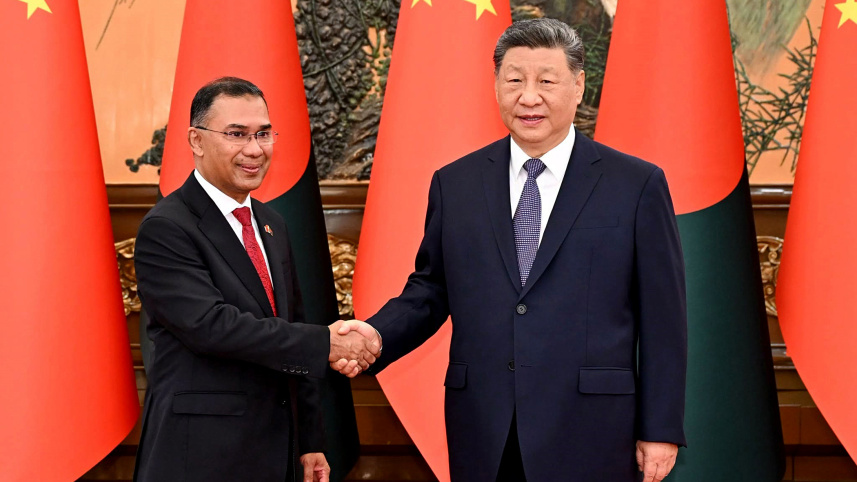
Prime Minister Tarique Rahman’s visit to China is an important milestone in Bangladesh’s foreign policy. While the agreements signed on trade, investment and connectivity are vital, the fact that Dhaka and Beijing decided to elevate their relationship to a comprehensive strategic cooperative partnership is even more significant. Cooperation between the two states was also defined in a few other areas such as artificial intelligence, green development, water management, maritime affairs, industrialisation, education, and defence. In other words, the relationship entered a new phase and became more institutionalised. From Bangladesh’s perspective, it offers new opportunities but also entails certain responsibilities.
China is among Bangladesh’s most important partners in the sphere of economic development. It has invested heavily in infrastructure construction in Bangladesh and plays an important role as a source of investment and manufacturing capacity. As Bangladesh prepares to graduate from the Least Developed Country (LDC) status, China will be an important partner in industrial relocation, renewable energy, digitalisation, and logistics. Bangladesh should be happy about such opportunities.

However, no matter what kind of relationship, the country should never become dependent on a strategic partner. This principle applies not only to China but to all major countries. The fact that relationships between countries in terms of the economy, technology or defence become too unbalanced reduces their ability to make independent decisions. Bangladesh’s main strength has always been the ability to establish productive relations with various rival countries without joining any alliance. This strength will become especially important in the future.
The question is not whether Bangladesh should deepen cooperation with China; it should. The question is whether the partnership enhances Bangladesh’s strategic opportunities or reduces them. It is important because the country’s prosperity is based on extremely diverse relationships.
The United States is the largest export market for Bangladesh, and the country is increasingly an important source of investment and innovation for the state. The European Union remains Bangladesh’s largest trading partner and will play a key role in the economic transition following the country’s LDC graduation. India will always remain Bangladesh’s indispensable neighbour, whose importance extends far beyond economic issues to include geographical, connectivity, water, energy, and regional security aspects. These relations cannot be replaced with each other.
The international environment today differs greatly from the situation a decade ago. Now, major countries are assessing cooperation in trade, infrastructure, technology and defence, not in commercial terms but in strategic ones. No matter why Bangladesh enters some kind of relationship with other states, it will be assessed by others in geopolitical terms. It is especially true in the context of defence cooperation.
The pledge in the joint statement by Bangladesh and China to deepen exchanges in the sphere of defence and to explore the possibility of establishing structured diplomatic and defence dialogue marks a new phase in bilateral relations. The problem of defence cooperation is not inherent; Bangladesh has maintained defence relations with various countries for a long time. However, there are many differences between defence and commercial cooperation. Systems of procurement, training, interoperability, and strategic trust usually define the relationship for many years. As strategic competition intensifies, such relationships attract the attention of the international community.
The US’s changing approach to China’s expanding defence relations demonstrates this tendency. It is not the question of whether Bangladesh will resist others’ pressure, but it is crucial to understand how major countries perceive their strategic cooperation. Perception may affect trade, investments, technology transfer, and diplomatic relationships.
India, too, will pay close attention to the implementation of the new partnership. In the joint statement, cooperation on water resources, maritime affairs, connectivity, and Teesta River Comprehensive Management and Restoration Project was declared. Such initiatives may provide development opportunities for Bangladesh, but they should be implemented in a way that strengthens trust in the region, rather than generating mistrust. Geography dictates that Bangladesh and India will always remain indispensable neighbours regardless of the changes in global politics.
Europe’s attitude is somewhat different. The main concern in Brussels is not geopolitical alignment but governance, transparency, sustainability, and regulation. As Bangladesh prepares for post-LDC trade arrangements and seeks to integrate into Europe’s economy, this confidence will be equally important for attracting Asian investment.
The conclusion from the Beijing visit, however, is not just about the need to exercise caution in dealing with China but about strategic consistency as well.
Each major relationship, be it with China, the US, India, the EU, Japan or any other country, should be assessed using the same criteria: does it strengthen Bangladesh’s productive capacity? Does it allow the preservation of the independence of policy? Does it diversify the opportunities? Does it increase Bangladesh’s strategic opportunities or reduce them?
Many middle powers have already adopted this approach. Vietnam, Indonesia, and Malaysia cooperate closely with China while also improving their relations with the US, EU, Japan, and other regional countries. Their goal is not strategic alignment but strategic flexibility. Bangladesh should adopt the same approach.
China will remain an indispensable partner of Bangladesh in economic development. The US will remain an important export market and technology partner. Europe will remain key to Bangladesh’s economic transition. India will remain the indispensable neighbour.
In this way, the success of the prime minister’s visit to China will be determined by the ability to strengthen Bangladesh’s strategic opportunities. For the middle power, strategic autonomy is preserved not by keeping a distance from rivals but by maintaining freedom of choice.
Zillur Rahman is a political analyst and president at the Centre for Governance Studies (CGS). He hosts ‘Tritiyo Matra’ on Channel i. His X handle is @zillur.
Views expressed in this article are the author's own.
Follow The Daily Star Opinion on Facebook for the latest opinions, commentaries, and analyses by experts and professionals. To contribute your article or letter to The Daily Star Opinion, see our guidelines for submission.
 For all latest news, follow The Daily Star's Google News channel.
Comments