


Saddam’s parole fiasco: A five-minute farewell is not mercy

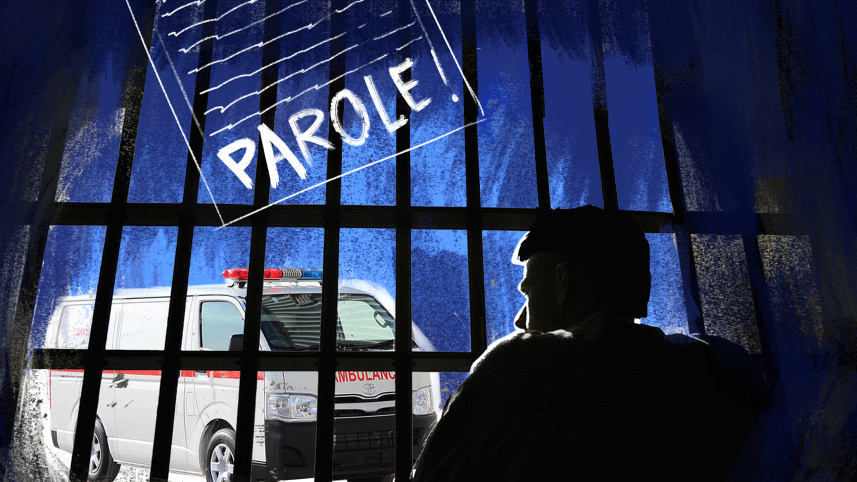
On January 24, an ambulance carrying the bodies of Kaniz Surbana Swarnali and her nine-month-old son, Nazim, reportedly arrived at Jashore Central Jail around 7pm. Six relatives were allowed to enter with it around 7:30pm and were escorted out five minutes later. During that brief interval, Jewel Hasan Saddam, a Chhatra League leader detained in multiple cases, was permitted to bid farewell to his wife and infant, after an earlier request for limited parole had been refused. The deceased were later laid to rest in his absence in Bagerhat.
The question here is not whether the state can impose strict conditions on a detainee accused of serious offences. It can and it should. The question is why the state chose a path that looked humane but operated as a denial of humanity. When mourning is administered like a privilege, compassion stops being a public duty and becomes political currency. That is how institutions lose legitimacy.

Parole in Bangladesh sits on a shaky foundation. There is no general parole statute enacted by parliament. Parole decisions have largely operated within the home ministry’s administrative domain, guided by policy rather than law. A home ministry policy updated on June 1, 2016, allows for conditional, temporary release in limited circumstances—including the death of a close relative—generally for a period not exceeding 12 hours and under continuous police watch. But parole approval and management are not anchored in any prevailing law, and even the 2016 policy did not clearly articulate the legal basis for granting parole. For under-trial detainees, a court-supervised temporary bail for funeral rites would be the more principled route. However, in a climate where bail is routinely blocked, executive parole policy often becomes a substitute for judicial oversight.
Where discretion is broad, reasons are scarce, and review is weak, the rule of law becomes a slogan rather than a constraint. Bangladesh’s constitution promises more, however. Article 31 frames treatment only “in accordance with law” as an inalienable right, and Article 32 protects life and personal liberty. The point is not that every prisoner has an automatic right to leave custody. The point is that the state must be able to explain, in lawful terms, why it will allow one humanitarian request and refuse another, and that explanation must be open to scrutiny.
The timing of this incident makes the stakes higher. The UN Human Rights Office’s fact-finding report on the July-August 2024 protests estimated that as many as 1,400 people may have been killed between July 1 and August 15, with the vast majority shot by state forces. After a rupture of that magnitude, Bangladesh’s obligation is not revenge; it is credible, evidence-led, individualised accountability that separates perpetrators from bystanders, and protects the innocent while ensuring the guilty are tried. If the interim government wants the moral authority of July, it must prove that even those it distrusts will receive due process and basic humanity.
But the warning signs have been visible for a while. “Dubious” cases filed after the uprising, often murder cases naming large numbers of accused and stacked with non-bailable provisions, risk turning law into theatre while undermining justice for victims. Human Rights Watch, in a report published last year, documented complaints linked to the unrest that named scores of people, including a case filed against 180 accused, where the complainant later acknowledged he did not even know at least one prominent figure he had named. In an August 2025 blog, Jerry Allen from Amnesty International described politically motivated prosecutions and routine bail denials that deepen fears of retaliation rather than justice.
When cases are filed in bulk, investigations stall, and bail becomes unattainable, pre-trial detention starts operating like a sentence without conviction. That is not only unjust to the accused. It is also bad governance. It clogs courts, weakens prosecutorial focus, and buries real perpetrators under a mountain of low-quality litigation. There have been documented concerns that the strategic use of murder cases as instruments of reprisal can ultimately obscure responsibility, overwhelming investigations with mass accusations and counter-cases that bury factual truth and, paradoxically, allow genuine perpetrators to evade accountability.
In that environment, refusing humanitarian leave is not a neutral administrative choice. It signals that the process itself is intended to hurt. International minimum standards for the treatment of prisoners, widely known as the Nelson Mandela Rules, underline that prisoners must be treated with humanity and should be able, under necessary supervision, to maintain contact with family. A state that cannot find a humane, controlled way for a detainee to mourn or bury their loved ones is not demonstrating strength. It is demonstrating fear dressed as policy.
Saddam’s five-minute farewell should also remind us how easily Bangladesh swings from one form of selective justice to another. Under the previous regime, parole and bail debates showed how executive preference could eclipse legal principle. After the political transition, the Appellate Division’s acquittal of Khaleda Zia in the Zia Orphanage Trust case, reported internationally, described the prosecution in terms that amounted to a malicious use of the criminal process.
What should change, then? Parole and humanitarian leave must be brought into the daylight through a clear statute debated in parliament, with published criteria, narrow grounds for refusal, strict timelines, and a duty to provide written reasons. A refusal should not be a shrug. It should be reviewable, so discretion is disciplined by law rather than insulated from it. The operative policy, whatever its current form, should be published in full, along with anonymised data on grants and refusals, so the public can see whether discretion is being exercised consistently.
At the same time, bail must be treated as a constitutional emergency. Courts must resist the reflex that “non-bailable” ends the conversation. Prosecutors must screen post-uprising cases and insist on individualised allegations. Police reports and trials cannot be allowed to drift while people spend months, even years, in custody without meaningful progress. Justice for July’s dead does not require a wider net. It requires a sharper one.
Finally, remedies matter. False and malicious cases must carry consequences, including sanctions for abuse of process, professional accountability, and compensation where the state has detained people without credible grounds. Otherwise, the incentives remain intact, and each new administration will inherit the same toolbox of repression. The five-minute farewell is a small scene with a large lesson: that we cannot build a “New Bangladesh” by reproducing old reflexes of humiliation, opacity, and selective mercy. If the spirit of July includes dignity for all, then dignity has to begin where the public rarely looks, including prison gates at 7:30pm.
Barrister Khan Khalid Adnan is advocate at the Supreme Court of Bangladesh, fellow at the Chartered Institute of Arbitrators, and head of the chamber at Khan Saifur Rahman and Associates in Dhaka.
Views expressed in this article are the author's own.
Follow The Daily Star Opinion on Facebook for the latest opinions, commentaries, and analyses by experts and professionals. To contribute your article or letter to The Daily Star Opinion, see our guidelines for submission.
 For all latest news, follow The Daily Star's Google News channel.
Comments