


Onslaught of AI content aims to sway voters
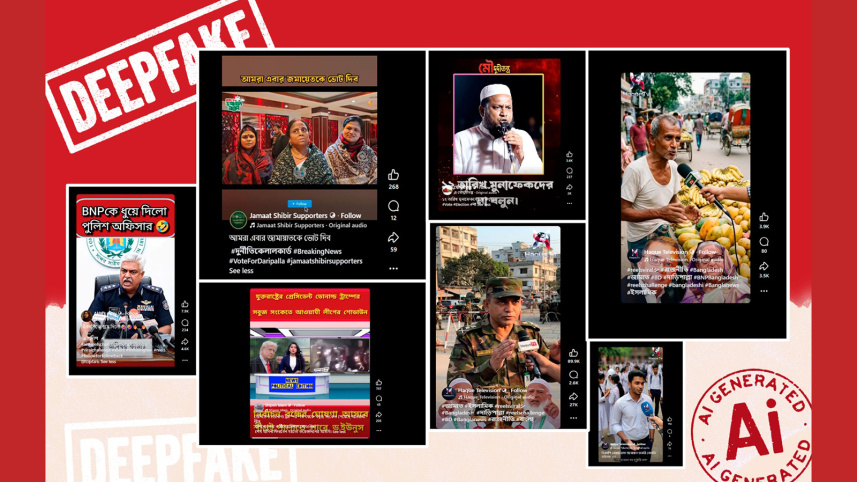
On January 11, a 30 second Facebook reel featured a police officer at a staged press conference, where the official confidently predicted that Bangladesh Jamaat-e-Islami would secure 200 seats in the upcoming election. The clip also uses derogatory language to accuse the Bangladesh Nationalist Party (BNP) of systematic extortion.
In another reel, posted the previous day, a purported news presenter claims that the United States is sparing no effort to ensure the Awami League’s return to power. The clip also claimed that Washington summoned Bangladesh’s National Security Adviser Khalilur Rahman to deliver this message. The video then cuts to US President Donald Trump, whose voice is used to declare that the US wants a "free, fair, and inclusive" election in Bangladesh, with the participation of the Awami League.

Another reel just days earlier featured a supposed Islamic preacher, vehemently criticising Jamaat for allegedly deviating from the principles of Islam practiced in Madinah.
But upon closer look, the inconsistencies become glaring: facial movements such as blinking and lip‑sync appear unnatural, the lighting and textures don’t match, and backgrounds often show distortion. Often, the audio fails to align with the speaker’s mouth movements.
This chart shows the volume of AI-generated content shared by Facebook entities aligned with different political parties. It also illustrates the total engagement—likes, comments, and shares—these posts received.
The fact is both videos are fake, made with deepfake and cheapfake artificial intelligence (AI) tools. Social media has no shortage of such content, however.
As the February 12 elections draw closer, AI-generated manipulative content and disinformation are increasingly flooding Facebook, an investigation by The Daily Star found.
Between December 14, 2025, and January 14, 2026, this newspaper documented and analysed 97 pieces of AI‑generated content in Facebook, most of them videos, coming from 11 pages, 6 profiles and 2 groups.
These contents pushed political agendas across parties, attacking opponents or boosting their own camps, often through manipulation and disinformation. Together, these contents drew 1.6 million engagements within the first 24 hours after they were posted, underscoring the vast number of users exposed to them and raising questions about their potential influence on voters.
Our first step is rapid detection and dissemination of accurate information. Secondly, we urge the public not to accept any claim as true without proper verification. And thirdly, refrain from sharing anything unless you are certain of its authenticity. Those who spread unverified content will be held accountable.
Many viewers were found to be believing the contents to be true, comment analysis shows.
Data also show an accelerating trend in such AI content as the election day nears. Between the first week and final week of data collection, the spread of such content more than tripled from 9 to 33, or a 267 percent increase within this limited dataset.
Experts point out that AI content acts as a strategic tool to sway public opinion, although its danger must be measured by whether it crosses the "harm threshold" of inciting violence or suppressing voters.
Noting that social media platforms have the technical capacity to detect coordinated inauthentic behaviour, experts also stressed that the platforms should apply their content moderation tools and policies effectively to fight disinformation, especially during elections.
Attacker, target, narrative
More than half the content spread by these actors were classified as manipulative content, followed by disinformation (39.18 percent). The remaining 9 percent were categorised as hate speech, religious provocation, character assassination, and sexual and gender-based violence.
Of them, 50 deepfakes and cheapfakes came from pages or profiles that appear to support Jamaat. BNP-aligned entities contributed 30 contents, while pro-Awami League (AL) entities spread 17 such items during the one month period.
However, none of these pages and profiles monitored for this investigation are official handles of any political parties. Their political affiliation was determined through a review of the 30 most recent posts from each page or profile at the start of the monitoring period in mid-December last year.
Classification was based on the consistency of narratives, including sustained promotion of a particular political party, repeated opposition to specific actors, the nature of interventions in ongoing political debates as well as visual and symbolic cues.
 For all latest news, follow The Daily Star's Google News channel.
 This chart shows the targets of AI-generated content shared by Facebook entities aligned with Pro-AL, Pro-BNP, and Pro-Jamaat. It highlights who these politically aligned actors focused their content on.
Analysis shows the BNP was the most frequently targeted political actor, with 27 content directed against the party, all originating from pro-Jamaat entities. Jamaat followed closely, facing 26 such content, 24 of which came from pro-BNP actors, which is 80 percent of the total pro-BNP content analysed.
This pattern indicates that online political activity between the two parties, now the most prominent contenders in Bangladesh’s post-Awami League political landscape, has largely focused on attacking one another on social media as the ground campaign also heats up.
Actors on both sides are using religion in this social media campaign to draw voters, a violation of election rules.
Most of the pro-Jamaat posts targeting BNP centred on allegations of extortion and corruption. For example, a video posted on January 13 by a page called Haque Television depicted a fruit seller claiming that the BNP was planning to steal votes in the same way as the Awami League. He ended with a call to resist “terrorists and extortionists.” [Source-1].
Several other posts portrayed the BNP as a party of corrupt actors and extortionists [Source-1, 2, 3]. In addition, some cheapfakes accused the BNP of conspiring with the Awami League [Source-1], while others circulated AI content denouncing the BNP’s proposal for issuing “family cards” if voted to power [Source-1, 2, 3].
Beyond efforts to delegitimise the BNP, many posts from Jamaat-aligned pages and profiles targeted the general public by promoting pro-Jamaat narratives intended to shape public opinion. These included false endorsements from AI-made characters, fabricated achievements, and portrayals of Jamaat as morally upright and superior to BNP.
In another instance, an AI-generated army officer appeared in a reel, stating that there is no alternative to Jamaat in order to create a terror-free and extortion-free nation.
Just as pro-Jamaat AI content overwhelmingly targeted the BNP, BNP-aligned actors targeted Jamaat with 12 manipulative posts and nine classified as disinformation.
Several pro-BNP posts deployed AI-generated figures dressed in traditional attire commonly associated with Islamic preachers, using them to denounce Jamaat. In one example, a 16-second reel posted by Next Insight Network featured such a figure vehemently criticising Jamaat for allegedly deviating from the principles of Islam practiced in Madinah. He also claimed that BNP leaders were educated in secular institutions rather than in madrasas.
By contrast, Awami League-aligned pages and profiles have been targeting the interim government that replaced them, the individuals leading the new administration, and actors associated with the removal of the AL regime.
The rise of AI content is a deliberate attempt to influence public opinion. However, we must distinguish between harmless political expression and content that hits the 'harm threshold' by inciting violence or undermining the electoral process. Blanket bans could disproportionately affect candidates who lack the financial resources of their rivals.
These targets include student coordinators, interim government advisers, and leaders of the National Citizen Party (NCP) and the Jatiya Chhatra Shakti, NCP’s student wing. Of the AI-generated posts spread from Awami League-aligned profiles and pages, 58.8 percent were designed to discredit these individuals and groups.
Several of the AI-generated posts involving manipulation and disinformation by Awami League-aligned actors focused on false achievements and false endorsements, portraying the party as either returning to power or being in a strong political position.
Five posts explicitly claimed that Donald Trump, the United States, or the United Nations were calling for the participation of the Awami League in the February election [Source-1, 2, 3, 4, 5].
Different pro-AL pages and profiles also attacked prominent female politicians with AI content. These posts, often suggesting moral laxity and sexual corruption, placed female leaders, sometimes alongside male counterparts, into fabricated or compromising situations.
One such image posted on December 17, 2025, depicted NCP leader Sarjis Alam and Tasnim Jara, an independent candidate who recently resigned from NCP, sitting closely on a bench. The accompanying caption read: “A photo of Sarjis Alam and Tasnim Jara went viral on social media.”
Other female political figures targeted by pro-Al actors include Dhaka University Central Student Union (DUCSU) leader Fatima Zuma [Source - 1], and July uprising frontliner Tahrima Jannat Surovi.
Manufacturing consent
Most manipulative content spread from pro-BNP actors sought to undermine Jamaat’s Islamic credentials, calling out its role in the 1971 Liberation War [Source-1], suggesting covert affiliations with India [Source - 2], and highlighting alleged violations of Islamic principles that turn people away from Jamaat [Source-3, 4].
In one reel, an AI figure references BNP’s nomination of four individuals from Jamiat Ulama-e-Islam Bangladesh party, portraying the party as the true pro-Islamic one and urging viewers to vote for BNP.
On the other hand, most Jamaat-aligned AI videos were designed to project broad-based support for the party by attributing endorsements to diverse social groups, including supposedly Hindu individuals [Source-1, 2, 3], rickshaw pullers and other working class individuals.
In one video, a man speaking in Bangla is shown standing in a desert environment, claiming that, as a migrant, he has “seen everything” and would vote for Jamaat in the upcoming election.
Another prominent feature of manipulative content associated with Jamaat-aligned pages was fabricated characters with institutional authority, such as police officials and army personnel.
This chart classifies AI-generated content based on its type, including disinformation, manipulation, and other categories. It shows how different forms of AI content are distributed.
For example, a page called Akhi’s Story circulated six AI videos featuring police officers who either delivered scripted condemnations of BNP’s alleged criminality or celebrated Jamaat’s imminent electoral victory.
Two such videos [Source-1, 2] explicitly equated voting for and supporting Jamaat and its student wing, Islami Chhatra Shibir, with supporting Islam itself. One urged viewers to “Let your vote be in favour of Islam,” while another framed Shibir’s recent victories in student council elections as a victory for Islam.
Overall, 50 of the 97 AI-generated content analysed appeared manipulative. Jamaat-aligned actors accounted for the largest share of these posts (34), followed by pro-BNP actors with 14, while Awami League-aligned sources contributed two.
For this investigation, manipulation was defined as content that seeks to generate fear, bias, or false binaries without presenting verifiable evidence, relying instead on insinuation or rhetorical framing. For example, unsupported claims that “Party X are agents of India” were classified as manipulation.
Voters fall for it
Comment sections show that many users are falling for this manipulation trap, taking the content to be true, although some flagged the content as AI-made.
For instance, in an AI-generated video, which received 2,700 comments, a supposedly Hindu individual was depicted saying that this time Hindus would vote for Jamaat. Commenting on the post, one user said, “Alhamdulillah Bhalo.”
The majority of comments below the same post appear to be positive, although many seem to be coming from bots.
Some users were also quick to call out the deception to alert other users. Md Reazul Hassan, a verified user, commented, “AI Video.”
This pattern of positive comments and calling out the deception is evident across the AI-generated content from other pages and profiles.
However, the engagement (1.6 million for these 97 contents) is distributed unevenly across parties, with Jamaat-aligned profiles and pages dominating both volume and reach, potentially influencing many of them.
This chart shows how AI-generated content is distributed across Facebook entities aligned with different political parties. It highlights which party-aligned actors share more content
For example, Jamaat-aligned Uttarbanga Television, with 14 videos, alone attracted over 1.06 million engagements, roughly 64 percent of all engagements across all posts. Other Jamaat-aligned pages include Akhi’s Story, Haque Television, and Jamaat Shibir Supporters.
Together, these four pages account for 44.33 percent of the 97 posts analysed, but about 78.37 percent of total engagement, revealing pro-Jamaat actors’ dominance in generating engagement.
Similar to Jamaat-aligned pages, where one or two pages accounted for a disproportionately large share of total engagement, the same pattern was observed among BNP-aligned content. Of the total engagement attracted by pro-BNP AI content analysed, 97 percent came from Next Insight Network.
In contrast, pages classified as pro-Awami League had a limited reach. From 17 posts coming from 10 profiles and pages, they generated 11,800 engagements. Although AL-aligned pages produced 17.53 percent of the AI-made content analysed for this investigation, they accounted for less than 1 percent of engagement. This suggests a much weaker circulation network in contrast with Jamaat and BNP-aligned groups.
The most prominent pro-AL actor was Shipon Islam, who disseminated six AI contents and accounted for 59.15 percent of the total engagement generated by Awami League-aligned actors.
A recent investigation by Dismislab, a fact-checking organisation, identified him as the third-largest spreader of disinformation in 2025, responsible for 62 such content.
The Daily Star reached out to the pages with the highest engagements across the political spectrum for comments. Of them, Shipon Islam (pro-AL), Engr. Jahirul Islam Tom (pro-BNP-), and Next Insight Network (pro-BNP) did not respond to multiple text messages.
Uttorbongo Television and Haque Television (Jamaat-affiliated) replied, denying any political ties and claiming their videos aim to present the "truth" to society.
Both pages avoided direct questions regarding the authenticity of their content or whether their AI-generated videos were misleading the public with disinformation.
They also said that all reactions, comments, and shares on their posts come from real individuals, a claim that contradicts our findings.
Miraj Ahmed Chowdhury, managing director of Digitally Right, said the influence of synthetic media depends entirely on a voter's individual digital literacy, making public awareness far more effective than police enforcement in preventing deception.
"While some can easily spot AI, others may be deeply misled by the 'realism' of the persona presented. This issue cannot be tackled by the police; it requires widespread awareness so that voters understand that what they see online isn't always real," he told The Daily Star.
Asked about the role of social media platforms in preventing manipulative AI content and disinformation, he said, "Platforms have the technical capacity to detect coordinated inauthentic behaviour and bot-driven engagement, but there are questions about their will to enforce these policies effectively. We need more transparency from platforms to act as watchdogs, and to share exactly why and under whose directive content is being moderated or removed."
Methodology
As part of a larger investigation into Facebook activity ahead of the upcoming election, The Daily Star compiled a watchlist of 615 pages, profiles, and public groups that may disseminate disinformation, misinformation, hate speech, manipulative content, or attacks related to gender and sexual violence.
This watchlist was created through a combination of manual observation of entity activity, keyword searches, and information from other fact-checkers and media resources. Following the creation of the watchlist, it was actively monitored from December 14, 2025, to January 14, 2026. During this period, 19 entities were identified as sharing 97 pieces of AI content.
AI content identification was achieved through a two-step verification process combining human observation with digital forensics. Digital forensics was done using DeepFake-O-Meter v2.0, a highly dependable and free open-source tool developed by the University at Buffalo. Of the 97 pieces of content analysed, 91 showed 88 percent to 99 percent probability of being AI-generated. Four had scores ranging from 73 percent to 79 percent. One image registered a lower probability score of 31 percent although manual review confirmed its synthetic nature.
The 97 items identified as AI-generated do not constitute an exhaustive dataset of all such content spread by the relevant entities during the data collection period. The findings presented here should be interpreted as indicative of observable patterns and trends rather than as a definitive or comprehensive inventory of all AI-generated content within the data collection period.
Additional reporting and research: Nourin Sultana Toma, Mir Rownak and Tarek Hosen. VIsualisation - Abdullah Hel Bubun.
[The authors and researchers are interns at The Daily Star]
Comments