


Economic democracy in Bangladesh: Scope and realities
The notion of democracy is traditionally interpreted and analysed in the political domain. But it is important to recognise that beyond political democracy, the notion of democracy has multiple dimensions - economic democracy, social democracy, cultural democracy etc. The importance of economic democracy lies in the fact that it strongly influences other terrains of democracy. Economic democracy implies a level playing field for everyone. That requires equal opportunities for all in various spheres.
Access, voice, and equitable outcomes

In order to avail opportunities, the capabilities of every individual must be built, which requires equal access to basic social services such as health and education. Such access must be ensured not only in quantitative but also in qualitative terms, including access to quality education and quality health services. Once human capabilities are built, equal opportunities require equal access to productive resources such as land, credit, financial assets, employment opportunities, and information and communication technology (ICT). In addition, equitable access to community commons such as forests, water bodies, and other environmental resources must be ensured for all groups.
Second, economic democracy requires that the voice and autonomy of everyone be protected. People must participate in decisions that affect their lives, and such participation must be effective rather than notional. Too often, the participation of the poor and marginalised becomes tokenistic, with their real voices unheard. Effective participation depends on equitable representation in economic debates, policy dialogues, and decision-making processes, without which economic democracy cannot be sustained.
Third, economic democracy must ensure equitable benefits for all citizens. If equal access to capabilities and opportunities, effective participation, and equitable representation are ensured, all groups can share in economic benefits. However, some groups—such as older persons, people with disabilities, and marginalised communities—require targeted measures, including social assistance and social protection, to ensure their inclusion in economic benefit cycles. Beyond these, economic democracy also requires the protection of universal human rights and human security, with all citizens treated equally before the law, regardless of religion, ethnicity, or language.
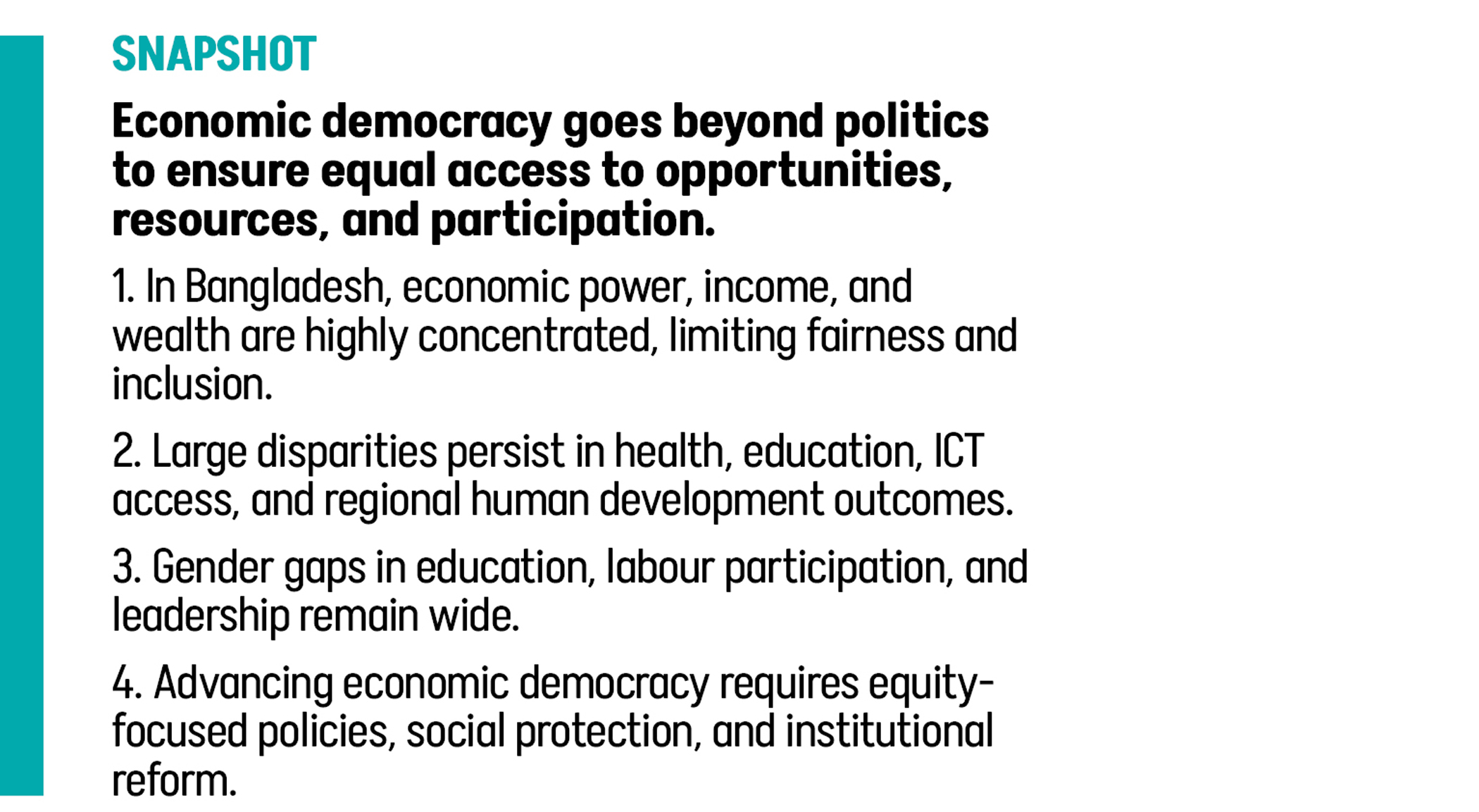
In the context of economic democracy, the Bangladesh panorama reflect significant inequalities and discriminations on various planes - regions, socio-economic groups, rural-urban and gender divides, ethnicities etc. Such inequalities and discriminations are evident in capabilities building, creating opportunities, providing voice and autonomy. In the economic field, existence of inequalities in income and wealth are well-known. In fact, a look either at the defaulted loans of banks or at cross-border money laundering amounting thousands of crores or taka clearly indicate that money and wealth in Bangladesh are concentrated in a few hands. An analysis of overall data shows that while the bottom 40 per cent of the population in Bangladesh receives 13 per cent of country’s GDP, the top 10 per cent of the population enjoys 38 per cent of it.
Inequality and concentration in Bangladesh’s economy
Such disparities exist in various human development areas as well. In Bangladesh, the under-five mortality rate among the bottom quintile of the population is 49 per 1,000 live births, while among the top quintile of the population, it is 25 per 1,000 live births. From a perspective of regional inequalities, for example, the adult literacy rate in Barishal is 75 per cent and that in Sylhet is 60 per cent. Disparities in the educational and the health opportunities are quite divergent. In education, with the co-existence of public and the private education, through different streams of educational structures catering to different socio-economic groups, large-scale inequalities have been created. Similarly, by maintaining a three-tier health system in, a huge discriminatory health system has been developed in the country. Furthermore, poor people have access to low quality basic social services, whereas the high-quality services are provided to the rich.
In ICT services, while three-fourths of the top quintile households have access to internet services, the comparable figure for the bottom quintile is only 9 per cent. In rural areas, only 3 per cent of the households have computers, and 78 per cent of the rural population do not know how to use a computer.
Human development gaps and social exclusion
In Bangladesh, there are gender-disparities in outcomes as well as opportunities. For example, the female enrolment rate at the tertiary level is 17 per cent, and the male enrolment rate at the same level is 24 per cent. The labour force participation rate among women is 36 per cent, compared to 81 per cent among men. The representation of women in senior and middle-management of the country is only 12 per cent. The gender-disparity in the use of mobile telephones is 29 per cent. About 33 per cent and 17 per cent men and women use internet respectively.
Gender, poverty, and democratic deficits
Overall deprivation of poor and marginalised people is a major obstacle to economic democracy. Today, about 36 million people live in poverty in Bangladesh, with 30 million new additions during the last three years. About 110million people do not have access to safely managed drinking water. Only 59 per cent births of children under-5 are registered and only 47 per cent of children have birth certificates. After finishing primary education, 56 per cent of children cannot make it to class 10. There has been a steep rise in child labour in Bangladesh over the past 6 years, from 6 per cent in 2019 to more than 9 per cent in 2025. Today, the rate of child marriage is 56 per cent, implying that 1 n every 2 girls get married before they reach 18. In the political spectra of Bangladesh, disparities are deep-rotted, a fact that has been observed again and again in the past and the near past. Any space for political discussion and discourse is monopolised by the rich and the educated segments of the society. Women are excluded from the process. Voice and autonomy, and freedom of expression do not mean a lot to the poor and the marginalised.
Without economic democracy, political democracy cannot endure. Inequality in access, voice, and opportunity undermines social cohesion and weakens the foundations of governance.
Policy pathways to democratise the economy
There are clear opportunities to democratise Bangladesh’s economic space. The core requirement is that economic policies be equitable and take account of all forms of human deprivation, with deliberate tilting towards those who are deprived and dispossessed where necessary. Accordingly, Bangladesh’s economic policy matrix must be framed with economic democracy in mind. This would include policies to ensure access to basic social services such as health, education, and safe drinking water. Pro-poor monetary policy, equitable fiscal policies on taxation and expenditure, and targeted incentives for small-scale and informal-sector entrepreneurs can further widen equitable access to productive resources. In short, an inclusive growth strategy can advance economic democracy in Bangladesh.
Second, corrective measures with targeted interventions are essential for groups unable to care for themselves, including older persons, people with disabilities, children, and those living in ecologically vulnerable areas. Social assistance and a comprehensive social protection framework should form the backbone of these targeted interventions.
Third, the governance and the institutional structure of the economy must be non-discriminatory and equity-friendly. Economic institutions must hold the values of economic democracy. Such values would require a strong framework of transparency and accountability, which would hinge on a strong monitoring and evaluation framework and a robust credible statistical system. With a goal to democratise the economic sphere would require institutional reforms. One of such reforms should concentrate on credible, robust disaggregated data on poor and marginalised people.
In recent times, country’s major political parties clearly indicated that if elected, the country’s economy would be their top priority. This is a welcome news to all the citizens of Bangladesh. But at the same time, one major goal of that priority should be democratizing the economic space of Bangladesh. Without economic democracy, the country will not be able to have either a sustainable political democracy or a society free from discrimination. The next elected government of Bangladesh must take note these challenges of economic democracy seriously and include them in the future economic road map of Bangladesh. If the government moves forward in the correct direction with objective and honest policies and strengthened institutions, it will build a development trajectory which will ensure economic democracy with equality and non-discrimination, enhanced well-being of the people of Bangladesh.
 For all latest news, follow The Daily Star's Google News channel.
Comments