


Shipping costs spiral as Iran war prompts new surcharges

Bangladeshi exporters and importers are facing higher shipping costs as major global carriers introduce war-related surcharges following the US-Israel war on Iran.
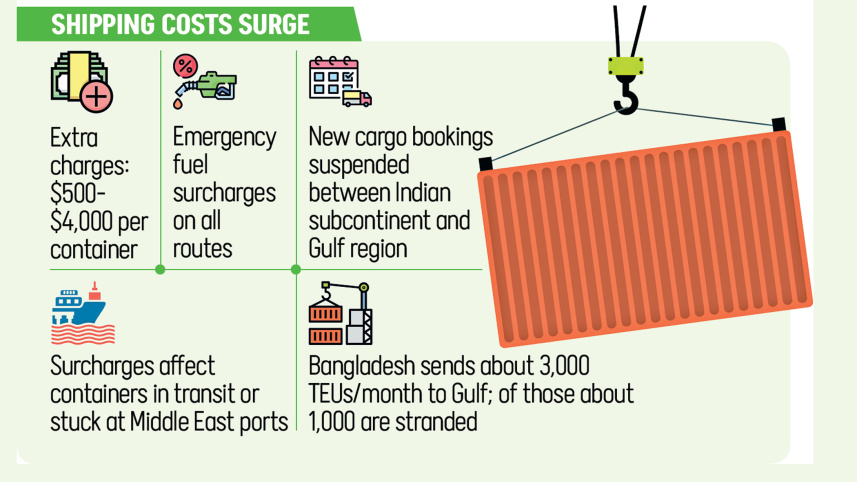
The extra fees, ranging from $500 to $4,000 per container, threaten to push up export prices, delay deliveries, and disrupt trade flows to the Middle East and other markets.

Foreign shipping lines have started applying the new charges, including emergency conflict surcharges and war risk surcharges, for cargo moving to and from ports in the Arabian Peninsula.
Besides, rising global fuel prices have prompted shipping lines to introduce an emergency fuel surcharge across all routes.
Immediately after the US-Israel war on Iran began, major carriers suspended all new cargo bookings between the Indian subcontinent, including Bangladesh, and the Gulf region, as vessels faced bomb attacks in the strategic Strait of Hormuz.
Despite the suspension, companies said the surcharges would also apply to containers already stuck at Middle East ports or in transit.
Around 60 percent of containerised cargo from Bangladesh is handled by four major global shipping companies. They are Denmark’s Maersk Line, Switzerland’s Mediterranean Shipping Company (MSC), France’s CMA CGM, and Germany’s Hapag-Lloyd.
SHIPPING LINES IMPOSE VARYING CHARGES
After the closure of the Strait of Hormuz, Maersk announced on March 3 an emergency freight increase for cargo to and from Gulf destinations, including the UAE, Qatar, Saudi Arabia (Dammam and Jubail), Bahrain, Kuwait, Iraq, and Oman (Sohar).
The new rates are $1,800 per 20-foot container, $3,000 per 40-foot container, and $3,800 for refrigerated containers, citing higher operating costs and the need to use alternative routes.
Since March 5, MSC has imposed an emergency war surcharge of $500 to $1,000 per container on cargo from the Indian subcontinent, including India, Pakistan, Sri Lanka, and Bangladesh, to East Africa, Somalia, Mozambique, and the Indian Ocean islands.
On March 7, the company introduced an emergency fuel charge of up to $200 on shipments from the Mediterranean and Black Sea to the Indian subcontinent, the Red Sea, and East Africa.
CMA CGM introduced an emergency conflict premium on March 2, setting the rate at $2,000 per 20-foot container, $3,000 per 40-foot container, and $4,000 for refrigerated containers for cargo linked to several Gulf countries.
The company also announced an emergency fuel surcharge of $75 to $180 starting March 16 due to rising bunker costs -- the price of fuel for ships.
CMA CGM said sharply higher fuel prices, caused by ongoing geopolitical tensions in the Middle East, have pushed up bunker costs across all regions, raising overall ocean transport costs.
Hapag-Lloyd has implemented a war risk surcharge of $1,500 per 20-foot container for standard containers and $3,000 per refrigerated container for cargo to and from the Upper Gulf, Arabian Gulf, and Persian Gulf.
The company has also introduced an emergency fuel surcharge of $70 to $225 on all trade routes, effective from March 23.
A senior executive at a local office of a foreign shipping company said the new rates were introduced to cover additional operating costs and risks.
IMPACT ON BANGLADESH EXPORTS
Bangladesh exports a wide range of products to the Middle East, including spices, mustard oil, and processed foods such as beverages, biscuits, puffed rice, chanachur, noodles, and other snacks.
 For all latest news, follow The Daily Star's Google News channel.
 Bangladeshi diasporas in those countries are the main consumers of those items. According to data from the Export Promotion Bureau (EPB), processed food exports to the Middle East are valued at $40-$45 million annually.
Shipping lines say that around 3,000 TEUs (twenty-foot equivalent units) of export containers leave Bangladesh for Middle Eastern countries each month.
Since the war began, at least 1,000 TEUs have been stranded at private container depots in Chattogram, at Chattogram port, and at transshipment ports such as Colombo, as well as on vessels in transit.
Pran EFL Group, which exports a wide range of food products to more than 70 countries, sends around 30 percent of its exports to the Middle East.
Kamruzzaman Kamal, marketing director of the company, said around 400 TEUs of the group’s export containers are currently stranded on vessels and at transshipment ports.
“We will have to pay additional surcharges for these cargoes,” Kamal told The Daily Star yesterday.
He said that the company is negotiating with shipping lines to find alternative routes for the stranded shipments.
At present, cargo can only be shipped to the Saudi port of Jeddah, where freight rates have surged to $6,300 per container from the previous $2,700, he said.
Freight forwarders said shipping from Chattogram to Europe now costs about $1,400 per 20-foot container and $2,000 per 40-foot container, with the new emergency fuel surcharge added on top. Freight rates on other shipping routes have also increased.
Rakibul Alam, director of the Bangladesh Garment Manufacturers and Exporters Association (BGMEA), said the freight rate for importing raw materials for the readymade garment sector from China to Chattogram has risen to $2,000 per 40-foot container, up from $1,500.
Comments