


Bangladesh's rivers are dying, and so is its future

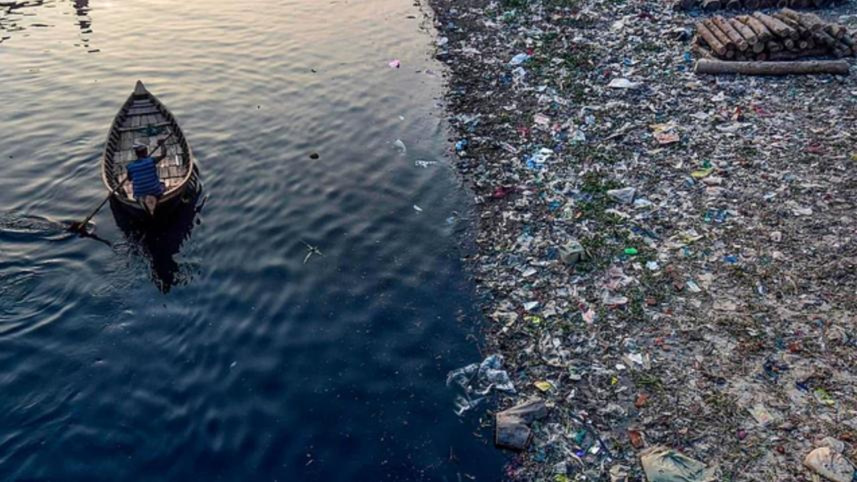
A few days ago, I stopped by the Turag River near Aminbazar on my way to Savar. The water, a murky greyish brown, barely moved. A thick film of industrial waste floated on the surface; the smell was difficult to endure. A local fisherman indicated that he had not caught anything worthwhile in three years. “This river is dead,” he flatly suggested, as if it were obvious, the way one might comment on the heat or traffic. That casual acceptance stayed with me. How did we arrive at a point where a dead river is simply another feature of the landscape?
The world marks March 14 as the International Day of Action for Rivers to recognise the crucial role of rivers in sustaining livelihoods and ecosystems. This year’s theme, “Protect Rivers, Protect People,” feels like an ultimatum. The world also observes March 22 as “World Water Day,” focusing on access to fresh water. The 2026 campaign slogan for the day is “Where water flows, equality grows.” Naturally, these two days commemorate deeply interconnected themes.

For Bangladesh, a nation shaped by the sediments from the Ganges, Brahmaputra, and Meghna, the health of our rivers is not a peripheral environmental concern—it is the very foundation of our survival. A 2025 study by the River and Delta Research Centre (RDRC) reveals a grim reality: at least 79 rivers across the country have either died or are drying up. The crisis is most acute in the Khulna division, with 25 dying rivers, followed by 19 in Rajshahi and 14 in Rangpur. This decay mirrors a parliamentary statement from February 2024: that 308 rivers around the country have lost navigability. While the total river network in Bangladesh spans approximately 24,000km, the portion that remains navigable during the dry season is roughly 3,800km, a staggering decline that threatens the very lifeline of our delta. And yet, the gap between our riverine identity and our developmental choices has never been more consequential.
The picture is bleak in the capital. A recent study reveals that over the last three decades, Dhaka’s built-up areas surged by 288 percent, while its vital water bodies shrank by 60 percent. Consequently, the six rivers encircling the city—Buriganga, Shitalakkhya, Bangshi, Turag, Balu, and Dhaleshwari—are now functionally dead, choked by industrial and municipal waste. The Department of Environment’s 2023 report confirms that these waterways fail to meet the vital Environmental Quality Standards set by law. This is not just an ecological issue but also an economic one: the World Bank estimates river pollution costs the nation $2.83 billion annually, a figure set to balloon to $51 billion over the next two decades if we fail to act.
The drivers of this crisis are well-documented but politically inconvenient. According to the Bangladesh Inland Water Transport Authority (BIWTA), roughly 350 tonnes of waste are dumped into Dhaka’s rivers daily from approximately 7,000 industrial and residential sources. Another RDRC survey report on 56 rivers finds them to be extremely polluted. The ready-made garment sector, the backbone of our economy, discharges an estimated 5.6 crore tonnes of wastewater annually, mostly into the Buriganga. The dissolved oxygen levels has become too low to support aquatic life in Buriganga, Turag and Balu. For nearby slum residents, the cost is physical: Human Rights Watch reports chronic fevers, skin diseases, and respiratory illness. Besides, with the rivers being choked by the 63,200 illegal encroachers identified by the National River Conservation Commission (NRCC), the city’s natural drainage is also failing. The urban waterlogging that paralyses Dhaka with less than an hour of rain is not a natural disaster but the predictable result of replacing waterways with concrete.
Beyond our borders, the challenge takes on a geopolitical dimension that demands far greater urgency than it currently receives. Bangladesh is at the downstream end of 57 transboundary rivers, which means we are perpetually subject to our neighbours’ decisions. During the dry season, upstream diversions reduce rivers like the Ganges to trickles, allowing salinity to advance deep into the agricultural belt of our coastal districts, ruining farmland and displacing communities. During the monsoon, sudden uncoordinated releases from upstream dams trigger what are often described as flash floods. There is nothing natural about a flood caused by dam management decisions made without warning or accountability. The Ganges Water Treaty was ratified decades ago, yet we still lack access to transparent, real-time data on upstream operations. As the treaty comes up for renewal, Bangladesh must push for enforceable real-time data-sharing, early warning systems for dam releases, and a genuine framework for joint ecological stewardship of the shared watershed.
Domestically, the problem is not an absence of law but a chronic failure to enforce it. In 2019, the High Court declared rivers in Bangladesh as living entities with legal rights, designating the NRCC as their legal guardian. The court also directed that encroachers be barred from participating in elections and getting bank loans. In 2026, those directives remain largely symbolic. Eviction drives generate headlines; encroachers return within months.
Breaking this cycle requires structural reform. The NRCC must be empowered with genuine fast-track authority to penalise polluters and evict encroachers beyond the reach of political interference. Every major infrastructure project must pass a mandatory river impact assessment before approval. In the case of industrial pollution, the standard cannot remain voluntary compliance. Industries operating without functional effluent treatment plants are externalising the true cost of their production onto the public health of millions. It is basic hydrological common sense, not idealism.
At the community level, the Halda River offers a model worth national attention. The partnership between local fishermen and government agencies to protect the country’s last natural carp breeding ground shows what is possible when communities are given genuine ownership rather than treated as spectators to top-down policy.
There is no foundation more fundamental than the water that flows through this delta. A Bangladesh of high-speed internet and soaring skylines means very little if the rivers are retreating. If we fail to act urgently through enforceable law, assertive diplomacy, and genuine community stewardship, we will be the generation that presides over the irreversible loss of our most defining natural heritage, and our aspiration for equality may remain elusive.
Dr Sabbir Ahmad is a researcher and expert in project delivery and engineering. He can be reached at sabbir@ieee.org.
Views expressed in this article are the author's own.
Follow The Daily Star Opinion on Facebook for the latest opinions, commentaries, and analyses by experts and professionals. To contribute your article or letter to The Daily Star Opinion, see our guidelines for submission.
 For all latest news, follow The Daily Star's Google News channel.
Comments