


Nepal flood shows why we must look further upstream

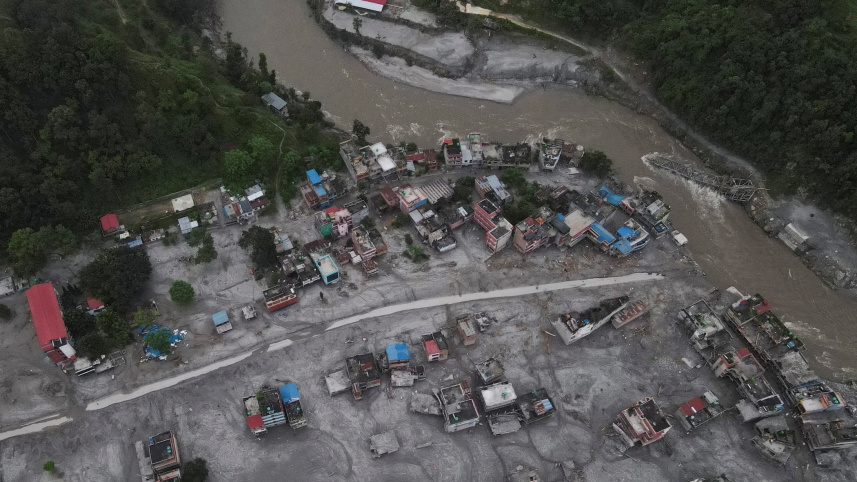
The devastating flash flood that ripped through Nepal’s Rasuwa district and China’s Tibet has so far claimed more than 600 lives, with around 3,000 still missing on both sides of the border. A wall of water and debris raced down the Bhotekoshi and Trishuli river systems from Lhende valley on August 26, taking people, settlements, roads, bridges, and power plants with it. Rescue teams are still struggling to reach some of the worst-hit stretches. This is a tragedy that deeply touched Bangladesh. For us, although there is no immediate flood threat, the disaster also holds a significance: it reveals how the country is now tied to the Himalayan river system in ways that go well beyond the water that eventually arrives in the Padma.
The Bhotekoshi River is part of Nepal’s Trishuli-Gandaki river system. The Trishuli joins the broader Narayani system near Devghat, which flows into India as Gandak, cuts through Bihar, joins the Ganges, and eventually enters Bangladesh as Padma River. Bangladesh has historically dealt with this river system at Farakka, where the Ganges Water Sharing Treaty governs lean-season flows. The river’s flood dynamics change considerably as it leaves the mountains and spreads across the plains, while the infrastructure, politics, and energy systems built along the basin remain connected. As such, what happens upstream can still create risks and shape decisions much farther downstream.

The electricity link is the clearest new dimension. Under the 2024 trilateral deal, Nepal is sending 40 MW to Bangladesh through India’s grid—18.6 MW from Trishuli and 21.4 MW from Chilime. Of course, 40 MW counts as little against Bangladesh’s peak demand, which often tops 17,000 MW, compared to the daily production between 14,000 and 15,500 MW. But the arrangement is important because of what Bangladesh hopes it will grow into. Against a small domestic market, Nepal has massive hydropower potential, often touted as one of the highest per-capita power productions in the world. So, Dhaka takes into account Nepal’s Himalayan rivers as part of its energy future.
But the trade was already constrained by India’s transmission limits. Nepal and Bangladesh wanted to raise the export to 60 MW this year, but India’s Central Electricity Authority refused the extra 20 MW because the corridor into Bangladesh is already tight. That was a middle-of-the-system problem, while Rasuwa has now shown the problem at the source. The Nepal Electricity Authority has said the flash flood hit 11 hydropower projects and a solar plant, taking more than 430 MW offline. Chilime, Trishuli, Trishuli 3A, and Rasuwagadhi were among these.
If Bangladesh eventually wants hundreds of megawatts from Nepal, the resilience of the plants themselves will matter as much as the price and route. Bangladesh should avoid securing all of the supply in one hydrological corridor.
Future procurement should be geographically diversified across river systems such as the Karnali, Sunkoshi, and Gandaki, rather than relying heavily on the flood-exposed Trishuli-Bhotekoshi basin. This would not eliminate climate or geological risks, but it would reduce the possibility of one extreme event disrupting a disproportionate share of Nepal’s power supply to Bangladesh. Future agreements should also have clear provisions for rapid notification, temporary supply adjustments, restoration, and compensation when major natural disasters disrupt generation or transmission.
The Ganges Water Sharing Treaty with India expires on December 12 this year, which is 30 years to the day from when it was signed in 1996. Its main job is to allocate lean-season flows at Farakka from January to May. The Rasuwa flood has nothing to do with this, since it was a monsoon event which occurred far upstream. Still, it has reiterated the fact that the river Bangladesh negotiates over at Farakka is part of a much larger basin, and large-scale climate events in the basin will not always start inside India or Bangladesh.
Events in Bihar last week further complicated the issue. As the Ganges rose, Bihar Chief Minister Samrat Choudhary asked West Bengal’s Suvendu Adhikari to open all the gates at Farakka, arguing that more discharge downstream would ease pressure upstream. Bihar’s leaders have also been telling New Delhi that the state’s own needs—flood control, irrigation, drinking water, and industry—must be factored into any new arrangement with Bangladesh. Foreign Minister Khalilur Rahman recently said that Bangladesh has formed a team to review issues related to the treaty and has informed Indian authorities accordingly. Bangladesh now awaits India’s response.
For Bangladesh, the important thing is what the argument shows about the politics around Farakka. Dhaka often treats the barrage as a decision made in New Delhi and negotiated with Bangladesh, but the reality is more complex. Indian river policy is shaped by competing state demands. Bihar has its flood worries; West Bengal has its interests in the barrage and the Hooghly; New Delhi has to balance those pressures against its commitments to Bangladesh. The next Ganges agreement will be shaped as much by internal arguments in India as by what Delhi and Dhaka want from each other, as already hinted by Indian External Affairs Minister S Jaishankar.
The Nepal-China flood has added another layer to this issue, as the upper basin is becoming harder to manage inside the neat seasonal boxes allocated in the current treaty. According to the US Geological Survey, a glacial collapse triggered seismic activity that went on to have catastrophic downstream impacts in Nepal and Tibet. In the Himalayas, one hazard can thus quickly trigger another: a slope failure blocks a river, a temporary lake forms, and its eventual collapse sends water and debris downstream. Glaciers, frozen ground, mountain slopes, and river channels are part of the same physical system, and changes in one affects the others. For countries downstream, there may be very little warning once a chain of events begins.
This is where Bangladesh should push for something practical rather than another broad commitment to regional cooperation. It needs a working early-warning arrangement across the wider basin. If a major river is blocked, a glacial lake forms, an unusual release begins at a barrage, or a hydropower plant is knocked out, the countries downstream should know quickly. India and Bangladesh do not need to turn the Ganges treaty into a four-country negotiation involving Nepal and China. The treaty can stay focused on lean-season sharing at Farakka. But alongside it, the countries involved could set up automated, real-time hydrological data exchange and disaster-notification protocols, bringing Nepal in when events on its territory could affect downstream rivers.
For decades, Bangladesh has treated Farakka as the main point of contact with the Ganges, and this focus remains relevant. What has changed is the range of interests now pulling the country further into the upper basin. The recent flood makes the shift harder to overlook.
Jannatul Naym Pieal is a writer, researcher, and journalist. He can be reached at jn.pieal@gmail.com.
Views expressed in this article are the author's own.
Follow The Daily Star Opinion on Facebook for the latest opinions, commentaries, and analyses by experts and professionals. To contribute your article or letter to The Daily Star Opinion, see our guidelines for submission.
 For all latest news, follow The Daily Star's Google News channel.
Comments