


Don’t let greed decide St Martin’s future
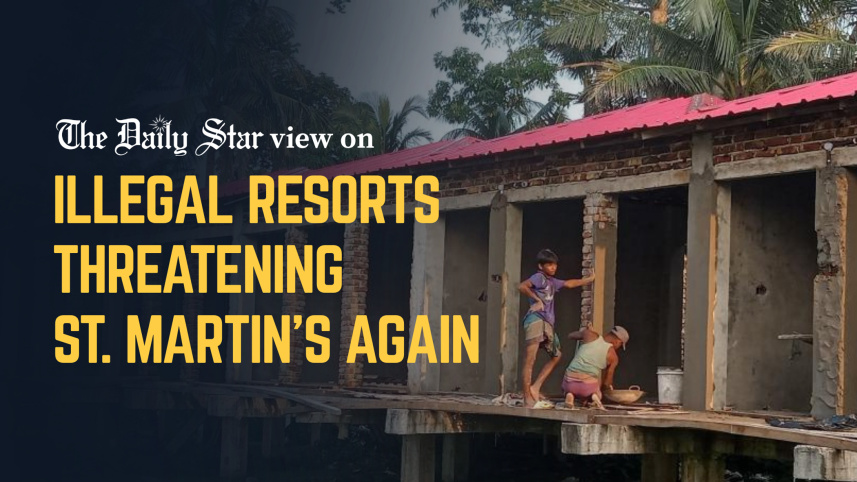
It is deeply concerning to see multiple new tourist accommodations being built on St Martin’s Island, despite a ban on unauthorised construction on the island. A recent report by Prothom Alo identified at least 12 new resorts and cottages under illegal construction on the coral-rich island, with locals alleging most construction began after the 13th parliamentary election. Conversations with residents further revealed that construction activity tends to intensify during adverse weather, when the tourist season ends, and when maritime communication between Teknaf and the island is largely cut off.
There are at least 230 hotels, resorts, and cottages on the island, according to the Department of Environment (DoE), but the figure is not updated. A revised figure including recently built resorts and those under construction would exceed 300. The new structures, whose owners allegedly enjoy backing from local BNP leaders, are being built by clearing Keya forests and felling coconut trees, which provide natural barriers against tidal surges and cyclones, help retain sand, stabilise the shoreline and create wind resistance. Besides, sand and limestone are being extracted from the beach for construction. It is troubling that most resorts on the island lack environmental clearance, while newer structures continue to be built without proper planning or regard for its fragile ecosystem. Disregard for environmental regulations is hardly new in Bangladesh. But the situation in St Martin’s clearly shows that enforcement remains weak in the face of politically backed, profit-driven ventures.

The island was declared an Ecologically Critical Area in 1999 and a Marine Protected Area in 2022. Authorities, too, have repeatedly demolished illegal structures and those lacking environmental clearance. More recently, overnight stays were banned, tourist numbers were capped, and travel was suspended for nine months to protect the island’s fragile biodiversity. A Tk 8.9 crore DoE project is also underway to strengthen the island’s climate resilience and protect its biodiversity. These interventions clearly recognise the island’s ecological significance. But when none of these interventions succeed in producing lasting change—amid institutional neglect and weak enforcement against influential groups with political patronage who violate environmental laws—it only points to a sad state of governance failure that continues to let down both human and nonhuman communities on the island. And, this must change.
Therefore, we urge the government to investigate allegations of political patronage, trace and regulate the routes bringing construction materials to the island, and strengthen monitoring and enforcement alongside meaningful community involvement. It is imperative that there is greater coordination between the DoE and the local administration to safeguard St Martin’s. After all, would it not be a shame to let greed decide the island’s future?
 For all latest news, follow The Daily Star's Google News channel.
Comments