


How forest loss, water crisis and inequality collide

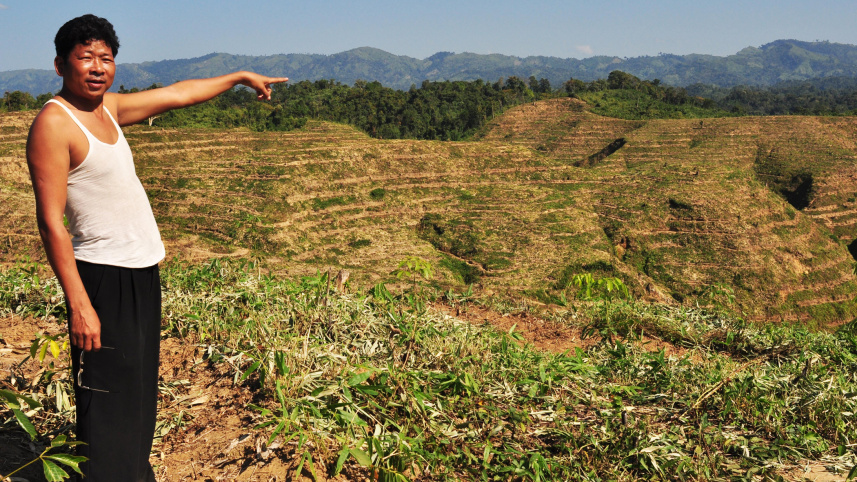
Last month, three special days of observation occurred in succession. March 21 marked both World Forest Day and the International Day for the Elimination of Racial Discrimination, while March 22 was observed as World Water Day. Historically, the themes of these days have been deeply intertwined. But in our civic and academic narratives, these issues have always been treated separately. Why is there no water in the streamlets of Soroi hill in Bandarban or in the Madhabkunda waterfall in Moulvibazar? In the name of establishing a commercial rubber plantation, the Lama Rubber Industries Ltd took over the Soroi hill area, cut down the forest, and poisoned the streamlets. On the other hand, under the guise of creating an eco-park, the Forest Department enclosed Madhabkunda, built artificial infrastructure incompatible with the local forest, and leased out this ancient waterfall to a private company. Reckless tourism has turned streams into dumping grounds for plastic waste. The very stones that retain water have been looted by powerful outsiders. That is why the streams in the hills are dying.
What is the relationship between the dying forests and water sources and racial discrimination? It is one that is historical and colonial. For the sake of profit and trade, water bodies and forests have been repeatedly plundered, occupied, and polluted. Authoritarian binaries and neoliberal power structures have legitimised this practice. Why does this looting and grabbing continue against poor farmers, forest dwellers, Indigenous communities, and fishers? Why must the rural “lower classes” be evicted from their ancestral land, streams, and sacred forests? Amid all this, the politics of historical racism and division continues to thrive.
 For all latest news, follow The Daily Star's Google News channel.
 In the 1700s, British colonial official Robert Lindsay wanted to take control of the limestone hills in Sylhet, but the local Khasi people fought against that. However, the Hajongs in an independent Bangladesh could not save the hilly mounds of Durgapur in Netrakona; to trade white clay and china clay, the entire area has been gouged out and mutilated. Why did they plan to build a five-star hotel on Chimbuk Hill, where there is not a drop of water? Why did Birsa Munda, Piren Snal, Abinash Mura, Salik, and Goni surrender their lives to save the jungle throughout history? To some, the jungle is a way of life, and to others, it is a profit mine.
Not just for forests, but the so-called lower classes have sacrificed their lives fighting to secure the right to water as well. In the haor region, the Bhashan Pani Movement arose with the aim to secure every individual’s right to accessing public water. For this, Barun Roy endured imprisonment and repression. Similarly, Karunamoyee Sardar and Zayeda of the southern region gave their lives to save wetlands and land from the salinity of commercial shrimp enclosures.
Just as forests cannot grow if water does not flow freely, so too water flow dies down when forests are ravaged. But in the conventional discussions on resolving water crisis or the conservation and management of forests that dominate the space, these interrelationships and multidimensionalities are always suppressed. There are also some stereotypical debate on the “elimination of racial discrimination.” However, in those discussions, the multidirectional tendencies of power, marginality, commerce, the relationship with nature, and hegemony remain strongly absent. Why do Indigenous and farmer households get upended in the name of coal or gas surveys? Why does a poor woman in the coast, the Barind, the hills, or the urban slums have to wait for hours to collect a single pitcher of water, or why does a poor farmer, after backbreaking agricultural labour, die by suicide after not getting a decent price for their harvests? Despite not having used fossil fuel in her lifetime, why is the life of a rural woman shattered by cyclones, floods or drought? Why do the rich of the world get to drink one bottle of Kona Nigari water for Tk 60 lakh, while poor fisherwomen in Bangladesh are forced to have their wombs removed because of sores caused by increased salinity in their water? Why do millions of children in the world go to sleep in agony without food every day, while the United Nations prepares lists of countries that waste food? These questions have yet to find any space in our racial discrimination discourse.
It is only against the poor, the powerless, the peasants, the fishers, the Indigenous peoples, the traditional healers, the forest dwellers, and the landless that ruthless discrimination and division go on unquestioned. All the facets of modern racism carried forward from the colonial legacy must be brought into mainstream discussion.
Isn’t access to water a fundamental right?
The theme for this year’s World Water Day was “Water and Gender.” Across the country, every day, it is our women who are burdened with the responsibility of household water management. Walking mile after mile, they fight, endure getting shoved, and expend valuable time to bring home water. Meanwhile, men typically end up either bottling up public water for sale or becoming part of the syndicate that keeps water under hostage. In a country plagued by barriers to accessing water, various multinational companies bottle up and sell gallons upon gallons of it. Why are there no protests against this on the streets or in parliament?
Water is fundamentally a matter of power. The High Court recently declared free, safe drinking water to be a fundamental right of every citizen, in light of Article 32 of the constitution. Will the government implement this order?
A law to ensure forest rights is urgent
The theme for World Forest Day this year was “Forests and Economy.” Forests in Bangladesh have always been viewed in terms of how many cubic feet of timber could be yielded from them. Not a single forest in the country is intact, let alone healthy. Each one is surviving against the unjust actions of the influential quarters in the country. Yet, geographically, the diversity of our forestry is quite notable.
Usually, in any conversation on forests, the forest authorities’ name come up not as a protector but as an adversary. Forest versus foresters is an imposed division, which has created a distance between the authorities and the forest dwellers and forest-dependent Indigenous peoples. At the same time, because the authorities never question this binary, they have not been able to learn from the foresters’ folk knowledge about ecology and conservation. The coloniality and historically established control still remains in force. With such a discriminatory attitude from the authorities, the development and expansion of natural forestland is not possible as such an ecosystem can only develop through the combination of natural and social forces.
The forest has its own right to develop and adapt itself per its needs. Legal recognition of forests’ personhood is urgent. At the same time, it is also important to legally recognise the rights of the people dependent on forests, as well as all other forest-dependent species. To this end, the government should start working on a forest rights law.
When the soul burns
On the International Day for the Elimination of Racial Discrimination this year, United Nations Secretary-General António Guterres said, “The ancient poison of racism is alive and kicking in every community, society, country and region of the world. The antidote is unity and action.” Do we have enough of this antidote?
In 2022, after two Santal farmers in Rajshahi’s Nimghatu village died by suicide because they were deprived of water for irrigation, other Santal farmers from the same village said, “There is no water. The soil’s soul is burning.” In Satkhira’s Gabura village, one Bangalee farmer told me about the paddy harvest suffering due to the lack of water. Every day, one could hear the cries of the forests as well. At the Beribadh slum in Dhaka, I have heard from many people the stories of souls being crushed by water scarcity. Across the country, souls are burning. The souls of water, soil, birds, fish, people, settlements, villages, wetlands, and forests are all ablaze. Not a single agency of the state will be able to handle this crisis or protect the citizens by itself. Effective coordination is needed among all the ministries and departments, alongside inclusive action. Shedding all biased outlooks, the state must stand on the side of every burning soul.
This article has been translated from Bangla.
Pavel Partha, an ecology and biodiversity conservation researcher, is director at Bangladesh Resource Centre for Indigenous Knowledge (BARCIK). He can be reached at animistbangla@gmail.com.
Views expressed in this article are the author's own.
Follow The Daily Star Opinion on Facebook for the latest opinions, commentaries, and analyses by experts and professionals. To contribute your article or letter to The Daily Star Opinion, see our guidelines for submission.
Comments