


Can MUN Alert help bring missing children home safely?

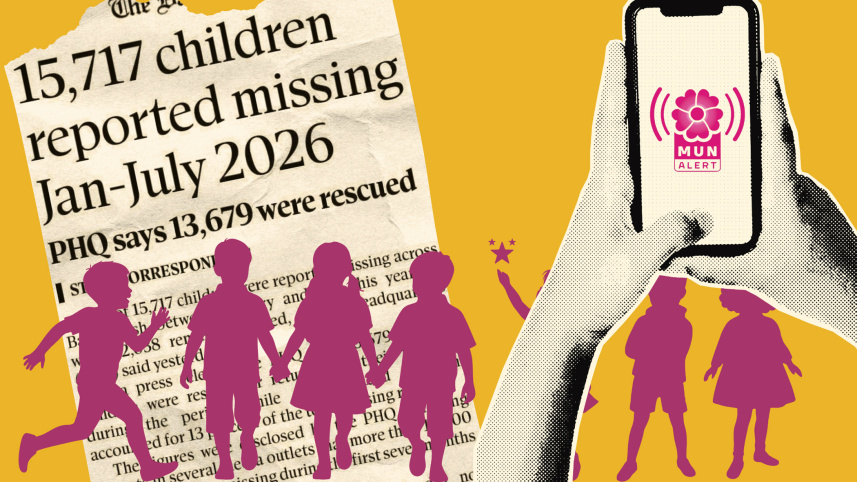
When a child disappears, every passing minute is a very frightening experience for the family. They search nearby streets, call relatives and friends, and eventually turn to the police. By then, however, valuable time may already have been lost.
On January 13 this year, to speed up the response time to missing children’s cases, the Criminal Investigation Department (CID) of Bangladesh Police and Amber Alert for Bangladesh launched MUN Alert, a national missing-child alert service with a toll-free hotline and an online reporting platform. The system was reportedly named after Muntaha, a child who was abducted and later found dead in Sylhet in 2024. MUN also stands for “Missing Urgent Notification.”

It’s worth recalling that the United States introduced its AMBER Alert system in 1997 after the 1996 abduction and murder of nine-year-old Amber Hagerman in Texas. Similar systems exist in many other countries; most have been introduced following a particularly shocking, high-profile case. These systems allow law enforcement agencies to rapidly distribute information about child abduction cases via television, radio, electronic road signs, mobile phones, and other platforms.
In the US, AMBER Alerts have helped recover at least 1,312 children. Bangladesh is, therefore, adopting an approach that has already been proven useful in other countries. The real challenge is to see whether the system can be made effective in our contexts, where the legal system, police structure, data collection systems, and child-protection mechanisms are much more different.
Children may disappear because of kidnapping, trafficking, or exploitation. But some also get lost or run away due to family abuse. For example, AMBER Alert Europe explains that national systems generally require specific conditions before issuing an alert, such as a serious risk to the child’s life or health and information that can help the public locate the child. Bangladesh should adopt the same principle because if every missing-child report produces a nationwide emergency notification, people may eventually become overwhelmed and stop paying attention.
What MUN Alert adds to our existing system is speed and possibility of public participation by quickly sharing a missing child’s information, and thus turning the public into additional eyes for the police.
Although kidnapping and abduction are punishable by law in Bangladesh, certain limitations exist. For one, punishment comes after the crime has been committed, and any punishment cannot undo the harm suffered by a child who has already been murdered or abused. The purpose of MUN Alert is not primarily to punish the offender, but to increase the possibility of the child being found before the worst happens.
Currently, Bangladesh lacks a single, comprehensive, and publicly available national database showing exactly how many children go missing every year, how many are kidnapped, how many are trafficked, how many return voluntarily, and how many are found dead. This makes claims about a precise national “increase” in missing-child incidents difficult to verify. The issue of unreliable information became obvious in July 2024, when social-media claims alleged that 35 children had gone missing in Dhaka and Chattogram within 48 hours. Police later said there was no evidence supporting the claim and that most of the children reported missing had subsequently been found. This is why Bangladesh needs reliable data as much as it needs alerts. A child does not always disappear from a safe environment. Some may leave home to escape violence, abuse, or exploitation.
Unicef identifies violence against children, sexual violence, trafficking, and other forms of exploitation as major child-protection concerns in Bangladesh. According to the Bangladesh Multiple Indicator Cluster Survey (MICS) 2025, 85.7 percent of children aged 1-14 years experience violent discipline. Therefore, after a missing child is found, authorities should not simply consider the case “closed.” They should ask: Why did the child disappear? What happened during this period? The answer may help prevent the next disappearance.
Ideally, MUN Alert should evolve beyond a hotline into a national missing-child response system with a secure verified database; measurable response times; proper coordination among police, border, transport, and child-protection agencies; strict privacy safeguards; and follow-up investigations into why children disappeared. The real measure of MUN Alert’s effectiveness would be to observe whether it helps recover children quickly and safely and whether the system can help prevent disappearances in the future.
Shanjida Jahan Iftee is a student at the Department of Law in Bangladesh University of Professionals (BUP).
Views expressed in this article are the author's own.
Follow The Daily Star Opinion on Facebook for the latest opinions, commentaries, and analyses by experts and professionals. To contribute your article or letter to The Daily Star Opinion, see our guidelines for submission.
 For all latest news, follow The Daily Star's Google News channel.
Comments