


Are teachers failing, or is the system failing them?
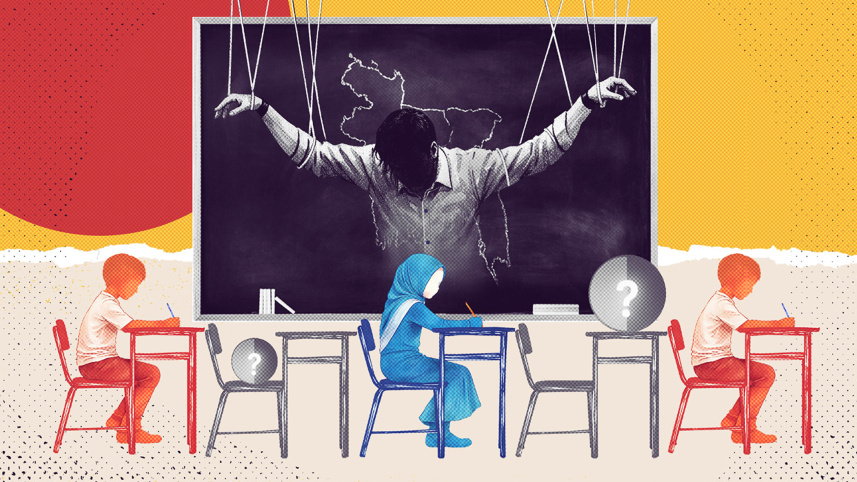
Recently, Education Minister Ehsanul Haque Milon told the parliament that 60,295 teaching posts are currently vacant in about 26,000 MPO-listed (government grant-receiving) secondary schools and colleges in the country. The UNESCO Institute for Statistics (UIS) reported that Bangladesh lags behind most in terms of qualified teachers in secondary schools in South Asia. Only 55 percent of the teachers at the secondary level in Bangladesh were considered qualified, whereas the Maldives rated 98 percent of its teachers as qualified. The rates were 97, 92, 80, and 68 percent, respectively, for Nepal, India, Sri Lanka, and Pakistan.
A manageable class size to teach is a basic working condition for a teacher to perform adequately. The average teacher-student ratio in Bangladesh’s secondary schools is reported to be about 1:35 compared to a standard of 1:15 in a well-performing system. The average hides the fact that many high school classes in Bangladesh have 60-70 or more students. This reality is reflected by the government’s rule for the MPO grant that allows a school to open a new section only when enrolment in the class exceeds 55 students. Due to MPO budget limitations, this rule is not applied often, and the enrolment reaches even higher. More critically, remote schools find the bureaucratic process and requirements of the Board of Intermediate and Secondary Education and the Ministry of Education for hiring additional teachers difficult.

According to the Bangladesh Bureau of Educational Information and Statistics (BANBEIS), a 2024 report found that of around 59,700 designated English teachers in secondary schools, a quarter had not studied English beyond 12th grade, and only 17 percent held a degreein English at honours or master’s level. The situation in mathematics is even more precarious. Of 61,700 mathematics teachers in secondary schools, 57 percent had not studied mathematics at the college level, and only 17 percent had mathematics as a subject at honours or master’s level. It is not surprising that low scores in English and mathematics are a major contributor to low pass rates in public examinations. The MPO rules for teaching staff allocation set a standard pattern. As noted above, the permitted staffing is often inadequate for the number of enrolled students, especially in the core subject areas.
A consultation committee appointed by the Ministry of Education in 2025, under the interim government, to recommend reforms in secondary education devoted a chapter of its report to teachers. The committee identified eight major obstacles to good teacher performance: First, there is no clearly defined framework for teachers’ responsibility, effort, and performance standards for assessment and incentives. Second, the current allocation of teaching posts is fundamentally inadequate for maintaining manageable student-to-teacher ratios, ensuring subject-specific instruction, and facilitating co-curricular activities. This systemic deficit is further exacerbated by a high volume of vacant teaching roles. Third, delays and inefficiencies in the selection, appointment, placement, promotion, and transfer of teachers are a common feature. Moreover, frequent complaints are voiced about corruption, nepotism, the role of syndicates in controlling decisions, and the lack of recourse for wrongdoing in personnel management.
Fourth, pre-service professional preparation, in-service professional support, and a culture of mentoring of new teachers in school are absent. Teaching quality is also severely hindered by poor foundational training at private teachers’ training colleges and Open University distance courses, coupled with infrequent, impractical on-the-job training. Fifth, there is no career path for teachers. Most teachers appointed as assistant teachers end up retiring as assistant teachers—a serious disincentive to teacher professionalism.
Sixth, teachers of only a few government secondary schools (three percent of total) are placed at the government salary level of grade 10 (out of 20 civil service grades). The salary starts at a basic level of Tk 16,000, with 60 to 70 percent more added as benefits. The MPO-listed teachers (in 97 percent of the schools) are paid the basic salary and roughly a quarter of the benefits. The non-MPO teachers paid from the schools’ own funds receive substantially less. Primary school teachers are placed at grade 12 (basic starting salary of Tk 11,300). Bangladesh school teacher salary is the lowest among the South Asian countries, while the average salary level is two to three times higher in India, Pakistan and Sri Lanka.
Seventh, there is no system of forming teachers’ organisations. Multiple organisations exist, often linked with political parties, mostly engaged in bargaining for material benefits, with little attention to improving the quality of education and system performance. And eighth, teachers are expected to be role models for their students in behaviour and attitudes; however, a study found that two-thirds of high school students do not see their teachers as role models, and half of the teachers do not see themselves as role models for their students.
The problems described are not a discovery of the consultation committee. In fact, various initiatives to improve teachers’ performance have been taken over the last two decades by the two ministries of education with technical and financial support from international development partners. Notable among them are the Teacher Quality Improvement in Secondary Education Projects (TQI 1 and 2 carried out between 2005 and 2020); Secondary Education Quality and Access Enhancement Project (SEQUAEP, 2008-2017) and ongoing Learning Acceleration in Secondary Education (LAISE, 2023-2028)—all at the secondary level. Under the Primary Education Development Program phases 1 to 4 (PEDP 1 to 4, 1998 to 2026), teacher capacity building and training have been a major strategy for quality improvement in primary education. PEDP5 is expected to begin in July this year. Multilateral institutions such as the World Bank, Asian Development Bank, Global Partnership for Education (GPE), UNICEF, UNESCO, and various bilateral aid providers have been associated with these projects.
A legitimate question is what the achievement has been from the multibillion-dollar investment of government and external funds for over two decades in enhancing the quality and performance of our teachers. Certainly, much less than expected if the criterion is the learning outcome of students. A newly elected government has pledged better performance of the education system and has raised people’s expectations once again. Development partners are willing to help. The ball is in our court; the government has to take the lead in setting priorities and strategies, and establish a result-focused implementation process and mechanism. This is where we have largely failed so far. Can we now move away from the rut of unfulfilled promises and unrealised expectations?
The consultation committee report on secondary education (and a similar report on primary and non-formal education) has put forward a set of recommendations on the eight issues noted above about teachers’ role and performance. The committees have underlined the importance of early and medium-term actions, largely within the present structure of a large and complex system (because the system has to be kept running). They have also emphasised the need for a longer-term view to bring about transformative change in our schools and the role and performance of teachers, attracting the “best and the brightest” to the profession. They have urged “out-of-the-box” thinking about teachers and the education workforce in the 21st century. They also underscored the need for systems thinking, rather than isolated remedies for symptoms of the disease.
The system is now failing both students and teachers. The diagnostics and remedies indicated by the consultation committees are not necessarily the last words on education reform. But their ideas merit serious consideration, particularly the suggestions about the process of initiating and carrying out reform. They emphasise that a devoted and specially designated task force of experts has to be assigned the task of initiating and guiding the reform effort holistically for the entire school education, pre-primary to pre-university, supported by strong political backing. Personnel in the existing organisational structure, mostly risk-averse and inclined to maintain the status quo, are not likely to be up to the task.
Dr Manzoor Ahmed is professor emeritus at BRAC University. He was the convener of the consultation committee on primary and non-formal education appointed by the Ministry of Primary and Mass Education, as well as of the consultation committee on secondary education appointed by the Ministry of Education. Views expressed are his own.
Views expressed in this article are the author's own.
Follow The Daily Star Opinion on Facebook for the latest opinions, commentaries, and analyses by experts and professionals. To contribute your article or letter to The Daily Star Opinion, see our guidelines for submission.
 For all latest news, follow The Daily Star's Google News channel.
Comments