


Abdur Razzaq’s memoir: Jamaat’s internal conflict for a 1971 apology

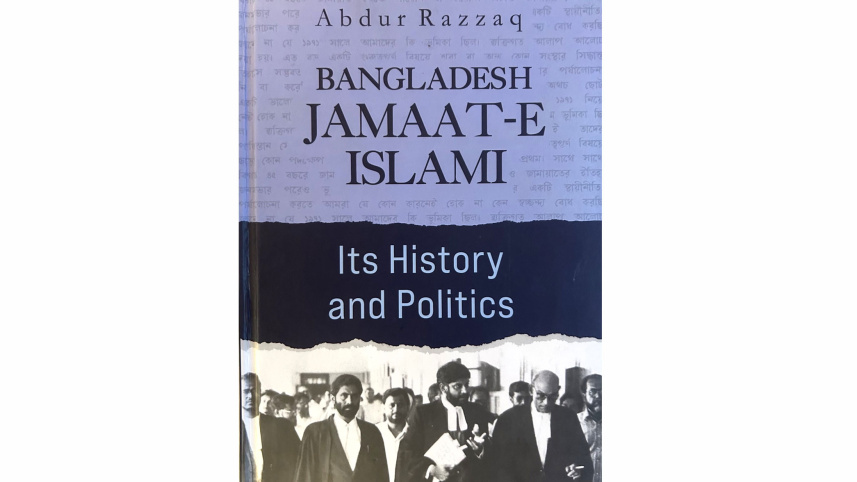
Barrister Abdur Razzaq, in his posthumous memoir on 33 years in the Jamaat-e-Islami, titled “Bangladesh Jamaat-e-Islami: Its History and Politics,”does not pull his punches. The late veteran lawyer and former assistant secretary-general of the party states that its leadership made “several policy mistakes and blunders” and that it was now “facing an existential crisis.”
Razzaq likely wrote this verdict before the largely unforeseen uprising of July 2024, which brought down the Awami League government and triggered Jamaat-e-Islami’s resurgence. Razzaq sadly died of cancer in May 2025, before the 2026 national elections in which Jamaat won about 31.76 percent of the vote and 68 seats in parliament—by far its best-ever result. Certainly, there was no crisis for the party by then.

But what of the “blunders” Razzaq identifies?
These centre on the party’s failure to back Sheikh Mujibur Rahman’s six-point autonomy plan in 1966, its decision to support the Pakistani military during the 1971 war, and then, after the country’s independence, its failure to apologise for its role in the war. The question is whether these “mistakes,” despite the party’s recent success, will remain its Achilles’ heel in the years ahead, or whether Bangladesh’s new political realities following August 2024 have effectively immunised Jamaat-e-Islami against them.
On the first blunder, Razzaq says the Jamaat leadership failed miserably to read the people’s pulse in East Pakistan at the time. “No sooner has Jamaat taken a firm position against the Six Points than it was identified as a force against the interests of Bengalis and in favour of the Pakistani ruling class.”
When the Awami League won the 1970 elections and West Pakistani leader Zulfikar Ali Bhutto announced a boycott of the new parliament, Razzaq notes that Jamaat was initially “on the people’s side,” with Ghulam Azam, then the party leader, publishing an article calling on the “authorities to transfer power to the elected representatives pending the framing of the constitution.” However, after the launch of the army crackdown on March 25, 1971, “Jamaat made a U-turn and supported the military action.”
Razzaq argues that this contradicted an earlier decision by the East Pakistan Majlis-e-Shura of Jamaat, the party’s highest decision-making body, which had resolved that in the event of a unilateral declaration of independence by Awami League, or a crackdown by the army, “Jamaat would not support either party.” Razzaq is unsparing in his criticism of Jamaat’s support for the Pakistani military during the 1971 war, which he acknowledges “committed atrocities against the Bengali population.” Jamaat’s failure to “dissociate itself from the Pakistan Army … was immoral and un-Islamic,” he says, adding that “it is impossible to justify the rape committed by members of the Pakistan Army. On that point and that point alone, Jamaat should have withdrawn its support to the army.”
Jamaat’s third mistake was its post-independence failure to confront its 1971 role and apologise, and the book’s account of Razzaq’s significant efforts to persuade the leadership to do so is a thread that runs throughout the memoir. “It is inexplicable why Jamaat did not address this issue,” Razzaq writes. “It is equally perplexing that there was no detailed and reasoned statement by Jamaat explaining its role in 1971 when volumes had been written against it on this issue.”
The first attempt came in June 1994, soon after the Appellate Division of the Supreme Court confirmed Ghulam Azam’s citizenship. A committee helped Azam prepare a speech, but in the end, the party leader only said, “In the past, if I have committed any mistakes, please forgive me.” Of this, Razzaq writes: “Professor Azam’s statement did not, by any stretch of the imagination, constitute an apology. In fact, it was a sloppy attempt to deal with a serious issue.”
Another opportunity came after the BNP-Jamaat alliance’s success in the 2001 elections, when Razzaq lobbied for Jamaat to address 1971. A draft statement was prepared that “explained Jamaat support for the cause of a united Pakistan and offered an apology to the nation for its political role in 1971.” Although three leaders—Ali Ahsan Mohammad Mojaheed, Muhammad Kamaruzzaman, and Abdul Quader Mollah, all later executed after conviction at the International Crimes Tribunal (ICT)—supported it, Maulana Motiur Rahman Nizami, by then Jamaat’s leader, had changed his mind, and the apology never happened.
Four years later, in October 2005, the question came up again before Jamaat’s Working Committee and was voted down. “The reasoning of those who opposed the proposal was diverse,” Razzaq writes, citing three arguments made against it: that there was nothing wrong with Jamaat supporting the unity of Pakistan, the second-largest Muslim country; that there was a justified apprehension of Indian hegemony; and that Awami League and its allies were never going to accept an apology.
Razzaq can be applauded for his efforts, which ultimately continued until 2019, to secure an apology from his own party for its role in 1971; but even had he succeeded, any apology would have been a limited atonement, not covering the crimes that Jamaat, including its student wing, was accused of committing.
Indeed, at no point in the book does Razzaq acknowledge that Jamaat was involved in any criminal activity in 1971. This no doubt reflects his own role, also discussed in the memoir, as a defence lawyer at the ICT—established after the Awami League came to power in 2009—where he defended several Jamaat leaders accused of genocide and crimes against humanity. Interestingly, Razzaq argues that had he succeeded in getting Jamaat to face up to its 1971 past, Awami League might not have embarked on the ICT prosecutions, sparing Jamaat’s 2010 leadership from execution.
In 2019, Razzaq resigned from Jamaat, with its failure to address 1971 a key factor—although its failure to reform in other ways, including greater involvement of women, was also relevant. By then, Razzaq had built a new life in London, having left Bangladesh years earlier to avoid arrest and prosecution by the ICT himself. After his resignation from the party, he helped set up the Amar Bangladesh Party (AB Party), which he hoped would eschew the traditional approach of establishing an “Islamic state” and instead focus on creating a “democratic welfare state grounded in Islamic values and principles.” However, in August 2024, following the fall of the Awami League government, he resigned from his position as chief adviser due to its failure to incorporate Islamic values and principles into the party’s programming.
This short book offers far more than an account of Jamaat’s 1971 mistakes. It is a rare and candid window into how Bangladesh’s most secretive party functions and into the arguments that have shaped its leadership since independence. With Jamaat now the official parliamentary opposition, more powerful than at any point in its history, it remains uncertain whether subsequent political events have allowed the party to unshackle itself from the burden of its past without actually having to acknowledge its historic wrongdoing.
***
“Bangladesh Jamaat-e-Islami: Its History and Politics” by Abdur Razzaq, published by the UPL, is being launched at an event at Lakeshore Grand, Dhaka, on September 18, 2026.
David Bergman is a journalist who has written about Bangladesh for many years. His X handle is @TheDavidBergman.
Views expressed in this article are the author's own.
Follow The Daily Star Opinion on Facebook for the latest opinions, commentaries, and analyses by experts and professionals. To contribute your article or letter to The Daily Star Opinion, see our guidelines for submission.
 For all latest news, follow The Daily Star's Google News channel.
Comments