


When coercion becomes a governance mechanism

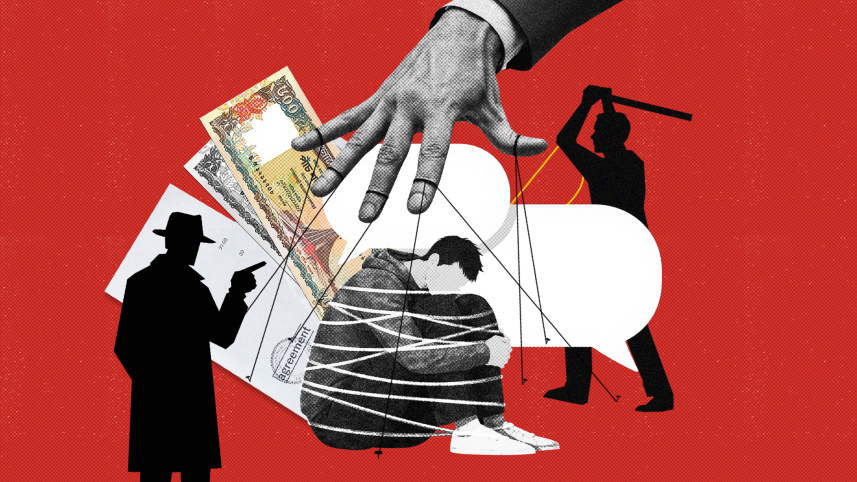
There are moments when a country’s anxieties arrive in the form of an ordinary-looking story: a raid, an arrest, a factory dispute in a crowded industrial belt. It is tempting to read them as separate incidents in the daily churn. And yet, some stories keep returning in different contexts.
Last week, two reports related to extortion sat near each other in the public conversation. One was almost cinematic: an overnight drive in Dhaka’s Mohammadpur and Adabor area leading to detention of a hundred. The four-hour sweep was framed as a push against extortionists, teen gangs, and criminal groups. The other report was messier: an export-oriented factory in Rupganj was allegedly attacked after the owner refused to pay an upfront “one-time” demand and a monthly payment thereafter, which was met with a sluggish and contentious police reaction, alongside reports that the victim faced significant hurdles in filing a case that accurately reflected their version of events.

The Rupganj incident carries competing theories: the owner calls it retaliation; the local BNP leader calls it a dispute that escalated. The deeper question is what becomes possible when coercion—whether justified, disguised, denied, or plainly transactional—begins to behave like a parallel authority.
The most useful way to read extortion is not as a moral failure. Morality doesn’t help a business owner at 11pm when people are breaking a gate. The more revealing way to read it is as a power dynamic: who, in practice, can impose costs and expect compliance.
In the Mohammadpur-Adabor crackdown story, the state appears decisive. It arrives at night, coordinates a drive, communicates purpose, and shows numbers. It is an authority with visibility. In the Rupganj factory account, authority looks different. This is authority as delay, friction, and ambiguity. Capacity seems to exist. So why does it feel, to citizens and businesses, as if it does not reliably belong to them when they need it? That is the contrast worth sitting with. The state can act, sometimes impressively. Yet, other actors appear able to impose obligations—money, deference, silence—outside legal mandate. In that condition, the citizen’s relationship to governance changes subtly.
People begin to calculate to adapt. A factory owner or trader does not need to admire a coercive actor to believe that refusal carries consequences and protection may arrive too late. Once that belief settles, extortion becomes more than theft. It becomes a pricing mechanism in the economy. Hidden payments operate like an informal tax. Formal taxes have schedules and receipts. Informal extraction has variables: who asks, how much, how often, and what refusal results in.
Markets can navigate inflation and even regulatory change. They are less comfortable with things that have no official name. That is why “law and order” language often fails to capture what businesses actually fear. It is not just violence. It is the possibility that the cost of business is being set by actors whose authority is not legible, and therefore not governable.
Rupganj sits inside the industrial horizon of Narayanganj. When a story emerges from there, it travels quickly through business networks. In Prothom Alo’s reporting, local businesspeople speak with an unsettling normalcy about paying “some” extortion as routine, while also expressing fear at the scale and brazenness of the factory attack. Routine is one thing; demonstrative violence is another. It teaches others what refusal costs.
Then there is the way language is beginning to strain under this topic. In recent days, a newly appointed minister offered a public definition that tried to separate coercion in the transport sector from what he described as an “unwritten rule.” He argued that money collected on roads should not automatically be called extortion if taken at fixed rates and described as welfare contributions under “mutual understanding.” He also acknowledged that the labour organisation aligned with the ruling party typically dominates these arrangements, while insisting this dominance does not automatically make the collection extortionate as it operates within a framework of agreement.
If dominance is present, the border between “agreement” and “compliance” becomes difficult to distinguish. You can call a payment “voluntary,” but the person paying is rarely paying in a balanced atmosphere of choice. They are doing so inside a confined zone of consequences. The question is: what happens to the public’s expectation of the law when a minister starts blurring the line between crime and custom?
Civil society reacted with unusual speed and sharpness. Transparency International Bangladesh warned that this kind of wording risks legitimising a criminal offence, and that it collides with anti-corruption commitments made by the regime. Their concern was institutional. If extortion is reframed as a compromise, the logic travels to other sectors where informal payments already shadow formal rules.
Early statements become signals, and signals settle into expectations. When allegations of coercive extraction intersect with ruling authority early in a governing cycle, reputational cost spreads outwards, from individuals to the perceived shape of power.
A state needs to remain the only authority that can impose obligations with credible enforcement. Once that exclusivity becomes porous—once citizens and businesses start treating coercive non-state demands as binding, while viewing state protection as optional—the meaning of governance shifts. This is where the two stories, placed side by side, begin to feel less like a contradiction and more like an early warning about how authority is being experienced.
A government can live with disorder. What governments struggle to survive is the normalisation of parallel power: the silent public adjustment to the idea that compliance serves more than one authority.
Extortion is not just a crime story. It is a governance signal. It shows who can add to the cost of operating here. And the danger here lies in its normalisation. Once citizens live as if authority is shared, the state may still conduct raids and count detainees. It will no longer be in charge.
Tasneem Tayeb is a columnist for The Daily Star. Her X handle is @tasneem_tayeb.
Views expressed in this article are the author's own.
Follow The Daily Star Opinion on Facebook for the latest opinions, commentaries, and analyses by experts and professionals. To contribute your article or letter to The Daily Star Opinion, see our guidelines for submission.
 For all latest news, follow The Daily Star's Google News channel.
Comments