


Changing media behaviour and role of media: Impacts and Challenges
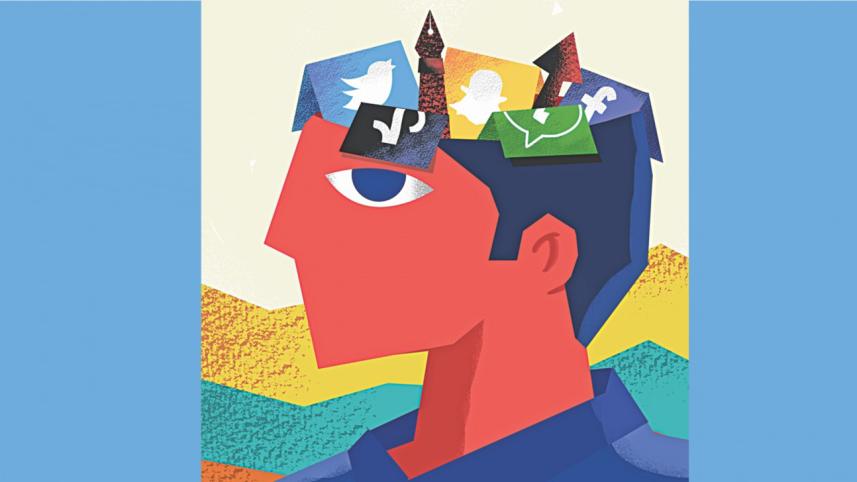
British musical band Duran Duran released a track "Too much information" in 1993. The song was meant to protest the aggression of US music industry and musical channels in the UK. Nowadays, apparently fact is becoming a state of desire globally. And the Covid-19 pandemic has propelled qualitative change of information circulated across the globe.
At the rate the audience is now being exposed to the tsunami of information, it reminded me of the title of the song. Millions of news portals, social media platforms, groups, pages, TV channels, newspapers and online versions of those, YouTube channels, blogs and what not!

The journey of social media started with a user base of MySpace in only 2004 and presently about half of the world population are connected to social media platforms, be it through Facebook, Twitter, Instagram and so on. Probably, no one could see it coming at this magnitude.
All types of media, including mainstream, digital and social have gradually been plunged into a crisis in phases.
Primarily, it was the emergence of online news portals that pushed the mainstream media into a back foot to some extent, because of its incredible capacity to share updated information instantly. However, mainstream media gradually responded with having their online presence.
The second phase of this crisis started with the emergence of social media which is more engaging. And finally an irrational competition among different media platforms as well as the players of particular platforms competing among themselves for TRP or number of views. The perceived difference between mainstream media and social media has been the focal point of this crisis. In a large number of cases, even mainstream media authorities have drastically failed to identify the demarcation line. Of course, there is a gray area and this is largely responsible for this intrusion into each other's territory.
Now the most important question is how the audience is perceiving the dynamics of these different media platforms that are generating enigmatic flow of information and giving audience the stress of finding out the credibility of a particular information that is reaching them with different versions. This scenario has put the overall credibility of the information industry into a kind of crisis. However, the scale of this crisis obviously varies from region to region.
CHANGED MEDIA LANDSCAPE DURING PANDEMIC
The crisis across the media landscape has been accelerated during the Covid-19 pandemic. If not in general, credibility, as well as objectivity aspect, of media had always been there while now most of the media across the globe have been overwhelmed by a wave of impulsive practices. Saying that, it would be unfair not to say that responsible and dependable media are still there. However, they are not leading the trend and those are finding it difficult to feed audience who have got habituated to sensationalised delivery of information.
This unhealthy competition to grab more TRP or views is making the media more vulnerable to non-verified, biased, distorted information and intended propaganda by vested groups. I believe there is hardly any country in the world where someone didn't claim to have invented medicine to cure Covid-19 patients. In the Indian sub-continent, a large section of local media carried this type of news.
Inconsistent, contradictory and not properly verified information regarding the spread, management, resistance and remedy of Covid-19 infection gradually led already panicked people towards a feeling of helplessness and hypertension with a fragile mind set -- weak enough not to handle things logically. Available data shows that the viewing of specialised news channels in Bangladesh almost doubled from mid of March and onward.
A few over enthusiastic YouTubers, which include a number of medical professionals as well, started promoting their opinions while others promoted rumours collected from secondary or tertiary level sources. Most belonging to the latter category had no background of healthcare in any form. An impulsive, confused, attention seeking audience shared anything and everything in the social media.
INEFFICIENT ROLE OF ESTABLISHMENTS WITH DIMINISHING CREDIBILITY
Historically propaganda had been used by empires, states, war lords or colonial rulers to generate favourable perception among the citizens. The modern form of propaganda was practically introduced during the First World War. Gradually, powerful states or alliances started considering propaganda as a key PR tool.
During the long span of Cold War, propaganda's usage reached its peak with the US and its alliances being clearly ahead of the rest. The West mastered the art of propaganda so well that people started believing 'the heroic role of US soldiers' in the Vietnam War as portrayed by the administration of five US presidents, despite the fact that they experienced a miserable defeat against the Viet Cong guerrillas.
However, there had been a consistency of lies which used to be supported by apparently credible but actually manipulated evidence. It was also possible because people did not have much choice in terms of accessing media and exposure to information.
And now, we can see what has been happening at 1600 Pennsylvania Avenue. The White House Boss Mr Donald Trump is changing his stance every other day on particular issues, refusing to admit his previous claims, suggesting the medical community to inject disinfectant into the human body and what not.
Unlike his predecessors, President Trump's aggression against the media from the beginning of his tenure probably prompted him to carry on in the same fashion. Naturally, all the key spokespersons of concerned departments and institutes had to be aligned with the president's stance no matter what. A completely puzzled US media had been left with no other option than independent or retired experts, different conspiracy theories and unsolicited data or claims.
The World Health Organization (WHO) is apparently the ultimate authority to provide the right direction to countries across the globe to mitigate the sufferings due to this pandemic. Despite a good start, WHO had been found to be in a hurry to disseminate new findings. In a good number of cases, WHO had to take a 360-degree turn. To make things worse, here again, a puzzled media had to disseminate contradictory information within a span of only a couple of days.
The origin of this Covid-19 breakout, China, was probably the only country that has used its propaganda machinery very efficiently to portray its capacity to deal with this outbreak of the new virus. Audience came to know only the Chinese version regarding the origin of Covid-19 virus as well the actual number of death toll in Hunan province. Global media could do nothing other than coming up with assumptions and conspiracy theories.
GOING BEYOND THE PANDEMIC
The 'adrenaline rush' rush of the major part of the global media as well as that of the audience is no more confined to only the pandemic. No doubt '2020' is one of the most happening years of this millennium. From the beginning of the year, a series of other events added spices to the aggression: the killing of Iranian Major General Qasem Soleimani by a drone attack and subsequent missile attack by Iran on US base in Iraq, killing of African American George Floyd, the oil price war between Russia and Saudi Arabia, tension between China and India in Ladakh, Hindu-Muslim riots in Delhi, the economic and political war between US and China, new dimensions of relationship between Israel and a part of Arab countries, the devastating explosion in Beirut, tension in East Mediterranean, Azerbaijan-Armenia conflict, US Election and so on. Besides, there have always been issues at the local level of different countries.
However, the tonality of the majority of media started getting quite similar, be it Covid or non-Covid issues. These all are interconnected. Standard media practices are now being overlooked frequently with a bid to stand out among the continuous inflow of information from numerous sources. It seems like objectivity has become very subjective in the global media landscape.
 For all latest news, follow The Daily Star's Google News channel.
 At this point, I must refer to an example of the media landscape of India. Although it started long before the pandemic, top Indian news TV channels have been engaged in a war of TRP. They started transforming topics with least news value into lead news by adding spice, arranging footage and sometimes even manipulating actual footage.
The worst part is Indian TV channels tend to share their own stance or perception instead of information. Sadly, it is adding fuel to the fire on very sensitive issues and these can lead society towards dire consequences.
TRANSITION AND TRANSFORMATION OF MEDIA PRACTICES ARE INEVITABLE
For decades, we got used to starting the day with a newspaper at the breakfast table with a freshly brewed cup of coffee. Watching the news on a TV channel at a particular time was gradually added to our daily routine. Satellite channels gave audience options and online platforms widened the access. It will not be fair to expect the information industry functioning in the same fashion for infinity.
The perspective has changed a lot. In the post-Cold War era, the war is more about economics. Geo-political scenario has changed significantly. Asia started becoming the powerhouse of global economics. The crisis in the Middle East became more complicated with millions of people migrating. Europe is struggling with lack of mutual respect and heterogeneous economies under the union. Information technology industry is getting upgraded on a regular basis.
At the same time things have changed in the global media landscape in terms of functionality, feasible working process and impact, new dimensions and elements of news, news presentation and editorial policies. Besides, increased number of stakeholders, ownership of a portion of media by large conglomerates, the degree of press freedom as well as access to information is largely varying from country to country.
At this moment, I assume, global media has been into a paradoxical situation. It shall not prevail for long. Things needed to be grounded. The sooner, the better.
The author is Senior Manager, Marketing Communication and Head of Department at SINGER Bangladesh Ltd.
Comments