


Missed targets: NBR needs Tk 2.6 lakh crore by June to avoid shortfall

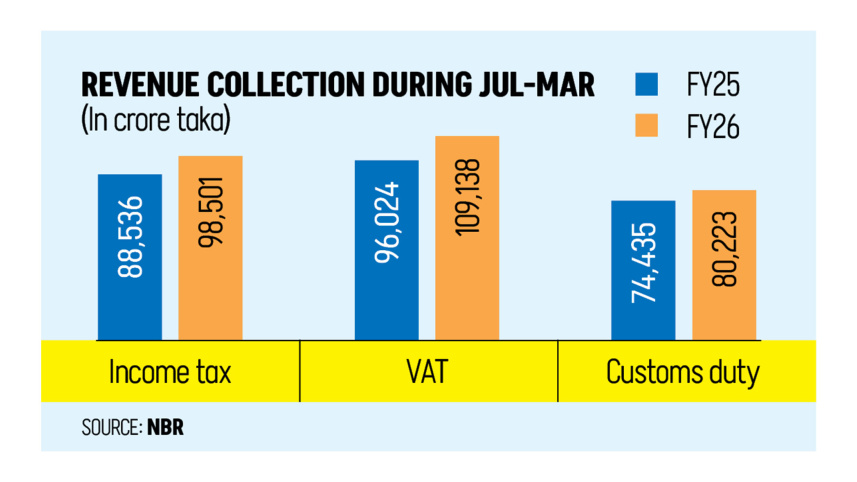
The National Board of Revenue (NBR) fell short of its nine-month tax collection target by nearly Tk 1 lakh crore, leaving it needing to mobilise over Tk 2.60 lakh crore in the final quarter of fiscal year 2025-26 (FY26).
Provisional data released yesterday showed collections of Tk 2.87 lakh crore during July-March, an 11 percent rise year-on-year, but well below the pace required to meet the full-year target of Tk 5.54 lakh crore.

Analysts say it is highly unrealistic to expect that the board will succeed in collecting nearly half of the full-year target in three months.
The board has consistently missed its annual target every year for over a decade. Yet in late November last year, the interim government revised the target upward from Tk 4.99 lakh crore, following strong first-quarter collections.
The revenue weakness is playing out against a deteriorating economic backdrop.
The country’s GDP growth slowed to 3.03 percent in the second quarter of FY26, down from 3.53 percent in the same period last year. Defaulted loans in the banking sector have reached Tk 5.45 lakh crore as of December 2025.
Finance Minister Amir Khosru Mahmud Chowdhury told parliament this month that the tax-to-GDP ratio has fallen from around 11 percent to below 7 percent, and that businesses are “in bad shape.”
More recently, the impact of the US-Israel war on Iran has been draining the state funds as the government was forced to buy fuel oils at high prices. Bangladesh imports about 95 percent of its energy, and state agencies have increasingly been forced onto the volatile spot market.
“The mounting costs are bleeding the exchequer,” the minister said on the sidelines of the IMF-World Bank Spring Meetings in Washington last week, citing nearly $2 billion in additional energy import costs following supply disruptions.
“On top of that, the tax-to-GDP (ratio) is not increasing because of business stress, the businesses are in bad shape,” he said, adding that if businesses do not recover, tax receipts will not improve.
He said the government has sought budget support from development partners and is pursuing structural fixes. It has prepared an action plan targeting a trillion-dollar economy by 2034, built around investment, employment and macroeconomic stability.
Amid consistent revenue shortfall, the government has turned sharply to borrowing. Net deficit financing reached Tk 1.05 lakh crore during July-February, up 67 percent from Tk 63,040 crore in the same period last year. Of that, Tk 88,309 crore came from the banking system.
Zaidi Sattar, chairman of the Policy Research Institute (PRI) and head of the National Taskforce on Tax Restructuring, said fiscal space has effectively closed.
“The gap between current expenditure and revenue means there is little to no surplus available to support development spending,” he said, adding that the Annual Development Programme (ADP) will likely depend almost entirely on deficit financing in the upcoming budget.
He warned that domestic borrowing carries serious risks. “It creates serious challenges, including fuelling inflation and potentially crowding out private sector investment,” he said.
Without fundamental reform in revenue administration, any substantial increase in collections is “almost impossible”.
Abdur Razzaque, chairman of Research and Policy Integration for Development (RAPID), said weak imports will further dampen revenue in the final quarter.
“If the government depends heavily on banks, it will affect credit flow to the private sector,” he said, warning that without revenue growth, more extreme measures such as money printing could not be ruled out.
Describing the broader pattern, Razzaque said, “The revenue target is not binding, it’s aspirational. We set targets and repeatedly fail to meet them. We are stuck in a Catch-22.”
“Big budget, big revenue deficit, and the NBR failing to raise revenue -- this is the typical Bangladesh story,” he added, noting that despite talk of reforms, “we are not seeing the momentum or a firm commitment.”
 For all latest news, follow The Daily Star's Google News channel.
 He mentioned the IMF’s recent decision to withhold a loan instalment, citing that the country has failed to implement agreed reforms in the revenue and banking sectors.
This decision by the multilateral lender adds to the country’s pressure. “It sends a signal about reform commitment, and other development partners take such signals seriously,” Razzaque said.
Within the July-March figures, VAT from domestic activity was the largest contributor at 38 percent of total collection, rising 13.66 percent year-on-year to Tk 1.09 lakh crore. Direct taxes accounted for 33.5 percent, climbing 11.25 percent to Tk 98,501 crore, while import tariffs grew more modestly at 7.77 percent to Tk 80,223 crore.
Facing mounting pressure, the NBR is eyeing structural changes for next year. Speaking at a pre-budget discussion earlier this month, NBR Chairman Md Abdur Rahman Khan pledged to strengthen enforcement to curb tax evasion and gradually reduce existing tax exemptions aiming to raise revenue collections.
He informed that the board is considering a range of measures to strengthen revenue collection in the upcoming fiscal year 2026-27 (FY27), including the reintroduction of a wealth tax, a new inheritance tax, higher rates for the ultra-rich, and a rationalisation of existing tax exemptions.
“We are exploring the possibility of reintroducing a wealth tax,” Khan said at the event, noting that Bangladesh had such a levy from 1963 until it was abolished in 1999.
A committee has been formed to examine the matter.
Khan added that the NBR is weighing the introduction of an inheritance tax, at least on a limited scale, with a focus on high-value property transfers.
On tax exemptions, Khan signalled a gradual shift away from the status quo. “We are committed to gradually phasing them out and bringing beneficiaries into the regular tax regime.”
The NBR also plans to raise the top marginal income tax rate for ultra-rich individuals from 30 to 35 percent, a measure tentatively set for FY28.
More immediately, he said the NBR is considering raising the tax rate for individuals earning over Tk 1 crore annually by around five percentage points from FY27.
Comments