


Yet another tragic fire at a factory
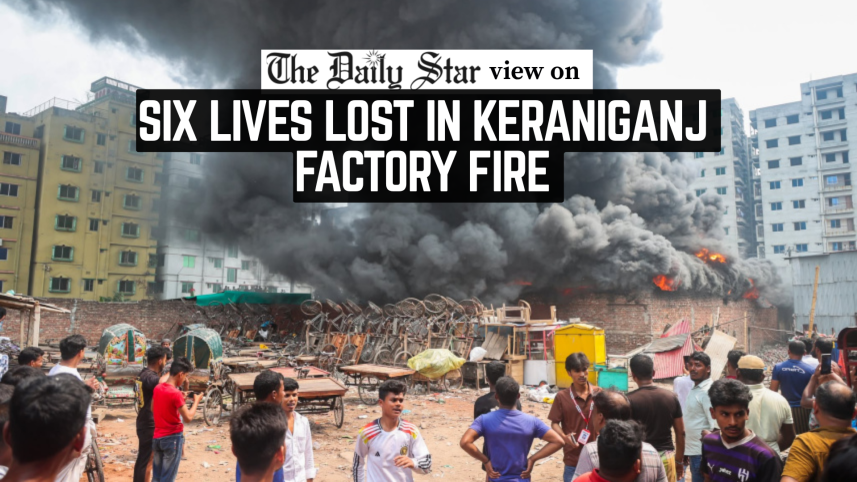
It is outrageous that fires at illegally-run factories keep claiming lives in our country, while authorities continue to produce patchwork solutions to address these recurring man-made disasters. On Sunday, a fire at a gas lighter manufacturing plant in Keraniganj took the lives of at least six people, including a young girl, and injured at least 15. It is feared that the death toll may rise, as several workers are still missing.
According to locals, there were at least 40 workers on the factory premises—mostly women and children—and many could not escape through the main gate, as it was locked during the fire. Although it was opened later, many workers had to find alternative ways to escape. This reminds us of the incident at the Rupnagar garment factory, where a chemical fire at an adjacent building took the lives of 16 workers, including minors, last year. They too could not escape the smoke and toxic fumes because the door to the roof was padlocked. Another disturbing similarity the Keraniganj fire shares with the Rupnagar fire is the lack of fire safety measures. Worse still, the factory was closed following a fire in 2024; yet it kept on operating without legal papers.

Sadly, similar disregard for the law appears to persist among many enterprises and business owners in this country. Otherwise, how can hazardous factories continue to operate in residential areas, as in the case of Rupnagar, or a minor as young as 12 work in a gas lighter manufacturing plant, as in Keraniganj? In fact, the way almost every unlicensed hazardous factory operates in Bangladesh is itself an accident waiting to happen. Thus, it is not a surprise that many of them lack fire safety measures or even a proper evacuation plan in case of fire.
While we appreciate that ministers visited the scene and announced financial help and medical treatment for the victims, this is not where their responsibility ends. The factory owner must be brought to justice, and the departments that failed to ensure that the shuttered factory remained closed must also be held accountable. Two probe committees were formed to investigate the incident, but such actions in the past have done little to prevent similar accidents from recurring. Therefore, we urge the government to take stern action based on the findings of the probe reports. The government must ensure that the Department of Inspection for Factories and Establishments has the manpower and resources to conduct routine drives against hazardous factories that operate without legal documentation or employ minors. Meanwhile, relevant authorities must ensure that all businesses and private enterprises have fire and building safety protocols and systems in place. Labour may be cheap in Bangladesh, but it must never be mistaken for cheap lives.
 For all latest news, follow The Daily Star's Google News channel.
Comments