


Time to address the unequal burden of environmental change

Every year, Bangladesh observes World Environment Day with the same familiar rituals: tree plantation drives, school rallies, and repeated promises to address pollution and climate change. However, between one Environment Day and the next, rivers still turn black with untreated waste, wetlands shrink under encroachment, urban air remains toxic, and flooding and waterlogging continue to disrupt day-to-day life. These recurring cycles raise a deeper question: are we really addressing the environmental crisis?
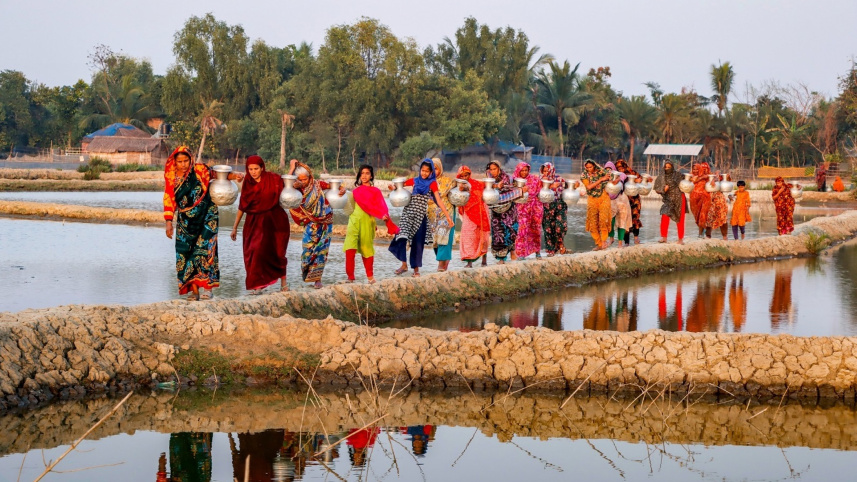
These challenges stem from an oft-ignored reality: environmental change, shaped by social roles, access to resources, and power, is not experienced equally. In Bangladesh, especially in rural areas, women are frequently at the frontline of environmental stress, but they remain largely invisible in environmental governance. When freshwater sources become contaminated or distant, it is often women and girls who spend additional hours collecting water. When floods damage sanitation systems, women are forced to manage hygiene and care work under difficult and often unsafe conditions. When fuel becomes scarce or expensive, women have to adjust cooking practices and absorb the additional workload. In urban areas, informal settlements are where environmental degradation is usually most severe.
 For all latest news, follow The Daily Star's Google News channel.
 There, poor waste management, unsafe water, and air pollution translate directly into increased unpaid care work—caring for sick children, managing household cleanliness, and coping with disrupted routines. Although these burdens are daily and cumulative, they rarely appear in environmental planning or budgeting.
This unequal experience reflects a deeper institutional problem. Environmental governance in Bangladesh is still largely blind to social differences in impact. Policies focus on technical solutions without asking who is most affected. As a result, environmental problems are usually treated as purely physical or technical issues, not as social and justice concerns as well.
Environmental justice shifts this perspective. It requires us to look beyond aggregate indicators and ask more difficult questions, such as whose time is being consumed by environmental failure, whose health is most affected, and whose voices are least heard in decisions about environmental resources and services.
An overlooked consequence of environmental degradation is its impact on unpaid care work. When environmental systems fail, households must compensate through additional labour. This invisible economy of care is largely carried by women. But it remains absent from environmental cost calculations and policy priorities. Because this work is not measured, it is not adequately addressed, hence it is not resourced.
In Bangladesh, women’s participation in consultations and community forums rarely translates into influence over decisions on budgets, infrastructure, enforcement, or resource allocation. This gap between participation and power highlights the need to move beyond consultation and ensure meaningful involvement in environmental decision-making.
Local governments offer an important but underutilised opportunity for advancing environmental justice. Since environmental problems are experienced locally, union parishads and upazila administrations are often the first to respond. Their capacity, however, remains limited as training, workshops, and policy discussions are mostly concentrated at the district level. Without adequate resources, technical capacity, and inclusive planning approaches, local institutions will continue to lack the capacity to overcome the existing inequalities. A just environmental governance system must ensure that local governments are properly equipped, mandated, and held accountable to deliver inclusive outcomes regarding proper environmental management.
Environmental justice requires a shift in how we understand environmental problems in Bangladesh. They are not only about pollution levels, forest cover, or climate targets, but also about unequal burdens, invisible labour, and unequal power. The central question is, therefore, not just how to protect the environment but also how to ensure that the costs and benefits of environmental change are shared fairly. Without environmental justice, environmental governance remains incomplete. A more sustainable future depends on fairer systems where those carrying the greatest environmental burdens are visible, valued, and empowered.
There should be no debate about the importance of environmental justice, even when immediate attention focuses on technical solutions. Environmental solutions that ignore inequality may deliver visible short-term results, but they rarely last. Without addressing who bears the burden of environmental failure and who is excluded from decision-making, sustainability remains incomplete.
Nazmun Naher is a water resources expert with extensive experience in regional and international integrated water resources management. She can be reached at nnazmun.mita@gmail.com.
Views expressed in this article are the author's own.
Follow The Daily Star Opinion on Facebook for the latest opinions, commentaries, and analyses by experts and professionals. To contribute your article or letter to The Daily Star Opinion, see our guidelines for submission.
Comments