


Independence and its discontents: For whom was 1971?

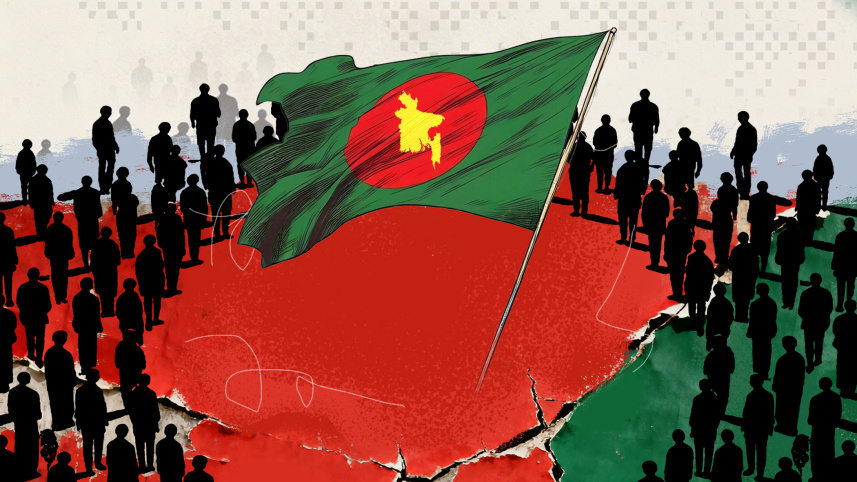
History, too, bristles up, staging and restaging questions and concerns that remain unresolved. They persist, stubbornly, as we continue to inhabit a conjuncture marked by chasms and contradictions: between rhetoric and reality, between what has been and what is yet to be. And so, as we step into the 56th year of our independence, these contradictions compel a crucial, even urgent, question: whose independence is it, anyway?
Globally, at a moment when Donald Trump has come to embody the gangster logic of US imperialism at its fascistic height, and when Israel, as a Zionist settler-colonial power, works in close cahoots with that imperialism, while continuing their genocidal assault on Palestinians and expanding their war against Iran, the question returns with renewed urgency: whose independence is it, really?
 For all latest news, follow The Daily Star's Google News channel.
 And it is hardly surprising—yet no less outrageously anti-independence—that the newly elected BNP government, in its foreign ministry’s recent statement on the imperialist war against Iran, failed to call a spade a spade—failed even to name, let alone condemn, the US and Israel. This silence is not incidental; it is symptomatic. For the stubborn historical fact remains that no government since 1972 has been genuinely or adequately critical of US imperialism—an imperialism that even opposed Bangladesh’s Liberation War both diplomatically and militarily. But Bangladesh, as an independent state, was not born at a negotiating table. Its being-and-becoming was forged in struggle: in 1971, through a people’s war that made independence not a concession but a gargantuan achievement. Its birth was not only an unprecedented event with its own rhythm, character, and content; it was also a rupture—a radical, insurrectionary interruption in the political history of South Asia.
Yet this rupture was no isolated singularity. It was tied to a genealogical horizon stretching far back, encompassing multiple forms of resistance by women, workers, peasants, and minorities, not only since 1947 but well beyond. Unlike other “postcolonial” states in South Asia, whose sovereignty was brokered across negotiating tables in the long shadow of World War II, Bangladesh emerged through an armed, collective uprising and war against the neo-colonial, militaristic, bureaucratic, oligarchic state of Pakistan—an uprising marked by genocide and the systematic, large-scale rape of women. Indeed, the blood-drenched emergence of Bangladesh remains the only instance in South Asia in which independence was wrested from within, not granted from above.
But the significance of 1971 does not reside there alone. The birth of Bangladesh dealt a decisive blow to the ideological foundations that underwrote the partition of India. It flagrantly dismantled the so-called “two-nation theory”—first incubated within Hindu majoritarian thought and later institutionalised by Muslim nationalism—by demonstrating, in the most historical-material terms, that religion alone cannot sustain a “nation.” At the same time, it unsettled the competing myth of a singular, seamless Indian nationalism, exposing the inherent fissures and fragility—indeed, the fiction—of homogenising narratives imposed upon a profoundly heterogeneous subcontinent.
The emergence of a Muslim-majority Bangladesh grounded in ethno-linguistic Bangalee nationalism delivers a clear historical verdict: language, culture, and lived social realities matter more than theological or statist abstractions. No state, however ideologically armed, can indefinitely bind diverse peoples under the sign of religion alone. In this sense, Bangladesh’s birth itself is a proposition, a living argument against all projects of forced unity, whether religious or secular-nationalist.
***
There is no doubt: without the Liberation War of 1971, there would be no Bangladesh. It remains our brightest historical achievement—the defining moment of our political history. And yet, the moment we say this, the question presses forward, insistent, unsettling, necessary as it is: whose independence have we achieved?
For what is increasingly evident is this: independence has been monumentalised, but not fully materialised.
The national ruling class—including the fascist Awami League and the BNP (whose own fascist tendencies during previous rules are well-documented, as Badruddin Umar has already demonstrated in his superbly researched work), along with other ruling-class formations, not to mention Jamaat-e-Islami, which opposed independence in 1971 and was complicit in genocide (to say the least)—has, in various ways, violated the promises of equality, social justice, and human dignity, the three core principles enshrined in the Proclamation of Independence on April 10, 1971. For women, poor peasants, workers, Indigenous communities, and minorities—ethnic, linguistic, religious, and gender/sexual—who fought, bled, and died, where is that promised equality? Where is justice? Where is human dignity?
To ask these questions is also to ask: who were the freedom fighters? Not merely a handful of leaders elevated to near-myth, but overwhelmingly peasants, labourers, and the lower middle classes; women who resisted, organised, nursed, and fought; even children who bore the brunt of a guerrilla war; and countless others across communities, whose names mainstream historiography refuses to remember.
Women, including those from Indigenous and other minority communities, played pivotal roles; yet their contributions remain elided in mainstream narratives dominated by ruling-class historiography. While middle-class Bangalee leaders occupy centre stage, how many of us know names like Kaket Heninchita, a courageous Khasia woman, or Princha Khen, a young Rakhine girl? What kind of independence did they achieve? What did the poor, who constituted the overwhelming majority of fighters, actually gain?
To celebrate Independence Day while erasing these struggles is not a celebration; it is a ritual emptied of history, a performance without memory.
And memory itself is a battlefield.
True, history was violently reduced to slogans—“Muktijuddher chetona” repeated to exhaustion, stripped of context, co-opted by authoritarian power. Partisan, class-driven repetitions masquerade as historical knowledge. We forget the longue durée of resistance: from the division of Bengal, to the Language Movement, to mass uprisings, denied electoral mandates, and the accumulation of economic, political and cultural grievances, to name but a few explosive conjunctures in our history. 1971 was not a beginning; it was an eruption, the culmination of histories still insufficiently reckoned with.
But true, Bangladesh’s history has been written in blood, even as it remains erased in official narratives. Mainstream historians often apotheosise their “heroes,” but there are other—and othered—historians: peasants, workers, women, minorities. They not only make history; they keep it alive through storytelling, through memory, through collective struggle.
To reclaim that history is an ethical and political task. It requires wresting history away from sycophancy, distortion, and spectacle, and returning it to the people. It requires refusing the comfort of victimhood even as we remember violence; resisting the conversion of nationalism into exclusion; and recognising, with clarity, that a people who fought oppression cannot afford to become oppressors.
***
Let me now turn, conjuncturally, to the relationship between 1971 and the July uprising of 2024.
There have been reactionary attempts—by apologists of Awami League and by Jamaat supporters alike—to pit 1971 against 2024. Yet the historical record resists such attempts and erasures. The July uprising repeatedly foregrounded the unfulfilled principles of 1971—equality, social justice, and human dignity—thus keeping the spirit of independence at the very centre of its discourse.
It was, in fact, the largest mass uprising in the history of Bangladesh. Marked by the sacrifice of so many individuals, it inaugurated an unprecedented moment: for the first time, a politically unaffiliated, student-led movement toppled an entrenched fascist autocracy, forcing Sheikh Hasina to flee. And its significance lies not only in its outcome but in its form: a decentralised, non-hierarchical movement that attests to the creativity and determination of both youth and the people. Its immediate success was rooted in more than 15 years of accumulated struggles—often unsuccessful, yet generative of political consciousness and collective rage. And I think it would be a grave historical injustice—an affront to our conscience and to the people themselves—if a mass uprising like that were reduced to a “conspiracy,” as some would have it, or dismissed as the handiwork of opposition-linked forces. Such erasures are not interpretations; they are distortions. The uprising belonged to no single party; it belonged to the people, the masses, thousands of whom shed their blood, many fatally.
That uprising—of which I was a direct, unrepentant participant—reclaimed the three foundational principles of 1971, long violated by successive regimes. It also dismantled the Awami League’s manipulative binary of “freedom fighter” versus “razakar,” exposing its inherent inconsistency and authoritarian deployment. It is not for nothing that the Anti-Discrimination Student Movement platform repeatedly declared, “A new Bangladesh will be built through the student-citizen uprising—one where equality, justice, and human dignity will prevail.” We must hold on to that declaration. To remember is to resist; to forget is to face defeat. Independence lives in memory.
Let us reject the false binary that pits 1971 against 2024. They are not antagonists but historical echoes, linked struggles animated by the same unfinished demands. As my favourite African revolutionary, Amílcar Cabral, reminds us, “Claim no easy victories.”
As I have argued elsewhere, every progressive mass movement is incomplete and paradoxical—never fully victorious, never entirely defeated. The struggle persists, even as there are attempts, domestic and external, to discredit both the gains of 2024 and the legacy of 1971.
What is required now is genuine connection-making, on behalf of those who continue to bear the weight of history: women, workers, poor peasants, and marginalised communities who constitute the overwhelming majority of Bangladesh. Democracy, if it is to mean anything at all, must serve that majority in real, material terms, not merely the upper and middle classes. And independence? It must mean the independence of that majority—economic, political, and cultural—not the ornamental sovereignty of a privileged few.
But let us be clear: no such independence can be realised within a political culture that remains stubbornly middle-class-centric, Dhaka-bound, dynastic, and beholden to money and the market. To speak of equality, justice, and human dignity under such conditions is to speak in promises perpetually deferred. The task, then, is not reformist tinkering but a radical reorientation—one that returns independence to the people who made it possible, and who continue, even now, to struggle to claim it.
Dr Azfar Hussain is director of the graduate programme in social innovation at Grand Valley State University in Michigan, US, where he also teaches interdisciplinary studies. He is also a summer distinguished professor of English and Humanities at the University of Liberal Arts Bangladesh (ULAB) and vice-president at the US-based Global Center for Advanced Studies (GCAS).
Views expressed in this article are the author's own.
Follow The Daily Star Opinion on Facebook for the latest opinions, commentaries, and analyses by experts and professionals. To contribute your article or letter to The Daily Star Opinion, see our guidelines for submission.
Comments