


Bangladesh should declare Ganges treaty obsolete before India's demands prevail

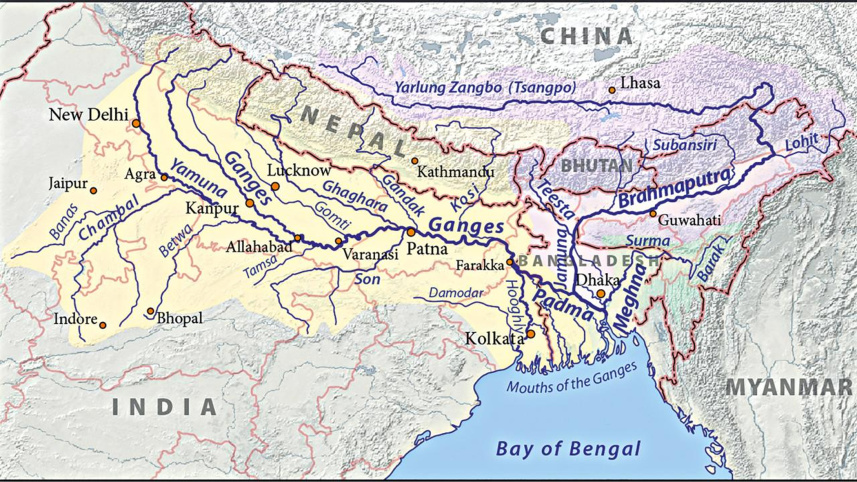
Bangladesh should declare the 1996 Ganges Water Treaty obsolete before negotiations formally begin, because the alternative is negotiating from a position of considerable weakness as India demands more water from rivers that climate change has already dried up.
India has already made its position fairly clear: shorter treaty (10-15 years instead of 30) and more water (additional 30,000-35,000 cusecs [cubic feet per second, the unit to measure water flow] during the lean season, also referred to as dry season, citing “development needs”. Additionally, West Bengal wrote a letter to the Indian internal committee tasked with consulting the stakeholders in the Ganga Water Treaty outlining its increased “industrial and drinking water needs” in the renewed post-2026 treaty. Unless Bangladesh reframes this discussion by declaring obsolescence due to climate change, it will negotiate over dividing water that no longer exists as before and under a framework designed for extinct climate conditions.

According to a 2015 report citing residents of the Matikata Union in Rajshahi’s Godagari area, before the commissioning of the Farakka Barrage, the Padma reached 100 feet deep during peaks, and 60 feet during lean periods. However, by 2015, some 18 years after the treaty, water levels came down to 15 feet during peaks and no water at all during dry seasons; the level of underground water plummeted as well. The Barind Tract region—producing major rice crop portions—is turning barren. The 1996 treaty says Bangladesh and India share water “if there is water.” Increasingly, there isn’t. From 1997 to 2016, Bangladesh received less than its treaty shares in 94 of 300 cases. During critical dry spells, Bangladesh didn’t receive the stipulated supply 39 times out of 60. Seventy-nine of Bangladesh’s rivers are now dead or dying. This is what 30 years under the 1996 treaty helped produce. And India now wants less favorable terms.
India wants shorter treaty terms (10-15 years) that will give it more frequent negotiating leverage. It cites “climate change” but only as justification for taking more water, not for climate-adapted governance. This is nothing but extractive negotiation, not cooperative adaptation. We are currently facing an “unprecedented hydro-variability, where Himalayan glaciers are projected to decline by up to 40 percent by 2100.” The Ganges basin experiences its worst droughts in 1,300 years. According to a 2023 study, climate change quadrupled flood-causing extreme monsoon rainfall events in Bangladesh and northeast India. Atmospheric rivers cause 73 percent of floods. The treaty allocates dry-season water but cannot manage droughts or flooding dominated by atmospheric floods. As Farhana Sultana said it in an article published by The Daily Star, the treaty “treats water as divisible commodity... rather than shared, interconnected ecological system. It lacks flexible mechanisms for climate adaptation, enforceable environmental flow regimes, or joint data-sharing platforms.” In climate-stressed world, this static agreement “becomes another mechanism of control.”
Climate extremes accelerate upstream erosion, filling reservoirs faster, forcing emergency releases during monsoons while sediment remains trapped. Research shows sediment could decline 15-80 percent if the extensive network of planned and under-construction dams across the Himalayan Ganges-Brahmaputra basin is completed. The 1996 treaty contains zero sediment provisions. Without sediment, Bangladesh’s delta subsides at 5-7 mm yearly. Saltwater advanced 15-20 kilometres inland, up 64 percent since 1973. Bangladesh extracts around 32 cubic kilometres of groundwater annually, the vast majority for irrigation, with aquifer levels falling 15-20 mm yearly. In contrast, groundwater usage is increasingly surging. These compound crises cannot be addressed by negotiating slightly different dry-season allocations. They require climate-adapted transformation, which the 1996 framework was never designed to accommodate and India’s position explicitly rejects.
If Bangladesh enters negotiations accepting 1996 framework validity, it accepts India’s framing: this is about dividing existing water more favorably for India’s “development.” Bangladesh then negotiates from weakness, preserving inadequate allocations under voluntary framework that already failed while India demands more extraction. Declaring obsolescence based on climate change reframes everything. The problem, as we have already indicated, has fundamentally changed over the years: anthropocentric forces including climate change created worst droughts in 1,300 years, quadrupled extreme weathers, triggered atmospheric river floods, and drove unprecedented groundwater depletion. The 1996 framework was never designed to address any of this; modifications cannot fix conceptual obsolescence.
If the crisis is systemic, the response requires rethinking how the river itself is governed. Climate-adapted sediment management—such as mandatory bypass during monsoon periods and minimum annual sediment delivery targets—can extend reservoir life upstream while restoring downstream systems Bangladesh depends on. Dam operations should be integrated with climate forecasting, allowing pre-release of water ahead of extreme events. Governance must be basin-wide, covering all tributaries and seasons, and include upstream actors like China on the Yarlung Tsangpo. Crucially, any new framework must move beyond voluntary compliance towards enforceable mechanisms with third-party monitoring, binding arbitration, and real consequences.
Around 74 percent of Ganga basin stations decline 17 percent per decade—climate models underestimated severity. Each year means worse droughts, more catastrophic floods, more trapped sediment, and more subsidence. India won’t propose climate adaptation on its own—it will try to extract maximum advantage unless Bangladesh forces transformation by declaring them invalid. Bangladesh has scientific evidence, documented failures, moral authority, and climate reality to make that declaration. The question is whether it will use that evidence while its negotiating position remains available, or negotiate defensively within obsolete parameters.
Dr Ahad Chowdhury is a geologist, currently teaching at Jefferson Community and Technical College in Louisville, Kentucky, US.
Views expressed in this article are the author's own.
Follow The Daily Star Opinion on Facebook for the latest opinions, commentaries, and analyses by experts and professionals. To contribute your article or letter to The Daily Star Opinion, see our guidelines for submission.
 For all latest news, follow The Daily Star's Google News channel.
Comments