


Fix our ailing healthcare facilities
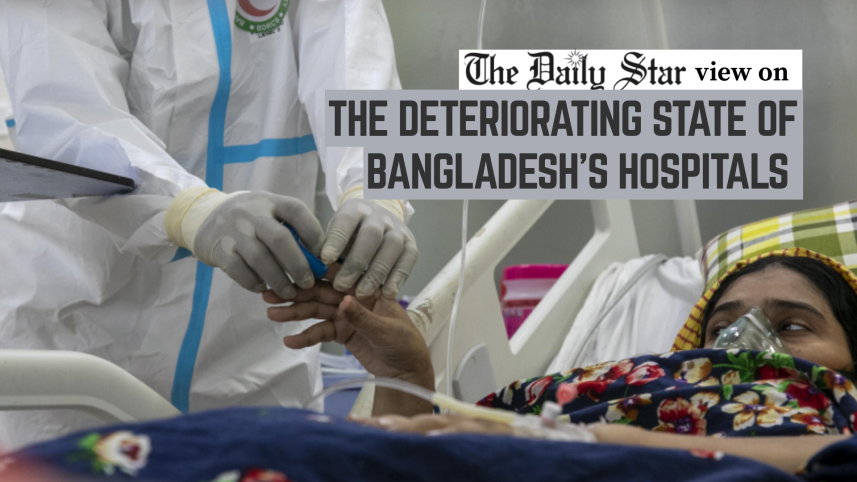
It is encouraging to see our lawmakers raising issues relating to public welfare in parliament. In a recent session, MPs highlighted the daily struggles of patients seeking even basic medical services, and during discussions under Section 71 of the Rules of Procedure, they drew the health minister’s attention to the alarming condition of hospitals and health complexes in their respective constituencies. From crumbling infrastructure to severe shortage of medical personnel, the failure is all-pervasive.
An MP’s remark that a hospital in her constituency is “like a patient” itself underscores the extent of institutional neglect in healthcare. Located in Brahmanbaria’s Sarail upazila, the 50-bed hospital in question reportedly has 64 vacant posts, including critical shortages of physicians, nurses, and technical staff. Services are continuing in a dilapidated facility, compromising patient care. Meanwhile in Rajshahi, a single health complex serves around 400,000 people, with doctors working in cramped conditions. The absence of something as basic as an ambulance driver has had fatal consequences, with critically ill patients unable to reach referral hospitals in time. In Bagerhat, despite getting an upgrade to 250 beds, the Sadar hospital remains crippled by staff shortages, with most consultant posts lying vacant. Even a newly inaugurated ICU has remained non-functional from day one, which is another example of infrastructure without operational readiness.

This daily has reported on such gaps in our healthcare systems many times, but little seems to have changed. A recent report found that 80 health facilities across 18 districts remain idle due to manpower shortages, lack of equipment, and bureaucratic delays, leaving thousands deprived of essential healthcare. Disturbingly, at a time when many hospitals are struggling to cope with a growing number of child patients amid the ongoing measles outbreak, six specialised children’s hospital buildings have remained unused for years after their completion. Every time a public health crisis arises in the country, these gaps in our healthcare system become evident. There is a persistent disconnect between planning and implementation in the health sector, turning vital institutions into symbols of inefficiency.
Addressing this problem requires a comprehensive and coordinated response. First and foremost, the government must urgently fill vacant posts at all levels of the healthcare system, ensuring that facilities are adequately staffed to meet patient needs. Second, strict accountability mechanisms must be put in place to prevent delays and the abandonment of development projects. Third, operational readiness—including staffing, equipment, and maintenance—must be a prerequisite for any infrastructure upgrade or inauguration. Equally importantly, ICU facilities in all hospitals must be made functional so that critically ill patients are not forced to travel long distances at great risk.
The concerns raised in parliament should serve as a wake-up call. The government must act decisively to address these long-standing deficiencies in our healthcare management. Lastly, all the MPs should raise issues troubling their constituencies and help make our parliament truly people-oriented.
 For all latest news, follow The Daily Star's Google News channel.
Comments