


Expedite port city’s flood-control projects
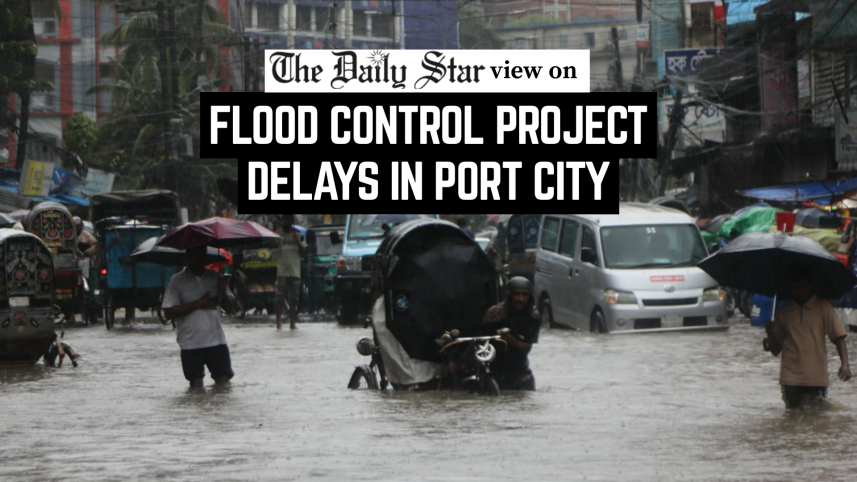
Bangladesh’s second-largest city is underwater again, and official explanations fail to match reality. While Chattogram’s mayor claims that megaprojects and cleared drains have reduced waterlogging by 80 percent, such assertions are doing little to ease the misery of residents wading through waist-deep water in neighbourhoods, including Bahaddarhat, Katalganj, and Bakalia. For the port city, heavy monsoon rain—330mm in a single day—colliding with a high tide, is not a freak accident. It is a recurring geographic vulnerability that will continue to drown the city every monsoon until the completion of its drainage infrastructure.
What should worry the authorities isn't the rain, but the delayed response. Four projects, together worth roughly Tk 14,000 crore, were meant to insulate the city from flooding. Yet, none is complete. The largest project by the Chattogram Development Authority (CDA) to rehabilitate 36 canals has seen its budget balloon by more than 50 percent to Tk 8,626 crore, while its deadline slips into a second extension. A parallel drainage project run by the Bangladesh Water Development Board has gone the other way. Its budget was cut, and the number of planned sluice gates reduced from 23 to 21. A third project, to build a protective embankment along the Karnaphuli river, has also seen costs climb by a fifth since 2019. Meanwhile, the Baraipara Canal excavation project run by Chattogram City Corporation at a cost of Tk 1,374 crore is roughly 95 percent complete.

Cost overruns and slipping deadlines are common in large infrastructure programmes. What is more problematic is that construction on some of the most critical stretches of the canal has been suspended since April. The temporary dams used by contractors themselves obstructed water flow and worsened flooding in nearby neighbourhoods in early monsoon rains. In other words, the projects designed to fix Chattogram's flooding problem have, in the short run, made it worse. What’s more, over the decades, the city has lost 47 of its original 104 canals and much of its natural water-retention capacity to unplanned development. Flood-control infrastructure built today is, in effect, trying to recreate drainage capacity that urban expansion destroyed decades ago. Retrofitting a city is always costlier and slower than protecting its natural drainage in the first place—a lesson for Chattogram and other cities growing just as fast.
Although officials say that these flood control projects are nearing the finish line, families whose homes are flooded and people who cannot commute to work find zero comfort in such statements. The authorities have been honest about the massive cost of these projects. What they owe residents now is complete candour about the timeline—and an explanation for why they used construction methods that actively made the flooding worse. Optimistic progress reports mean nothing to people bracing for their fourth consecutive monsoon, watching the water rise.
 For all latest news, follow The Daily Star's Google News channel.
Comments