


Break the cycle of project delays
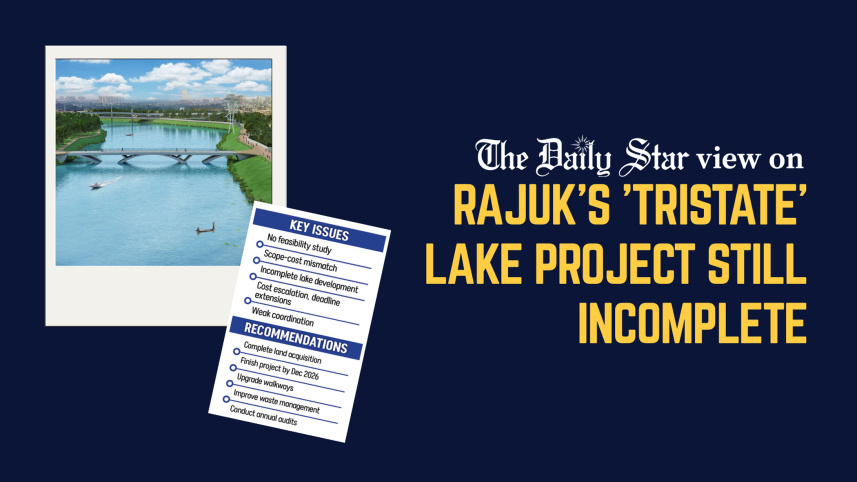
Here’s a familiar story: a public development project was approved by Ecnec on July 6, 2010 and was to be implemented by June 2013 at a cost of a little over Tk 41,000 lakh. Over a decade and a half later, the project remains incomplete, slated to be done by December this year, with the cost standing at over Tk 55,000 lakh, 35.36 percent higher than the original estimate. One has to feel deeply disappointed to realise that the previous sentences could be referring to any government project anywhere in the country. What is truly baffling is that the project in question, the Gulshan-Banani-Baridhara Lake Development Project, was undertaken without a detailed feasibility study.
The project was reportedly implemented by Rajuk and aimed to develop about 8.80 km of lakes in the Gulshan, Banani, and Baridhara areas of the capital. Although the project proposal envisaged the development of around 60 percent of lake area, only 3.80 km of development work was completed. In its recent evaluation report of the project, the Implementation Monitoring and Evaluation Division (IMED) pointed out that, despite this reduced scope of work, project expenditure did not decrease as no feasibility study had been conducted at the preparation stage. Additionally, land acquisition was added to the DPP much later and was only approved in May 2025. To note, the proposed lake drive was constructed in 2019, even before the land was acquired. Now, besides a series of other tasks—such as upgrading walkways, implementing waste management solutions, and enhancing overall safety and cleanliness—10.75 acres of land remains to be acquired against a deadline that is less than six months away.

The issue here is the same as in most government development projects. The idea and intent are surely noble and even necessary, but the implementing bodies of these projects rarely seem to take into account the importance of a deadline and allocated project costs. There is a severe lack of accountability, which now has us stuck in a cycle of project approvals, deadline extensions, cost inflation, and then not much to show for all of it in terms of project outcomes. How much longer will the government allow for these dire and unacceptable inefficiencies to continue?
We urge Rajuk to internalise the IMED findings about the lake development project and ensure that all elements in the revised DPP are fulfilled by this December. More importantly, we want the government to ensure strict accountability for delays and cost escalations in public projects. Development cannot become synonymous with inefficiency, which is unfortunately the path we have been on for many years now.
 For all latest news, follow The Daily Star's Google News channel.
Comments