


Bangladesh in the crossfire of a distant war
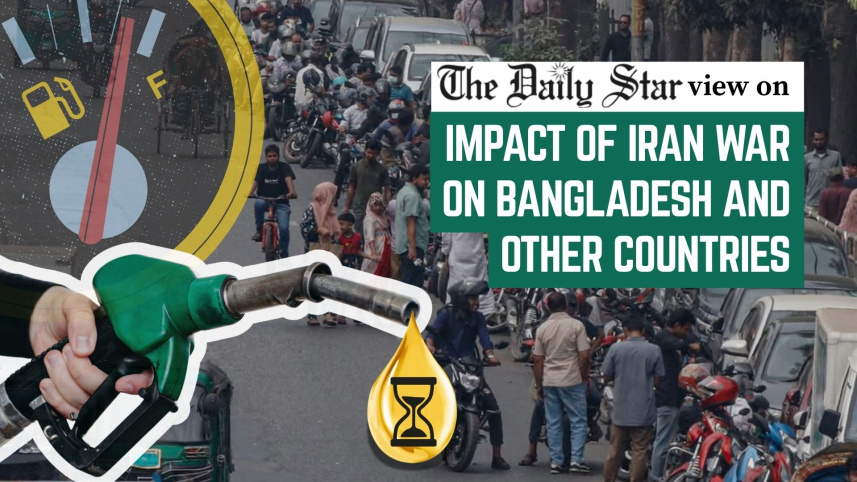
As the US-Israel war with Iran drags into its fifth week, economic hardship for ordinary people across the globe continues to intensify. Despite President Donald Trump’s claims of success in “engineering” regime change in Tehran, the United States continues to strike Iranian targets while mobilising additional troops in the region, raising the prospect of a ground invasion and further escalation. In retaliation, Iran has sustained missile and drone attacks on Israel and on US military assets in neighbouring Gulf states. Pro-Iran forces in the region—Hezbollah in Lebanon, several militia groups in Iraq, and the Houthis in Yemen—have also entered the conflict. What began as a war of choice against Iran has now engulfed much of the Middle East.
The disruption of shipping through the Strait of Hormuz has driven oil prices sharply upwards over the weeks, with knock-on effects already visible in fuel, fertiliser, and global supply chains. Meanwhile, threats to shipping are now emerging at another critical chokepoint, the Bab-el-Mandeb Strait in the Red Sea.

The economic consequences of this war are comparable to the oil shock of the 1970s. In October 1973, Arab oil producers imposed an embargo on countries led by the United States over their support for Israel during the Yom Kippur War, causing oil prices to nearly quadruple within months. While current prices have not yet reached that level today, market analysts warn that the scale of global supply disruption is significantly greater. The 1973 embargo reduced global supply by an estimated 5-7 percent, whereas the current crisis is affecting as much as 20 percent of the world’s oil flows. Its ripple effects are already being felt across fuel markets, fertiliser production, and supply chains worldwide. Although global dependence on Arab oil has diversified since the 1970s, the region remains a critical source of natural gas, fertilisers, and key petrochemical products.
In Bangladesh, the effects of the ongoing war are already evident in the agricultural sector, where shortages of diesel are disrupting irrigation, and rising costs of fertiliser and transport are squeezing farmers. Export-oriented industries are being forced to scale back production as inventories accumulate. Factory owners are increasingly concerned about potential power shortages, particularly as summer demand rises and gas supply remains constrained. Meanwhile, millions of expatriate workers in Gulf countries face an uncertain future, as a prolonged conflict could trigger widespread lay-offs.

Across Asia, long queues at petrol stations reflect the strain on fuel supplies, with governments struggling to manage the widening gap between supply and demand through rationing and anti-hoarding measures. While no country is immune to the economic fallout of this conflict, the burden falls disproportionately on developing nations and low-income populations.
World leaders, therefore, must urgently recognise the scale of this suffering and act decisively to alleviate it. Ending the war immediately is paramount. Equally important is the formulation of a comprehensive economic recovery package to support countries affected through no fault of their own. The government of Bangladesh, too, should raise its voice in calling for an end to this unjustified war and seek international support to mitigate the severe challenges now confronting its people.
 For all latest news, follow The Daily Star's Google News channel.
Comments