


Climate-displaced people should not become rights-deprived refugees in their own country

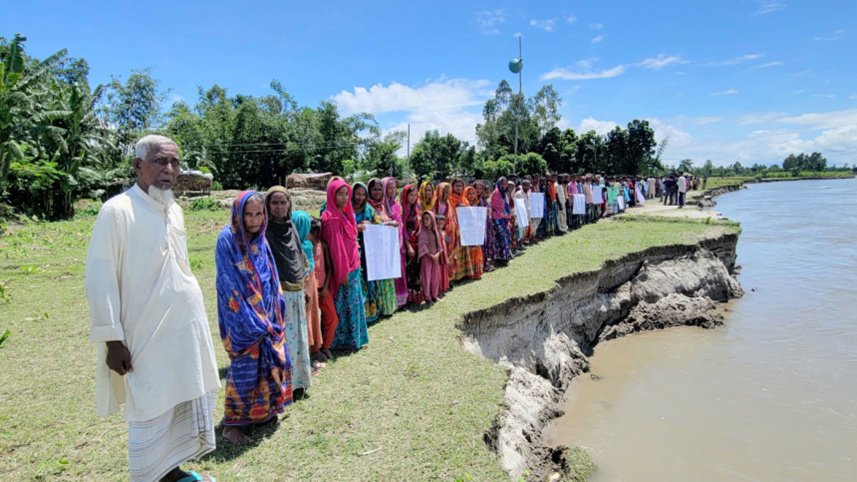
Thousands of people across the country are being displaced every day by climate-induced events such as river erosion, salinity intrusion, floods, and cyclones. In search of livelihoods, these people are moving to large cities. However, even after arriving in urban areas, they do not receive minimum civic services or any institutional support. As a result, the lives of climate-displaced people have become a prolonged struggle.
Kalam is 19 years old and hails from Subarnachar in Noakhali. He lost his home to river erosion alongside his means of livelihood. Bearing the responsibility of supporting a six-member family, he came to Chattogram city with his father six years ago. At first, he worked in a tea stall, later drove a pedal rickshaw, and now earns his living by renting and driving a battery-powered autorickshaw. His father, Majid Ali, also drives a rickshaw to support the family. Kalam and his family never received any assistance from either government or non-government organisations.

A similar story is seen in the life of Sadeqa, a resident of Banshkhali. After losing her home to the erosion of the Sangu River, her family took shelter six years ago in a settlement for displaced people near New Bridge in Chattogram. Her husband drives a rickshaw, while Sadeqa works in a dried-fish factory. Like Kalam, Sadeqa also never received support from any social protection scheme.
The number of climate refugees is increasing globally, and Bangladesh has a particularly dire case. It ranks fifth in terms of disaster-related internal displacement, with the total number of displaced people standing at around 50 lakh, according to an estimate by IOM. Of this estimate, around 63 percent were displaced before April 2020 while 12 percent after April 2024.
Displaced people face multidimensional crises in their lives. Alongside the psychological trauma of losing their homes, they also suffer from inadequate housing, lack of safe drinking water, and social insecurity. After arriving in the city, most climate refugees live in low-income colonies where several families share kitchens, toilets, and bathing spaces. During the monsoon season, waterlogging worsens their suffering. In many areas, inadequate sanitation and piles of waste create serious health risks. The shortage of safe drinking water and use of water containing excessive iron make for challenging living conditions. Even though they live in cities, they remain largely deprived of basic civic services.
Even after living in urban areas for a long time, many climate refugees are deprived of essential services as they lack necessary legal documents such as national identity cards or citizenship certificates. The absence of an integrated national database for climate refugees exacerbates the situation by keeping these people in the peripheries of society. However, there is some hope.
According to the Refugee and Migratory Movements Research Unit (RMMRU), with the support of the Internal Displacement Monitoring Centre (IDMC), preliminary preparations have been completed to create a database of climate refugees. But its implementation still requires government approval and effective initiatives.
On the other hand, although meetings, seminars, and workshops on climate change, displacement, and adaptation are regularly held in the country, sustainable support for affected groups remains limited. So far, Bangladesh has received around $464.6 million from the Green Climate Fund. The amount has been spent on various development projects for agriculture, infrastructure, and climate-resilient rural and urban areas in disaster-prone regions. This has, both directly and indirectly, benefitted climate refugees and vulnerable communities. However, existing policies fall short of creating solid social protection schemes.
There was a time when mitigation and adaptation were given priority consideration in addressing climate change. However, at the moment, it has become essential to establish a strong “loss and damage fund” to ensure the rehabilitation of people who have suffered permanent climate-related losses. And given current realities, it is also an urgent task to formulate integrated, sustainable, and inclusive policies for climate refugees. Climate refugees do not exist outside of society. A sustainable solution to this crisis is only possible by ensuring their rights, identifying the existing gaps in climate policy through multidimensional strategies, and taking effective action.
Minhazur Rahman Shihab is researcher at the Institute of Forestry and Environmental Sciences, University of Chittagong.
Views expressed in this article are the author's own.
Follow The Daily Star Opinion on Facebook for the latest opinions, commentaries, and analyses by experts and professionals. To contribute your article or letter to The Daily Star Opinion, see our guidelines for submission.
 For all latest news, follow The Daily Star's Google News channel.
Comments