


Strikes on Lebanon test shaky truce
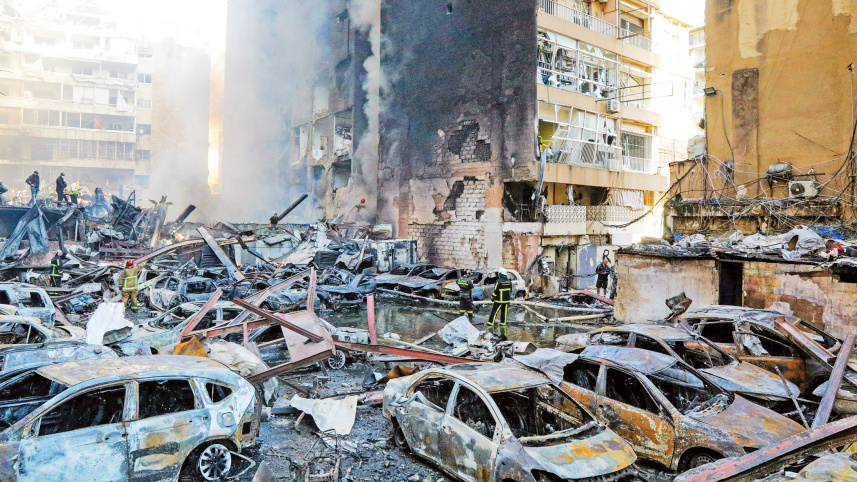
Israel vowed to continue its campaign against Hezbollah yesterday, dismissing mounting international concern that its strikes on Lebanon threaten a fragile US-Iran truce that could lead to peace negotiations.
At least 203 people were killed and 1,000 wounded in airstrikes on Wednesday, the Lebanese health ministry said, while Hezbollah said it was engaged in close-quarters combat against Israeli forces on the ground yesterday in the south Lebanon town of Bint Jbeil.
 For all latest news, follow The Daily Star's Google News channel.
 Iran’s parliamentary speaker Mohammad Bagher Ghalibaf warned Tehran sees Lebanon as an “inseparable part of the ceasefire”, and President Masoud Pezeshkian said Israel’s strikes rendered “meaningless” talks with US envoys planned for the end of the week in Pakistan.
President Donald Trump claimed victory in the Middle East war after agreeing on a two-week truce to allow talks between US and Iranian negotiators to end a conflict that has already killed thousands and plunged the global economy into turmoil -- but both Israel and the US insist the fighting in Lebanon is not covered by the ceasefire.
Pakistan and Iran say Lebanon was included in it.
“We are continuing to strike Hezbollah with force, precision, and determination,” Israel’s Prime Minister Benjamin Netanyahu said, in a social media post. “Our message is clear: anyone who acts against Israeli civilians, we will strike them. We will continue to hit Hezbollah wherever necessary.”
Tehran’s ambassador to Pakistan, meanwhile, deleted a social media post saying an Iranian delegation would “arrive in Pakistan on Thursday”.
An official at the Iranian embassy in Islamabad told AFP the post was removed “because of some issues” and refused to say whether the delegation was still expected.
Amid fears that the fragile truce could break down in the Gulf, there were international calls for the ceasefire to encompass Lebanon.
“Israeli actions are putting the US-Iran ceasefire under severe strain. The Iran truce should extend to Lebanon,” the European Union’s top diplomat Kaja Kallas said.
France’s foreign minister Jean-Noel Barrot condemned the strikes as “unacceptable”, while his British counterpart Yvette Cooper called for the ceasefire to include Lebanon.
UK Foreign Secretary Yvette Cooper said Israel’s attacks on Lebanon were “deeply damaging” and Britain wants to “see Lebanon included in the ceasefire”.
Spain’s Prime Minister Pedro Sánchez said Israeli Prime Minister Benjamin Netanyahu’s “contempt for life and international law is intolerable.” He also called for Lebanon to be included in the ceasefire.
Italy’s Foreign Minister Antonio Tajani said he summoned the Israeli ambassador to protest the attacks, adding: “We want to avoid there being a second Gaza.”
UN Secretary General António Guterres also “unequivocally” condemned the strikes.
The Lebanese prime minister’s office yesterday said it would be “a national day of mourning for the martyrs and wounded of the Israeli attacks that targeted hundreds of innocent, defenceless civilians”.
UN rights chief Volker Turk called the scale of killing in Lebanon “horrific”, after strikes across the capital Beirut that came without warning triggered horror and panic.
Hezbollah said it had fired rockets towards Israel in response to what it called a violation of the truce.
US Vice President JD Vance backed Israel in saying Lebanon was excluded from the truce, days before he was due to lead talks with Tehran in Pakistan.
“If Iran wants to let this negotiation fall apart... over Lebanon, which has nothing to do with them, and which the United States never once said was part of the ceasefire, that’s ultimately their choice,” he said.
Separately, the head of Iran’s nuclear energy agency, Mohammad Eslami, dismissed Washington’s suggestions that the truce deal would halt Tehran’s nuclear programme.
“The claims and demands of our enemies to restrict Iran’s enrichment programme are merely wishes that will be buried,” he said.
The bellicose rhetoric came ahead of high-stakes talks in Pakistan expected on Friday or Saturday.
A key point of contention remains the Strait of Hormuz, through which a fifth of the world’s oil as well as vast quantities of natural gas and fertiliser pass in peacetime.
Iran yesterday announced alternative routes for ships travelling through the strait, citing the risk of sea mines.
But it was unclear if Tehran was in practice allowing vessels to pass through the strait, following reports on Wednesday suggesting it was shut -- something the White House called “completely unacceptable”.
The EU yesterday said that freedom of navigation in the strait must be ensured with “no payment or toll whatsoever”, after Iran suggested it could charge for letting ships through.
The war has also strained US ties with Nato, with Trump threatening to quit the alliance if it doesn’t join its effort to open Hormuz.
Three European diplomats yesterday told Reuters that Nato Secretary General Mark Rutte has briefed some capitals that Trump wants concrete commitments within the next few days for help securing the strait.
Rutte met with Trump in Washington on Wednesday, amid tensions within the alliance over the Iran war.
Meanwhile, an Israeli court yesterday said corruption trial against Netanyahu’s will resume on Sunday, hours after Israel lifted a state of emergency imposed over its war with Iran.
Netanyahu, the first sitting Israeli prime minister to be charged with a crime, denies charges of bribery, fraud and breach of trust brought in 2019 after years of investigations. His trial, which began in 2020 and could lead to jail terms, has been repeatedly delayed due to his official commitments, with no end date in sight.
Israel is due to hold elections in October, and Netanyahu’s coalition, the most right-wing in Israel’s history, is likely to lose.
Comments