


Which roles will emerge and disappear by 2030?


The modern job market is crowded, with far more job-seekers than available opportunities. Add the rapid rise of artificial intelligence, which threatens to replace many roles, and the anxiety is understandable. From fresh graduates to seasoned professionals, everyone is asking the same question: which jobs will still matter tomorrow, or even four or five years from now?
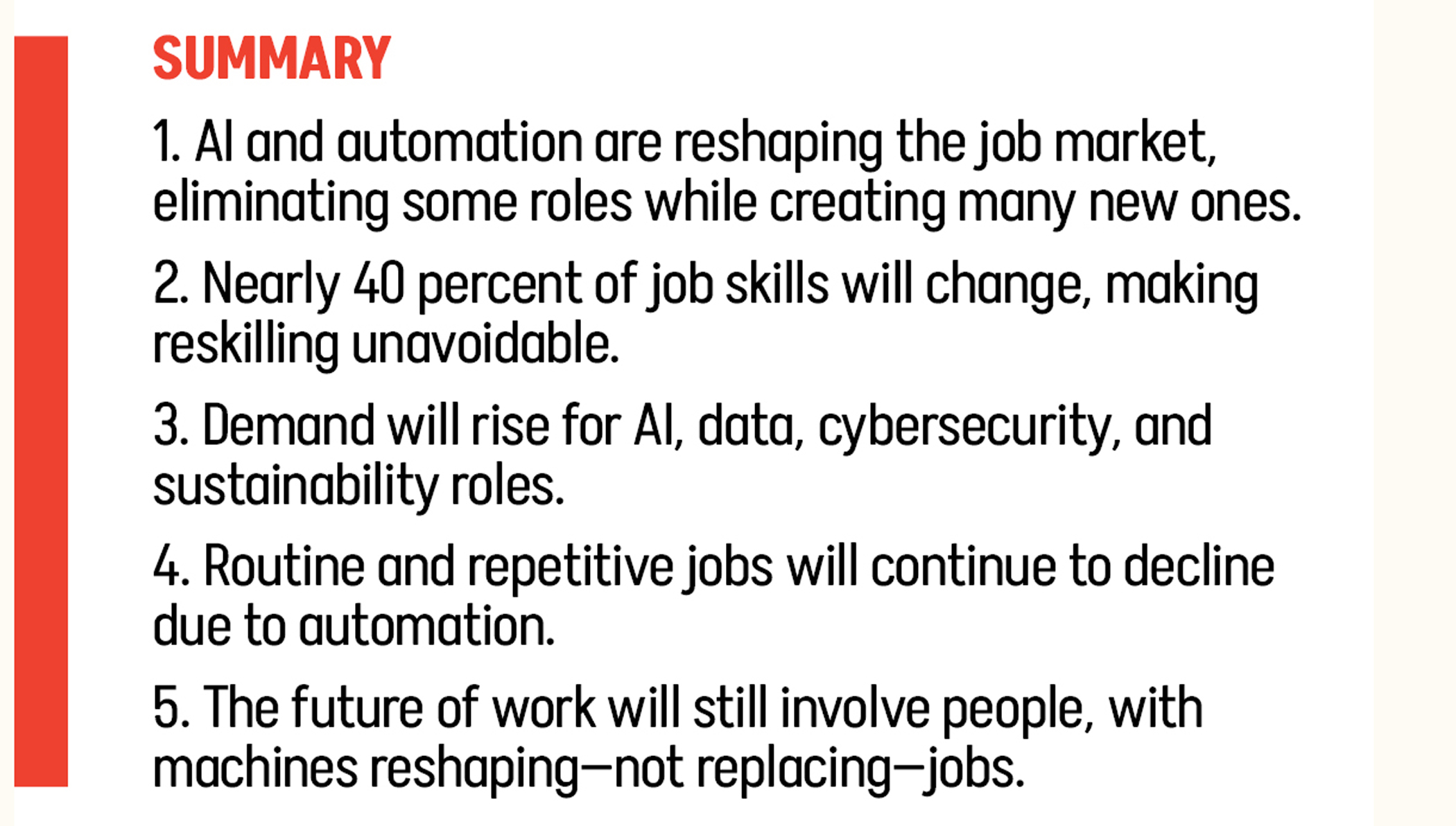
According to the World Economic Forum’s (WEF) Future of Jobs Report 2025, the global workforce faces a dual movement: about 92 million existing roles may be displaced, while 170 million new jobs are set to emerge by 2030, leading to a net gain of 78 million roles globally. This sweeping reshuffle is driven by the rise of artificial intelligence (AI), automation, green transitions, digital platforms, and the pandemic-powered evolution of work.

The WEF report also notes that almost 40 percent of core job skills are expected to change, forcing workers to adapt or risk stagnation. In the midst of this global upheaval, it helps to understand which jobs will emerge and which will disappear.
Let’s start with the roles that are likely to emerge or gain more popularity within the next four years.
AI AND MACHINE LEARNING SPECIALISTS
Globally, the demand for AI and machine learning (ML) experts—from algorithm training to ethical governance—is surging. Specialised AI roles, in particular, are expected to grow in the coming years.
These specialised AI and ML roles are not necessarily purely technical jobs. They also include roles like ethical AI deployment, bias mitigation, and even extensive AI and ML research.
In economies like Bangladesh, where digital services and IT export are growing, this creates a stark opportunity for tech-ready talent. According to UNESCO’s Bangladesh Artificial Intelligence Readiness Assessment Report, Bangladesh is already seeing plenty of academic research being done on AI. However, the focus needs to shift toward the practical use of AI across industries, rather than limiting it to just scholarly research.
DATA SCIENTISTS AND BIG DATA ANALYSTS
Information, today, is the raw material of transformation, and those who can wrangle, interpret, and act on it are in premium demand. With data volumes expanding exponentially, organisations in sectors from health to banking and agriculture seek professionals who can translate bytes into business insights.
What’s more, the demand for data analysts will also continue to grow. If you don’t want to learn advanced coding to work with data, you can choose to skip it—but having basic coding knowledge, along with the ability to use tools like Microsoft Power BI, is essential for anyone looking to work in this field.
CYBERSECURITY ANALYSTS
When work goes digital, risk follows. Cybersecurity roles are expanding as businesses and governments grapple with threats targeting sensitive data and critical infrastructure. A world where remote work, cloud storage, and Internet of Things (IoT) are commonplace requires defenders as much as inventors.
Emerging markets like Bangladesh, whose digital economy is gaining momentum, must build local capacity not only in software development but also in defensive cyber skills. According to the 2024 Global Cybersecurity Index, published by the International Telecommunication Union (ITU), Bangladesh scored more than 96 out of 100. While this is a remarkable achievement, the next step is to invest in developing skilled manpower and preparing them to tackle emerging cyber threats.
Renewable energy technicians and sustainability experts
The world’s pivot toward net-zero emissions and climate resilience casts green jobs in the spotlight. Roles connected with solar, wind, and grid integration, as well as consultants who guide firms on environmental compliance (ESG) and sustainability, are becoming part of modern labour landscapes.
This trend is focused on societal priorities as nations confront climate change with both urgency and investment. Bangladesh, being extremely vulnerable to climate change, needs these professionals more than any other country. Together, using data and AI, our renewable energy, climate, and sustainability experts must develop models and blueprints that offer effective solutions to our climate challenges.
Several roles are also expected to decline within the next four or five years.
Data entry clerks
The era of manual record keeping and repetitive data chores is ending. Optical Character Recognition (OCR) powered by AI now processes volumes of structured information faster, cheaper, and more accurately than human operators could ever hope to.
 For all latest news, follow The Daily Star's Google News channel.
 What was once a common office starting point for new graduates is now being replaced by automated pipelines. Many in Bangladesh also work as data entry specialists on platforms like Fiverr and Upwork. These freelancers are also struggling to secure data entry work. Soon, those who once entered data will instead be training systems to automate such tasks.

Image: Bady Abbas/ Unsplash
Retail cashiers and bank tellers
Self-checkout kiosks, mobile payments, automated credential verifications, and digital banking apps have chipped away at the economics of human-operated counters. Roles that dominated retail and financial services will see a decline as consumers adopt contactless systems, not out of disdain for people, but for convenience and efficiency.
This does not mean banks will be paperless or devoid of human interaction. However, as the WEF notes, the traditional role of the teller, rooted in routine transactions, will shrink.
Administrative assistants and secretarial roles
AI-powered assistants, scheduling bots, and document automation tools are redefining office support functions. Similar to how spreadsheets restructured accounting tasks decades ago, AI is now embedding itself into what used to be considered indispensable human support work.
This trend points to a future where organisation and communication tasks are augmented, not erased. Professionals will need new organisational skills that complement context and creativity.
Why these transitions matter
For many Bangladeshi youth entering the job market, this global tectonic shift will feel personal. However, jobs are not vanishing as much as they are mutating. The future professional will likely hold several careers, pivot fields, or create entirely new ones.
At present, reskilling is not optional; it has become foundational. And the better a labour market anticipates change, the better it weathers it. Countries with strong vocational training, digital inclusion, and flexible education systems will thrive. Those who cling to outdated models may see their brightest leave for greener pastures.
Put bluntly, traditional four-year degrees—once a guaranteed passport to lifelong employment—are becoming only one part of a much larger ecosystem. What matters increasingly are skills that machines cannot replace, like creativity, critical thinking, emotional intelligence, complex problem solving, and intercultural communication.
The conversation about future jobs often swings between dystopian fears and utopian dreams of a machine-free life. Both extremes are exaggerated. The reality lies somewhere in between, where people will continue to work, and machines will not take over the labour market, but they will reshape it.
And how we shape our skills, policies, and education today will determine who thrives in the decades ahead.
In Bangladesh and beyond, governments, universities, and industry must change in concert. Curricula should emphasise digital fluency and lifelong learning. Employers should invest in upskilling rather than downsizing. And individuals should approach careers with flexibility and courage, because the future of work is not a fixed destination, but a journey of continuous reinvention.
Comments