


Monetary policy alone can’t cool inflation
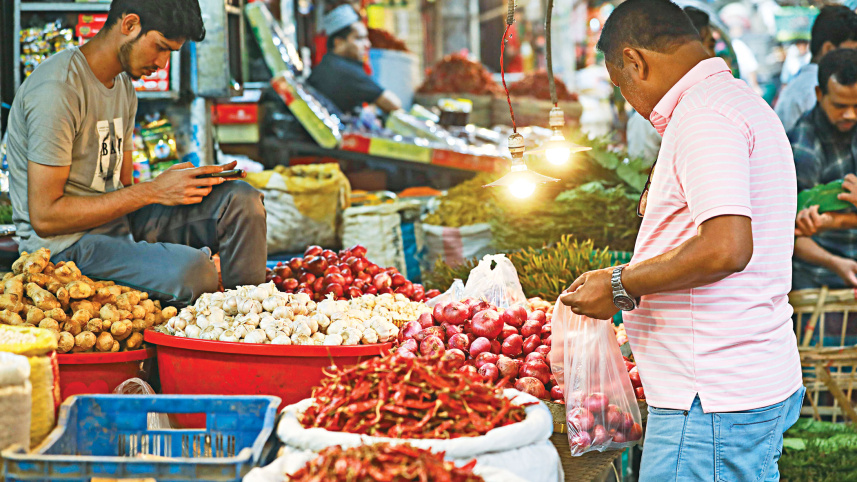
After the interim government kept bank lending rates high for about one and a half years to reduce inflation, Finance Adviser Salehuddin Ahmed acknowledged that tight monetary policy alone cannot cool soaring prices.
At a programme in Dhaka yesterday, he said inflation control also requires effective supply-side management, stronger market supervision and cooperation from both businesses and consumers.

Even so, the adviser leaned towards maintaining the current policy stance, saying that an abrupt cut in interest rates could hurt the wider economy.
Local business leaders have long pressed for lower lending rates, but Salehuddin said that the issue could not be settled through a single decision.
“Interest rates are often discussed as if simple solutions exist, but lowering rates in one area can create pressure elsewhere in the economy,” he told the publication ceremony of the Banking Almanac at the CIRDAP auditorium in the capital.
Referring to the recent fall in treasury bill yields, he said the impact would gradually feed through to the market. However, higher returns on treasury bills or savings instruments could pull deposits away from banks, posing risks to the financial system.
The former Bangladesh Bank governor said the core role of the banking sector is to bridge savings and lending. “Banks and non-bank financial institutions play this intermediary role, and any weakness in this structure negatively affects the entire economic system.”
On the Banking Almanac, Salehuddin said the publication does not offer direct investment guidance, but it is an important data source for analysing the banking sector. It contains key information including paid-up capital, authorised capital, capital ratios, provisioning, retained earnings and credit-deposit ratios.
Discussing the health of the banking sector, he said conditions were critical when he took office in August 2024. Recent data analysis, however, shows early signs of improvement in provisioning and lending at some banks -- trends also reflected in the banking Almanac.
Calling on the media, Salehuddin urged journalists not to portray Bangladesh only in negative terms, but to highlight positive developments alongside constructive criticism. He said the country has made notable progress despite many constraints.
Abdul Hai Sarker, chairman of the Bangladesh Association of Banks (BAB), said the exact reasons behind high interest rates remain unclear.
Sarker, the chairman of Dhaka Bank, said banks are receiving funds from both the Bangladesh Bank and the government, yet lending rates remain high.
Despite adequate liquidity, banks are unable to invest because of an unfavourable business climate, he said, adding that weak law and order and low business confidence are discouraging fresh investment.
Sarker said politically driven bank approvals have eroded confidence and triggered capital outflows from the banking system.
High interest rates are also hurting exports by raising production and financing costs, weakening competitiveness in global markets, according to the BAB chairman.
Hossain Zillur Rahman, acting chairman of the board of editors of the Banking Almanac and a former adviser to the caretaker government, said business and entrepreneurial confidence remains a key challenge. He said this should be understood broadly to include farmers and small producers.
Economic democracy, especially access to credit and policy support for small and medium enterprises and grassroots actors, is another critical benchmark, he added.
“While inflation and daily economic comfort have shown mixed trends, persistent gaps remain due to inefficiencies in policy execution and supply chains.”
The economist said strong economic governance depends on quality data, professionalism, better norms, continuous monitoring and effective consultation with stakeholders.
Nazma Mobarek, secretary of the Financial Institutions Division at the Ministry of Finance, said that Bangladesh depends more on the money market than the capital market, leaving banks under growing pressure.
 For all latest news, follow The Daily Star's Google News channel.
 She said the Banking Almanac should include a chapter offering recommendations and possible exits from the crisis, including the problem of rising bad loans.
Md Khairuzzaman Mozumder, secretary of the Finance Division, said the financial sector has been passing through a difficult period over the past one and a half years.
He said some challenges, including letter of credit payment problems, have eased. The true scale of bad loans has now become visible following loan classification under international standards, he added.
Bangladesh Bank Deputy Governor Nurun Nahar also spoke at the event as a special guest. Mohammed Nurul Amin, a member of the editorial board of the book, made remarks on the publication.
The ceremony marking the seventh edition of the Banking Almanac was organised by ShikkhaBichitra with support from the Bangladesh Bank.
Comments