


Migration to US: Visa freeze pushes families into uncertainty

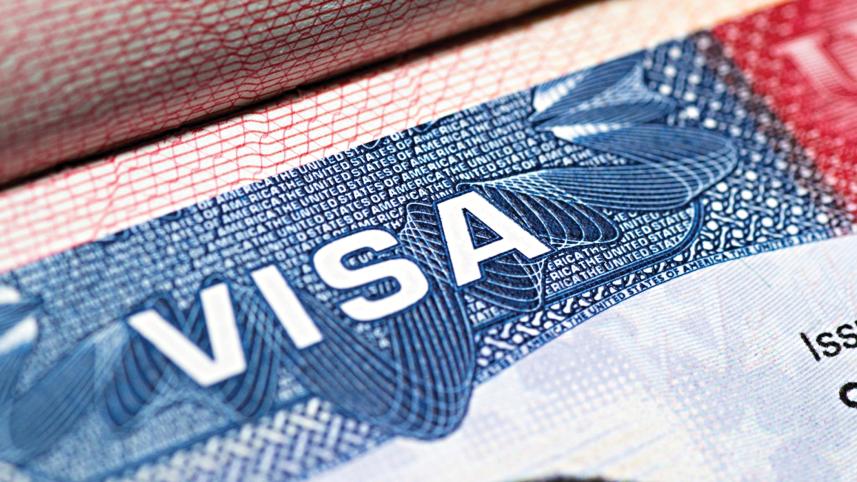
Tamim Hossain applied for a US immigrant visa two years ago to reunite with his family -- his wife and two daughters -- who have been living there for more than a decade.
He was expecting a visa appointment this February. But his hopes of reunion have been thrown into uncertainty after the US government announced a pause on issuing immigrant visas to nationals of 75 countries, including Bangladesh.

Tamim, 51, said his wife is a college teacher in New York, while his elder daughter, 19, is studying at a university and working part-time.
“My family is working hard to survive and paying taxes. They are not dependent on any welfare scheme. As my daughters are still students, I rather send money for them,” the mid-career professional at a private company told The Daily Star.
He said he has already sold his assets and planned to resign from his job, while his sick father-in-law is undergoing treatment in the US. His elder daughter was supposed to move to another state for university but decided to stay back in New York, hoping to be with her father.
“Altogether, it is a family reunion that I am missing. I am frustrated,” Tamim told this correspondent.
Tamim is one of hundreds of thousands of Bangladeshis and other nationals who have applied for immigrant visas but now face total uncertainty over reuniting with their families in the US -- a country built by immigrants and their children.
In a statement on January 14, the State Department said President Trump has made clear that immigrants must be financially self-sufficient and not be a financial burden on Americans.
“The Department of State is undergoing a full review of all policies, regulations, and guidance to ensure that immigrants from these high-risk countries do not utilize welfare in the United States or become a public charge,” it added.
Immigrant visa applicants who are nationals of the affected countries may submit applications and attend interviews, and the department will continue to schedule appointments. However, no immigrant visas will be issued to these nationals during the pause.
No immigrant visas have been revoked as part of the guidance. Tourist and business visas do not fall under the new suspension order.
However, an earlier visa bond policy introduced by the Trump administration has also made it difficult for ordinary visitors and businesses to travel to the US.
On January 6, the US State Department expanded its visa bond list from seven countries to 38, including Bangladesh, with the measure taking effect on January 21.
The visa bond programme, which began in August last year, applies only to B1 and B2 visas. The bond amount -- $5,000, $10,000 or $15,000 -- will be determined during the visa interview.
As part of the Trump administration’s election promises, immigration laws have been enforced more strictly, with undocumented immigrants being deported.
Over the past year, the US repatriated about 300 irregular Bangladeshis, while more than 300 others are eligible for repatriation. In addition, over 4,000 cases are pending in court, according to a diplomatic source in Washington.
According to the Fiscal Year 2024 Entry/Exit Overstay Report by US Customs and Border Protection, Bangladesh recorded an overall overstay rate of 5.73 percent. Of this, 5.60 percent were suspected in-country overstays, meaning more than 2,200 of 38,590 expected departures either overstayed their visas or were suspected of doing so.
The report said India’s overstay rate was 1.28 percent, Nepal’s 3.12 percent and Pakistan’s 3.46 percent.
Tamim said those who violate US immigration rules should face punishment, but questioned why genuine immigrants or visa seekers should suffer as a result.
During a recent meeting between Bangladesh National Security Adviser Khalilur Rahman and US Under Secretary of State for Political Affairs Allison Hooker, the latter said the US government would positively consider Khalilur’s request to ease travel and business visas for Bangladeshis, as bilateral trade was moving in a positive direction.
 For all latest news, follow The Daily Star's Google News channel.
 She said Washington may review the bond requirement if tourist overstays decline significantly, while also appreciating Bangladesh’s cooperation in returning undocumented Bangladeshi nationals.
Mohammad Jalal Uddin Sikder, associate professor at the Department of Political Science and Sociology at North South University, said current US immigration policies could be used as bargaining tools with the countries concerned.
“However, the problem is that when you control legal migration pathways, illegal migration increases. This also creates new criminal networks,” said the migration researcher.
The suspension of immigrant visas hampers family reunification, he said.
“This will create family distance and social problems. Parents will not be able to reunite with children, and wives with husbands. Sometimes this can also lead to inhuman conditions and even human rights violations,” he said.
He expressed hope that the US would carefully consider these consequences.
Comments