


Law and order lapses stoke public fears


Despite the launch of Operation Devil Hunt, continued killings and law enforcement’s failure to arrest escaped criminals and recover looted weapons are raising serious concerns ahead of the national election.
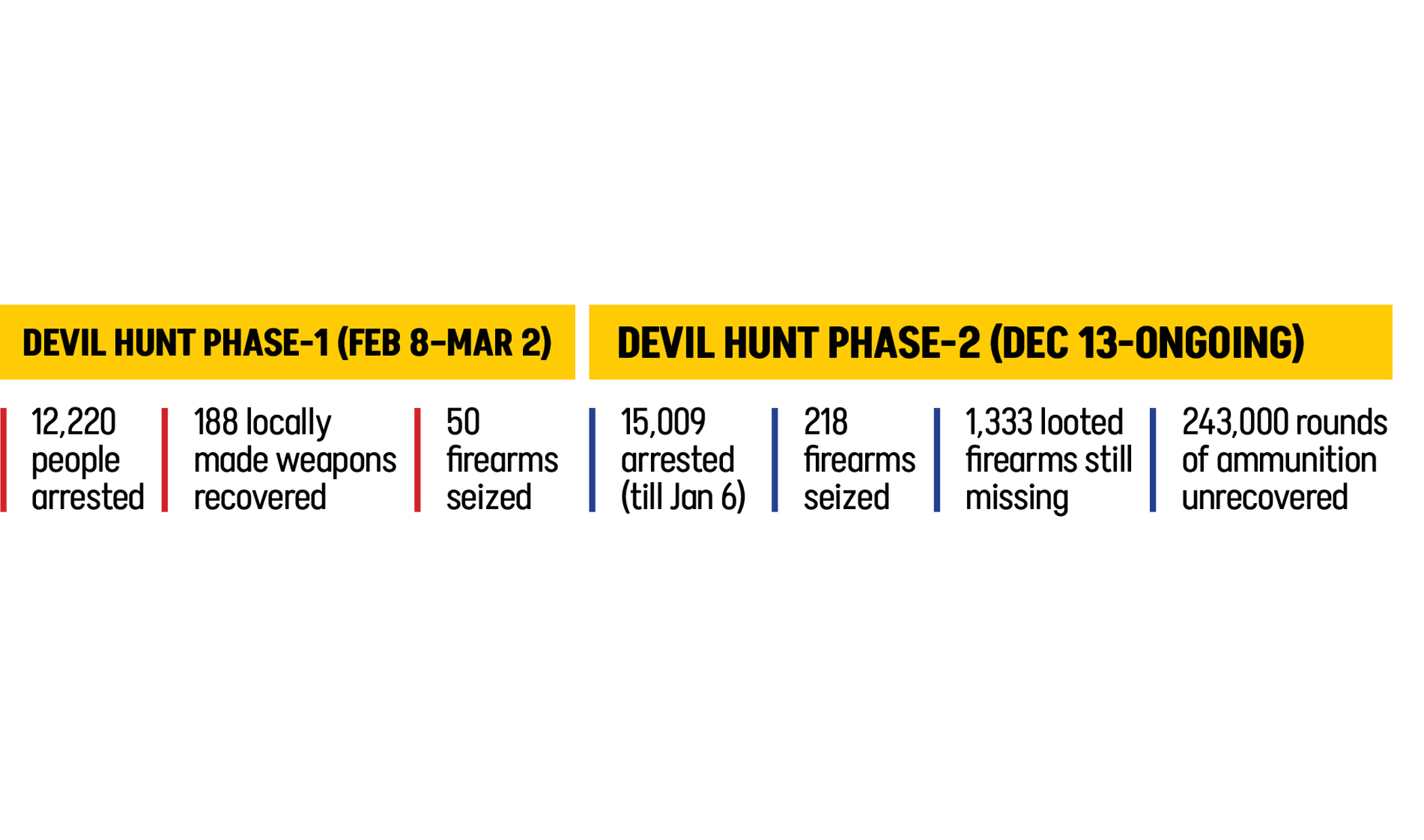
The first phase of the operation, designed to curb crimes, began on February 8, 2025, while the second phase, which is still ongoing, began on December 13.

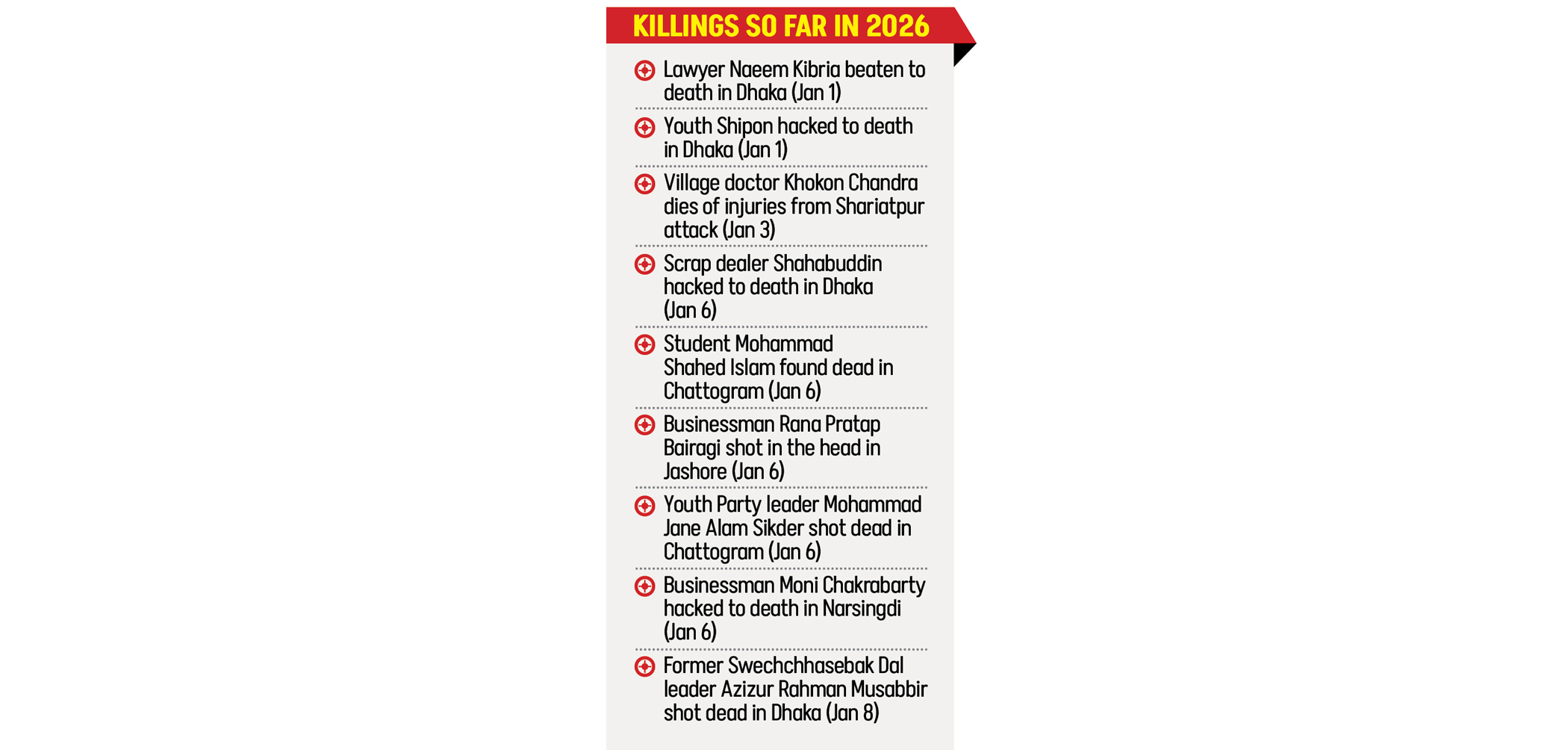
However, at least a dozen murders were reported in the first week of this year alone, around four of them in the capital.
Moreover, eight political killings have taken place since the declaration of the election schedule on December 11, including that of Inqilab Moncho spokesperson and July uprising frontliner Sharif Osman Bin Hadi.
According to Police Headquarters data, over a thousand firearms looted during the July 2024 uprising, including 28 stolen from Narsingdi jail, are still unaccounted for.
Furthermore, the whereabouts of around 710 inmates who escaped from various prisons during the uprising remain unknown.
Contacted by The Daily Star on Wednesday, Dr Tawhidul Haque, associate professor at the Institute of Social Welfare and Research of Dhaka University, said, “The ongoing operation is not sufficiently addressing the crime situation. With the election fast approaching, the failure to apprehend escaped criminals and recover looted weapons are causing anxiety among the people.
“Despite many arrests under Operation Devil Hunt, the rise in targeted killings and political violence is deeply troubling. If this trend continues, it is likely to undermine voter participation, as citizens may be reluctant to risk their lives.”
He added, “For a genuinely participatory and fear-free election, law enforcement agencies and the Election Commission must take more stringent actions to ensure a stable and democratic environment.”
However, AHM Sahadat Hossain, assistant inspector general of police, said, “While there are challenges in the current law and order situation, Bangladesh Police is working tirelessly to bring it under control.
“Despite limitations and fast evolving circumstances, we are ramping up patrols, conducting operations against criminals, maintaining intelligence surveillance, and taking prompt legal action. The police are performing their duties with professionalism and dedication to protect public life and property and to maintain normalcy.”
SPATE OF KILLINGS
At least four murders have taken place in Dhaka city alone so far this year.
In the latest incident on January 8 (Wednesday), unidentified assailants shot dead former Swechchhasebak Dal leader Azizur Rahman Musabbir and injured another man near the Super Star Hotel in Karwan Bazar.
On the first day of the year, Naeem Kibria, a lawyer, was beaten to death after a private car collided with his motorcycle in the Bashundhara Residential Area.
On the same day, Shipon, a 24-year-old surgical assistant for circumcision procedures, was hacked to death in the Hazaribagh Zhauchar area. Police brought him to Dhaka Medical College Hospital in critical condition, where doctors declared him dead.
On January 6, scrap dealer Shahabuddin was hacked to death in Kadamtali.
Outside the capital, village doctor Khokon Chandra, who was critically injured in a knife and arson attack in Shariatpur’s Damudya upazila on December 30, died at Dhaka Medical College Hospital on January 3.
Two days later, three murders were reported in three districts: Rana Pratap Bairagi, a trader in Jashore’s Monirampur, was shot in the head; Mohammad Jane Alam Sikder, a Youth Party leader in Chattogram’s Raozan, was shot dead; and businessman Moni Chakrabarty was hacked to death in Narsingdi’s Palash upazila.
 For all latest news, follow The Daily Star's Google News channel.
 On January 6, police recovered the body of Mohammad Shahed Islam, a student who had been missing for a day, in Chattogram.
PHQ data shows 3,785 murder cases were filed across the country last year, including cases related to killings during the uprising. In 2023, 3,023 murders were reported, while 3,126 were recorded in 2022.
According to Ain o Salish Kendra, 102 people were killed in political violence last year. The figure was 100 in 2024, 45 in 2023, and 70 in 2022. The Human Rights Support Society reported 133 deaths from political violence last year, compared to 145 in 2024 and 96 in 2023.
Last year, at least 197 people were killed in mob violence, up from 128 in 2024, ASK data shows.
During the interim government’s tenure, which began on August 8, 2024, at least 293 people were killed in mob violence, the rights body’s data shows.
A recent ASK report shows that at least eight people from minority communities were killed in different districts from December 2, 2025 till January 6 this year. The incidents include the murder of Amrito Mandal in Rajbari on December 24, Brajendra Bishwash in Mymensingh on December 29, and businessman Prantosh Sarker in Narsingdi on December 2.
Contacted, Saifur Rahman Chowdhury Sujan, general secretary of the Karwan Bazar Brihattar Paikari Kacha Bazar Arot Byabasayi Malik Samity, said, “The operation [Devil Hunt] needs to be strengthened, especially with the upcoming election. Disturbances are already visible. With looted weapons yet to be recovered, public concern is natural.”
National Citizen Party spokesperson Asif Mahmud Shojib Bhuyain described the election-time law and order as “very disappointing”.
After a meeting with the Election Commission on Tuesday, he said, “Since the announcement of the polls schedule, a known criminal recently released on bail killed one of our comrades [Sharif Osman Hadi]…. This has further intensified public concern about the election.”
He also criticised the lack of visible security measures, adding that the NCP has urged the EC to increase law enforcement presence at the grassroots level.
LOOTED WEAPONS BEING USED
The Awami League regime was overthrown in a student-led uprising on August 5 last year, after which 5,753 firearms and 651,609 rounds of ammunition were looted from police stations and outposts, according to PHQ.
At least 1,333 looted firearms, including 113 Chinese rifles, 31 SMGs, three LMGs and 206 Chinese pistols, remain unrecovered. More than 243,000 rounds of ammunition are also missing.
Police have recovered looted firearms from multiple crime scenes in at least six incidents over the past year.
In Chattogram, police seized pistols and bullets marked “police” from arrested suspects and crime scenes, including after a gunfight between rival criminal groups in Chandgaon. In another case, bullet casings marked “police” were found at the scene of a businessman’s murder.
Similar instances have been reported in Dhaka and other districts, where suspects confessed to using firearms stolen from police stations during the unrest.
An official of Dhaka Metropolitan Police, requesting anonymity, said a portion of the looted firearms were sold to criminal gangs in Dhaka.
Residents of Mohammadpur alleged that firearms looted from Mohammadpur and Adabor police stations are now in criminal hands.
ESCAPED INMATES STILL AT LARGE
Around 2,241 inmates, including 88 death-row convicts, fled prisons during and after the uprising. Of them, around 710 remain at large.
Inspector General of Prisons Brig Gen Syed Muhammad Motahar Hussain said efforts to capture the fugitives and recover looted weapons have stalled due to limitations.
“Multiple operations were conducted at known addresses, but without success. We suspect some may have fled the country. We also don’t have documentation for about 178 escapees, particularly from Narsingdi jail, as records were destroyed.
“The relevant ministry and law enforcement agencies are aware of the issue. We have raised it in law and order meetings, and efforts are ongoing.”
OPERATION DEVIL HUNT SO FAR
Following the launch of the second phase on December 13, law enforcement agencies arrested 15,009 people and seized 218 firearms by January 6.
In August last year, the government announced rewards for information leading to recoveries, but no major breakthroughs have been reported.
During the first phase, from February 8 to March 2 last year, 12,220 people were arrested, while 188 locally made weapons and 50 firearms were recovered.
After a January 5 advisory council meeting, Home Adviser Lt Gen (retd) Jahangir Alam Chowdhury said all forces were directed to work in coordination and intensify grassroots activities before and during the election.
“Instructions were given to take all necessary measures to ensure stability during political programmes and campaigning,” he said, urging cooperation to ensure a conducive election environment.
Comments