


Ishwardi silk seed farm: Once-profitable, now left to crumble

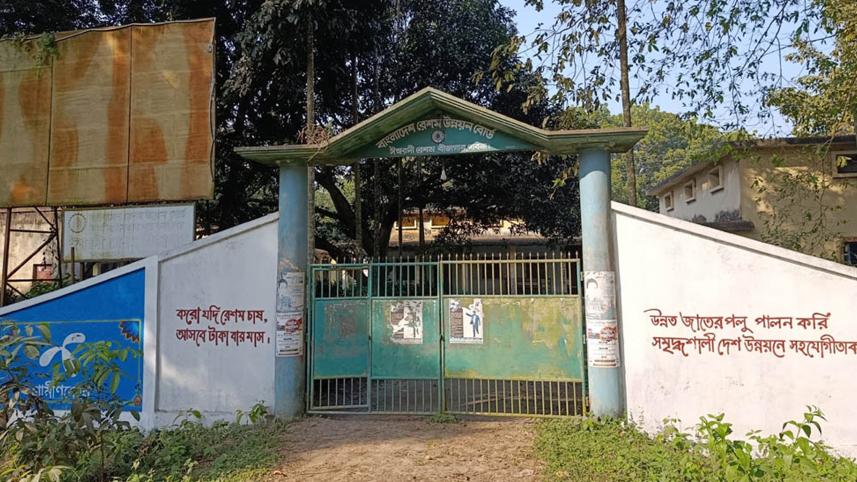
The state-owned Ishwardi Silk Seed Farm, located along the Pabna–Ishwardi road, has largely fallen into abandonment due to years of neglect and lack of initiative.
According to the Bangladesh Silk Development Board, the Ishwardi Silk Seed Farm was established in 1962 on 107 bighas of land near the Alhaz Intersection area in Ishwardi upazila of Pabna.


Initially, mulberry trees were cultivated on 59 bighas of land, while the remaining 38 bighas were used to construct 19 buildings, including offices, residential quarters, silkworm rearing houses, a weaving shed and four ponds. At its peak, the facility employed 17 officers and staff members, along with more than a hundred labourers.
During a recent visit, large parts of the farm were found overgrown with vegetation, while most of the buildings were in a dilapidated condition. Currently, official activities are limited to a single room operated by just two officials, with one night guard assigned to patrol the premises.
Facilities such as the silkworm rearing house, cocoon production room, yarn production room and the laboratory have been severely damaged due to a lack of maintenance. In the absence of proper monitoring, trees and other materials have also been stolen from the premises.
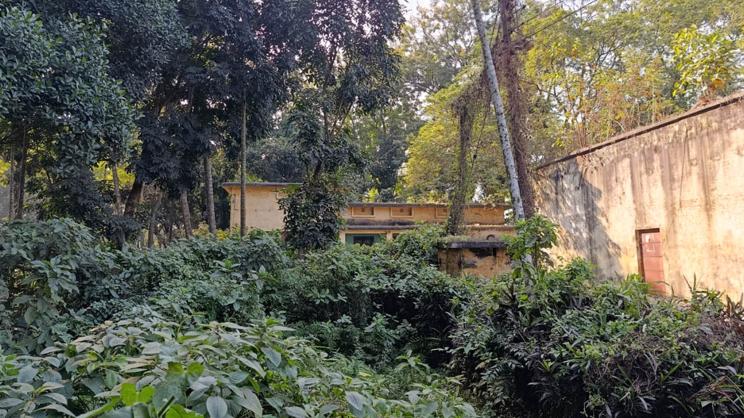
Farm officials said only 11 bighas of land are now being used for cultivating mulberry saplings, while the rest has remained neglected for years.
The farm’s decline began in 2018 after staff salaries were stopped.
Md Khokon Ali, acting manager of the farm, said the primary purpose of the facility is to rear silkworms and produce cocoons for manufacturing silk yarn.
“However, silkworm rearing has remained suspended for the last seven years due to a lack of efficient manpower and necessary funding,” he said.

“Currently, we are only planting mulberry trees to supply saplings to other silk farms across the country. There is no production work taking place at this large facility,” he added.
According to farm officials, the institution, once profitable, began incurring losses, followed by disputes between workers and officials over salary arrears. Workers’ salaries were eventually suspended in 2018, prompting officials to leave. Since then, the facility has continued to deteriorate.
Sources said around 50,000 mulberry trees were lost due to neglect, while the buildings have remained abandoned.
Md Insaf Ali, the night guard, said, “It’s an impossible task to guard this vast area singlehandedly.”
Local residents said the farm had once generated employment and supported the country’s silk production. They blamed the current state of the facility on a lack of government initiative.
Md Tarikul Islam, deputy director of the BSDB regional office in Rajshahi, said efforts were underway to resume production at the farm.
“Due to a shortage of funds, we cannot begin operations. We are trying to arrange financing to restart silkworm rearing and silk cocoon production at the Ishwardi farm,” he said.
 For all latest news, follow The Daily Star's Google News channel.
Comments