


How fintech is reshaping our ties with the world

Let’s walk down memory lane to 1971, when a new nation had just emerged after a brutal nine-month war. There was hope and excitement to rebuild, but the country faced severe economic challenges. Infrastructure was destroyed, industries were barely functioning, and agricultural production later fell sharply after the 1974 famine.
From the war and its aftermath to the present day, it is clear Bangladesh has made significant progress. In GDP growth, financial systems, remittances, and overall economic stability, the nation has advanced across sectors, with government institutions, private organisations and the youth contributing at the same time. Yet there is still much to achieve, as other nations have reached higher levels of development despite facing severe challenges of their own.

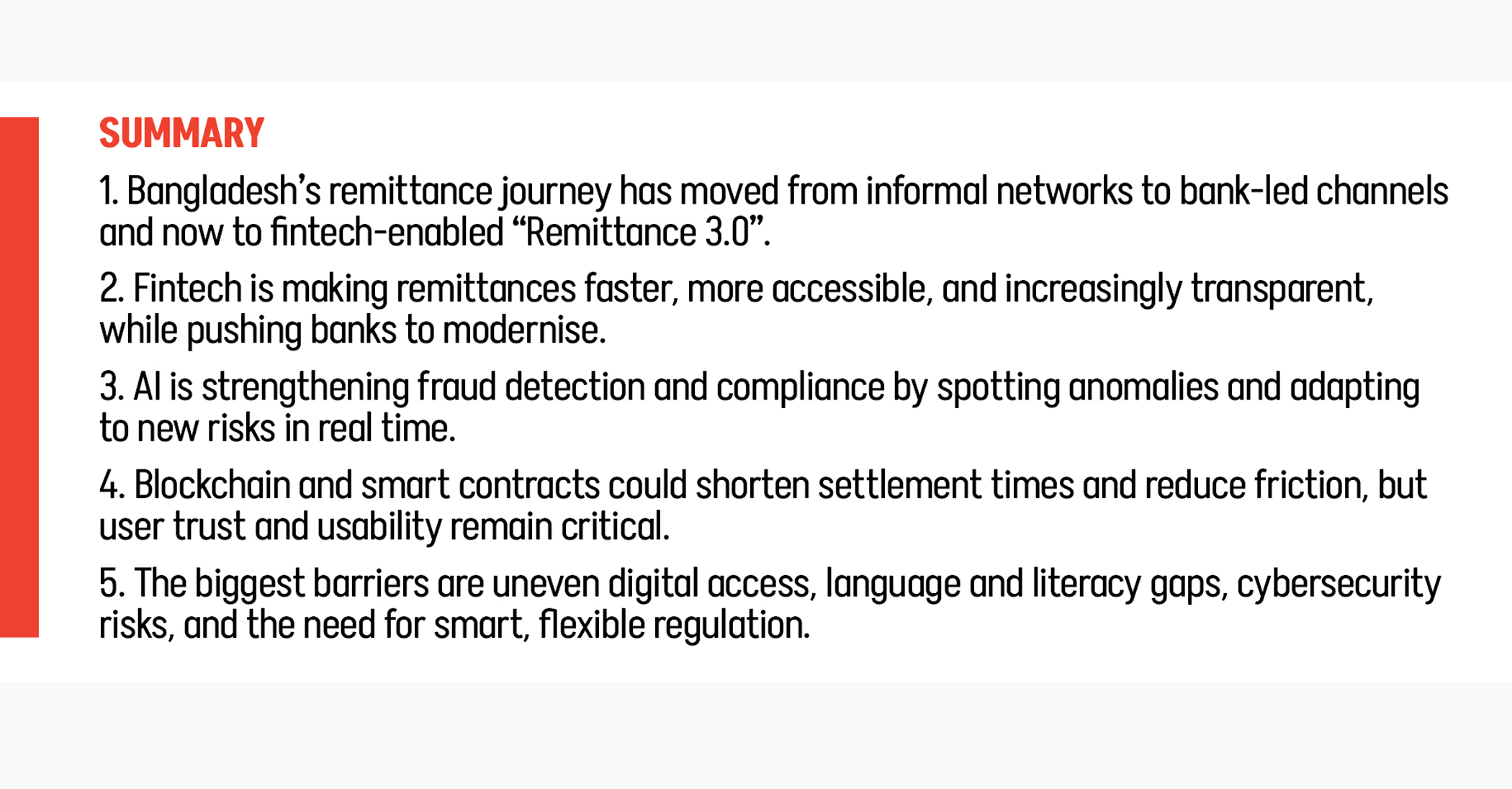
Remittance 3.0, a modern, technology-driven approach, can unlock economic potential and should be adopted in Bangladesh to accelerate growth.
THE EVOLUTION OF REMITTANCES
Even during that bleak period, the oil boom of the 1970s generated massive demand for foreign labour across Gulf countries. That was the first wave that ignited Bangladesh’s remittance story, which emerged not only as a strategic policy choice but also as an economic necessity. Migrants’ blood, sweat and tears became a lifeline for their families and communities, and a crucial source of foreign exchange. This marked the start of Remittance 1.0: an informal process of sending money back through friends, relatives, or travellers, supported by postal money orders and the growth of hundi networks.
Back then, remittances and their link to the wider economy were viewed narrowly. They were seen primarily as a survival mechanism for families. As globalisation gained momentum through the 1980s and 1990s, labour mobility became one of the country’s crucial export channels.
Gradually, remittances grew steadily, shifting from household support to a macroeconomic pillar. The foreign exchange market strengthened, and parts of the rural economy stabilised. This period also pushed banks to deepen relationships with foreign banks and money transfer operators (MTOs) such as Western Union and MoneyGram, ushering in the era of Remittance 2.0.
As the sector expanded, transparency improved and reserves increased. Yet informal channels such as hundi often prevailed, driven by simpler processes and, at times, better exchange rates than formal routes. Next came Remittance 3.0: a technological shift that pulled the country further into fintech, powered by the rise of BKash and Nagad and the emergence of newer fintech players such as Nala, TapTap Send, and now Google Pay. This ripple effect also pushed traditional banks to accelerate their own fintech initiatives, reshaping remittances into a faster, more accessible, technology-driven ecosystem.
Even so, the promise of Remittance 3.0 has not reached everyone. Many users still face a quieter form of digital segregation, shaped by unfamiliar interfaces, language barriers, low digital literacy, and compliance models that can feel rigid and opaque. In practice, these frictions can deter migrants and families from using formal digital channels, even when the tools exist.
AI, BLOCKCHAIN, AND FINTECH
The remittance sector has been undergoing major change worldwide. Technology has made transfers faster, safer and more accessible. Artificial intelligence (AI) is a clear example.
Machine-learning models can analyse data in real time to flag anomalies, identify fraud patterns, and support compliance with anti-money laundering (AML) and counter-terrorism financing (CTF) requirements. They also adapt to new risks by learning from historical data across millions of transactions.
Blockchain can add a second layer. It functions as a shared, secure digital ledger in which every transaction is recorded permanently and cannot be altered. By reducing reliance on long banking chains, blockchain can shorten settlement cycles and shrink the distance between sender and receiver. Transfers that once took days can reach recipients’ mobile wallets far more quickly.
For instance, Surgepay in the Philippines is often cited as part of this shift. Users acquire stablecoins (USDC, BUSD, and USDT) from an authorised cryptocurrency exchange, send them to their Surgepay wallet, and from there can make transfers with minimal transaction fees.
At the same time, fintech is changing the financial behaviour that surrounds remittances. In many countries, it is creating easier pathways to save, invest and build financial resilience, reducing how dependent households are on remittance income alone. Fintech is beginning to shift the picture in Bangladesh as well. Mobile financial services (MFS) are now widely used for domestic transactions, while a growing range of international transfer applications have become reliable channels for remittances. Digital wallets and banking technologies have also made it easier for ordinary citizens to save and invest small amounts without relying on informal channels or physical bank branches. Government services now offer digital payment options for utility bills and other fees, helping suburban and rural populations gradually adopt cashless transactions.

In Bangladesh, the combination of AI and blockchain could push these developments further by strengthening fairness, resilience and efficiency. AI can act as a smart guide for transfers routed over blockchain networks, reading congestion and cost to find quicker, cheaper routes, saving time and money for senders. Smart contracts, essentially automated rules written into software, can add efficiency too. They can verify whether a transaction meets defined conditions and then execute transfers instantly when requirements are satisfied, reducing paperwork and delays.
This blend of technologies does more than speed up remittances. It creates new ways to use money, and new routes for diaspora capital to support development. For Bangladesh to benefit fully, it will need a supportive environment. That includes clear, flexible rules, including tools such as regulatory sandboxes where new ideas can be tested safely. Data privacy must be taken seriously. Digital literacy programmes are also essential so people can use these tools confidently and safely. If these pieces come together, remittance inflows can evolve from short-term household support into a longer-term development tool.
Remittance 3.0 as a tool of global influence
Remittance 3.0 is not only about sending money faster or cheaper. It represents a shift that can strengthen Bangladesh’s position in the world and reshape society from within. When remittances move through digital, formal channels, they become more transparent, traceable and reliable. This can help strengthen foreign exchange reserves and improve macroeconomic visibility. With clearer data and stronger buffers, Bangladesh may be better placed to engage with international institutions and partners, including in trade and development discussions, with greater confidence.
 For all latest news, follow The Daily Star's Google News channel.
 At the global level, this transformation can also improve Bangladesh’s reputation. Successful local platforms and fintech companies demonstrate that the country can build world-class financial technology. Instead of only importing solutions, Bangladesh can increasingly share ideas, products and operational lessons. That shift can raise its soft power and position the country as a leader in digital finance within the Global South.
Remittance 3.0 also has the potential to strengthen ties between the diaspora and the homeland. Fintech platforms can go beyond transfers, allowing overseas Bangladeshis to invest directly in local businesses, community projects, or climate-resilience initiatives.

Challenges and setbacks
Challenges remain. Cybersecurity threats, digital fraud and data privacy risks persist. Digital literacy gaps also remain, despite efforts to address them, limiting how fully migrants and their families can benefit from digital tools. Policymakers and fintech players therefore need to work together through a rigorous, coordinated push that protects users without stifling innovation, and builds an ecosystem of trust among both senders and receivers.
Today, remittances are more than a financial flow. They can be a tool for diplomacy, social progress and shared nation-building. Digital channels have made transfers faster, safer and more traceable, but access is still uneven. To sustain diaspora engagement, Bangladesh must offer secure, trusted and user-friendly digital services. By combining smart technology with smart policy, the country can help its young population move from simply receiving money to building wealth, supporting local business growth, and creating a more self-sufficient economy.
The future of remittances in Bangladesh depends on how well technology, policy and people are aligned. Remittance 3.0 offers a chance to formalise flows, deepen trust and unlock productive use of diaspora capital. If guided by smart regulation and user-first design, fintech can transform remittances into a strategic tool for sustainable growth.
Mahmudul Hasan is the Head of Growth at NALA Bangladesh, a mobile financial services provider.
Comments