


A year of deadly dengue outbreak

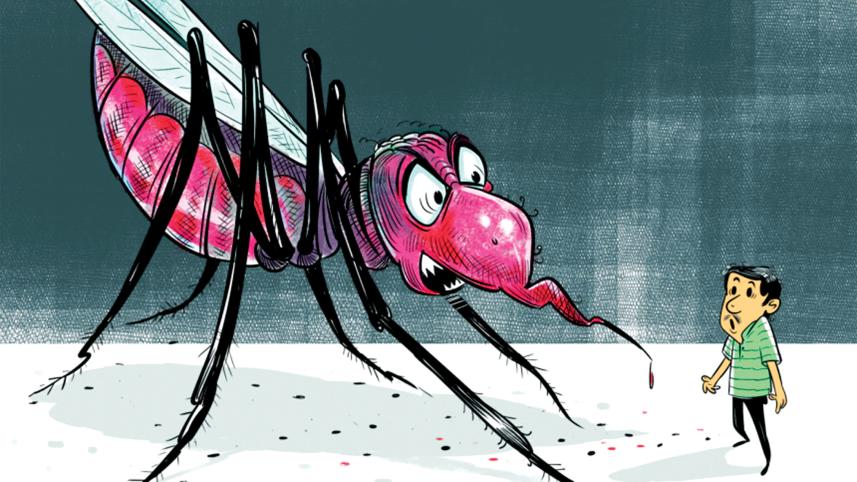
With 68 new dengue cases reported in the last 24 hours till yesterday, the total number of cases this year reached 1,02,861, the second-highest tally recorded in Bangladesh over the past 25 years.
The country also recorded 413 dengue-related deaths this year, making it the third deadliest on record.

The highest 3,18,749 dengue cases and 1,705 deaths were recorded in 2023.
Among the divisions, Barishal recorded the highest 21,551 dengue cases this year, followed by Dhaka division (outside city corporations) with 17,386 cases, and Chattogram with 15,116 cases.
Within Dhaka city, 17,059 cases were reported in Dhaka North areas and 14,623 in Dhaka South city corporation areas, according to data of the Directorate General of Health Services (DGHS).
Of the total dengue cases, 62.5 percent were male and 37.5 percent female, while 52.1 percent fatalities were male and 47.9 percent were female.
Month-wise data shows that November recorded the highest 24,535 cases this year, followed by 22,520 in October, 15,862 in September, 10,684 in July, and 10,496 in August.
To prevent a similar situation next year, entomologists and health experts stressed that preventive measures to control Aedes mosquitoes must begin as early as January.
GM Saifur Rahman, an entomologist at National University, stressed the need for full adoption of an Integrated Mosquito Management System, establishment of a dedicated mosquito-control authority, and implementation of coordinated nationwide programmes.
"There must be a consistent surveillance system followed by continuous control mechanisms," he said.
He also noted that dengue prevention efforts lack uniformity. "We cannot have one system in Dhaka North, another in Dhaka South, and a different one in Chattogram. There must be a single top authority issuing unified instructions nationwide," he said.
He also identified late case reporting as a critical issue. "If cases are detected early and information is shared promptly, early control measures can prevent severe outbreaks and epidemics," he explained.
"We always act after widespread transmission begins. This must change," he also said, citing Brazil, where dengue cases rose to 6.5 million by 2024.
"Our situation could worsen even faster due to our high population density," Saifur added.
 For all latest news, follow The Daily Star's Google News channel.
Comments