


Women going to China on family visas soaring

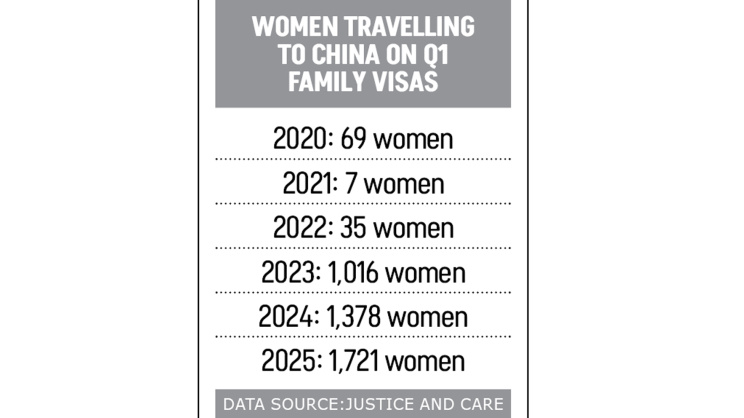
At least 4,226 Bangladeshi women travelled to China on family visas between 2020 and 2025.
The annual number rose from 35 in 2022 to 1,721 in 2025.

The disclosure comes amid growing concern over women being trafficked to China through sham marriages, while officials said a proposed standard operating procedure to tighten scrutiny of marriages involving foreign nationals is now being vetted by the law ministry.
The figures were disclosed at a workshop on the Prevention and Suppression of Human Trafficking and Smuggling of Migrants Act, 2026, organised by Justice and Care Bangladesh with the support of the British High Commission, at a Dhaka hotel yesterday.
Over 4,000 women travelled to China on Q1 visas -- a long-term family reunion visa for stays exceeding 180 days -- between 2020 and 2025.
Officials working at the special branch told The Daily Star that the proposed standard operating procedure would impose additional documentation and verification requirements on marriages involving foreign nationals.
Under the draft, a foreign national would have to be staying in Bangladesh with a valid passport and visa, and a visa on arrival would not be accepted for the purpose.
Before marriage, the foreign national would have to produce an unmarried-status certificate issued by the relevant local council in their country and authenticated by that country’s embassy or high commission in Bangladesh.
The marriage would have to be registered through an authorised marriage registrar. In the three hill districts, registration would also have to comply with local rules involving the district councils.
After registration, the marriage certificate would have to be authenticated first by a notary public and then by the law ministry and the foreign ministry, according to the proposed procedure.
Concerns over trafficking through cross-border marriages have persisted for years, particularly involving women from vulnerable communities.
According to sources, trafficking networks were targeting Bangladeshi women, including indigenous women from the Chattogram Hill Tracts, and arranging marriages with Chinese nationals.
A Chakma woman in Rangamati filed a case in 2024 alleging her 21-year-old sister had been taken to Dhaka and forced to marry a Chinese man, while a 21-year-old Marma woman from Khagrachhari separately alleged that traffickers had compelled her to marry a Chinese national before she was rescued.
More recently, in August, a 19-year-old woman from Bagerhat alleged she was drugged, threatened with compromising videos, and married off to a Chinese man before being trafficked to China, where she said she was subjected to torture and sexual abuse.
She returned to Bangladesh on August 4 with the help of Justice and Care.
The Chinese embassy in Dhaka has also raised concerns over illegal marriage brokers. In a July 14 notice, it warned Chinese citizens that illegal “bride-buying” arrangements could lead to trafficking, extortion, threats, physical harm and financial losses.
At yesterday’s workshop, Md Abu Noman, additional superintendent of police at Immigration, said criminal networks were exploiting the system by forging documents to secure visas and were also using artificial intelligence to fabricate information for trafficking.
He said Bangladesh Immigration had introduced several measures and tools to prevent such crimes, including offloading potential victims.
Dr Ziauddin Ahmed, additional secretary at the home ministry, said trafficking and migrant smuggling were transnational organised crimes and the media had a critical role in raising awareness.
Mohammad Tariqul Islam, country director of Justice and Care Bangladesh, said the 2026 law introduced migrant smuggling as a separate chapter in line with international protocol and expanded the powers of Anti-Human Trafficking and Migrant Smuggling Tribunal judges and investigation officers.
 For all latest news, follow The Daily Star's Google News channel.
 He said offences such as rape and murder linked to trafficking cases, which previously fell outside the tribunal’s jurisdiction, could now be dealt with by tribunal judges as ancillary offences.
Comments