


MT Hossain Institute: A fading chapter of our cultural history

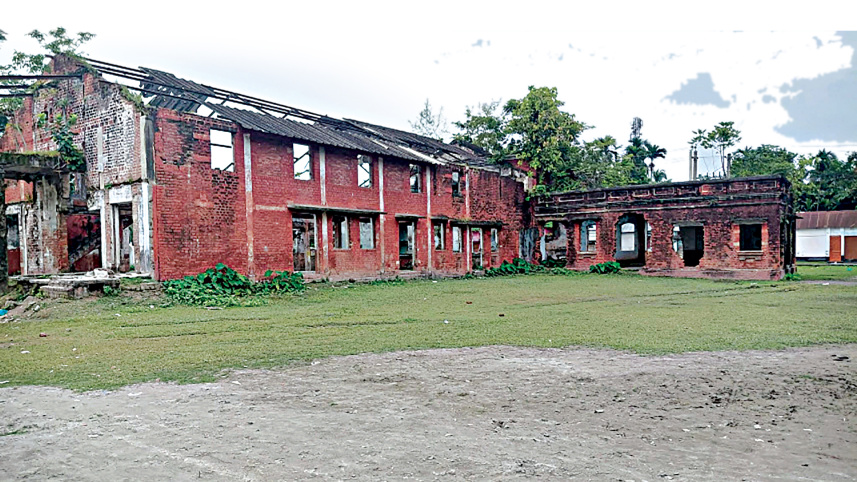
A crumbling building on a sprawling railway compound along Fire Service Road in Lalmonirhat town stands as a fading reminder of the region’s rich cultural history. It is the historic MT Hossain Institute, once a major cultural hub of northern Bangladesh and home to one of the Indian subcontinent’s rare revolving theatre stages.
Established in 1905 as the Pierce Institute on around 2.73 acres of railway land, the institution was renamed in 1934 after railway ticket examiner MT Hossain, whose dedication and service earned him widespread respect among railway employees.

Naming such an institution after a local railway worker during British rule was considered highly unusual, as public institutions at the time were generally named after colonial officials.
The institute’s most remarkable feature is its revolving stage, built on a circular platform with an iron rail-and-wheel mechanism that allowed scenery to be changed without lowering the curtain. Theatre historians consider it one of the last surviving revolving stages in South Asia.
During its heyday, the institute hosted theatre productions, musical performances, poetry recitals, literary gatherings and film screenings, attracting artists and cultural figures from across the country.
Veteran playwright and actor Chittaranjan Roy, who performed there several times, said it was once considered a prestigious venue for cultural organisations.
“I acted here many times. Today, it breaks my heart to see this historic institution reduced to a skeleton,” he said.
Cultural activist Shamim Ahmed said the institute had served as a theatre, cultural centre and cinema hall.
“It was simultaneously a theatre, cultural centre and cinema hall. It introduced modern entertainment to the people of Lalmonirhat,” he recalled.
Researchers believe the institute also played an important social and cultural role before and after Bangladesh’s Liberation War by fostering public awareness and strengthening community ties.
However, from the 1980s onwards, its activities gradually declined due to a decline in sponsored cultural programmes, the rise of television, waning public interest in theatre, inadequate funding and prolonged administrative neglect.
In 2017, a proposal to build an educational institution on the premises triggered protests from cultural activists and civil society members, eventually halting the plan. Heritage advocates have since demanded that the institute be declared a protected heritage site.
A theatre festival in 2019 and a folk festival in 2023 briefly revived activities there, but no comprehensive restoration followed.
Architect Abeg Rahman completed an award-winning adaptive restoration proposal for the institute in 2024, documenting its historical significance and suggesting new cultural uses for the century-old building.
Sufi Mohammad, general secretary of the Sammilito Cultural Forum in Lalmonirhat, said they had been campaigning for years to revive the institute.
The Department of Archaeology (DoA) says it is now working to bring the institute under its conservation programme.
As part of the initiative, the Ministry of Cultural Affairs has requested the Ministry of Railways to transfer ownership of the property before conservation work can begin, said Abu Sayeed Enam Tanvirul Islam, DoA field officer in the Rangpur Division.
“The MT Hossain Institute was once the centre of cultural activities in northern Bangladesh. It possesses immense historical value and deserves preservation,” he added.
 For all latest news, follow The Daily Star's Google News channel.
Comments