


LDC graduation: UN report flags serious gaps in readiness

Bangladesh’s readiness for graduation from least developed country status in November this year has been undermined by domestic and international crises, a UN assessment warns, with the US-Israel war on Iran adding a new threat.
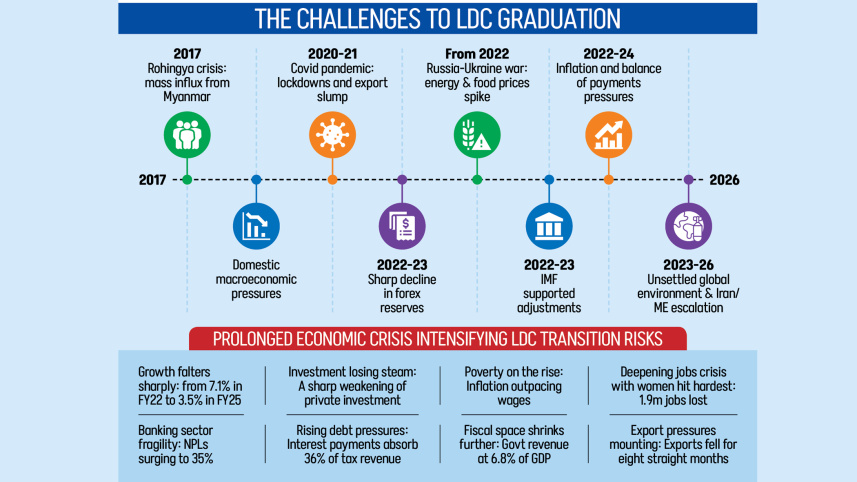
The report, released yesterday, underscores a series of shocks the country has faced between 2017 and 2026. These include continued exposure to climate vulnerability; the Rohingya crisis; a prolonged macroeconomic downturn predating the regime change; Covid-19 fallout; political transition; the Russia-Ukraine war; inflation; and balance of payments pressures.
 For all latest news, follow The Daily Star's Google News channel.
An expert panel of the United Nations Office of the High Representative for Least Developed Countries, Landlocked Developing Countries and Small Island Developing States (UN-OHRLLS) has prepared the Graduation Readiness Assessment.
It finds that while Bangladesh meets all three criteria for graduation, significant risks persist, including the loss of trade preferences, fiscal and financial vulnerabilities, and fragile institutional coordination.
The report stresses the need for urgent reforms, stronger implementation capacity, adequate policy space, and a whole-of-society approach to ensure a smooth and sustainable transition.
Mohammad Abdur Razzaque and Daniel Gay, consultants to UN-OHRLLS, presented key findings at a consultation organised by the Economic Relations Division at the Planning Commission in Dhaka yesterday morning.
“The assessment report shows that the graduation readiness of Bangladesh is weak and has a lot of concerns and challenges,” Razzaque told The Daily Star on the sidelines of the event attended by ministers, diplomats, economists, business leaders, and researchers.
“Transition away from reliance on international support measures (ISMs) deserves to be viewed as a complex and carefully managed adjustment, requiring sustained policy attention and international support, institutional capacity, and risk mitigation to ensure that development gains are preserved and further consolidated in the post-graduation period. Smooth transition is key,” the report said.
It added that a difficult political transition and prolonged macroeconomic crisis have dented socio-economic gains, intensifying Bangladesh’s LDC transition risks.
Citing economists and other stakeholders consulted for the assessment, the report said rising import costs for fossil fuels create severe operational constraints with gas supply shortages worsened by the war.
“A reliable, affordable energy supply is prerequisite for offsetting preference erosion through productivity enhancement and export diversification,” it added.
Bangladesh is scheduled to graduate on November 24 this year after meeting all three criteria -- per capita income, human asset index, and economic vulnerability index -- twice since 2018, under two triennial reviews by the UN Committee for Development Policy (UN CDP), which decides on LDC graduation. The country also received a two-year extension due to the Covid-19 pandemic.
Amid criticism from local businesses over potential export losses and economic vulnerabilities, the immediate past interim government had requested an independent UN assessment.
Subsequently, the BNP government applied to the UN CDP on February 23, seeking to defer graduation by three years to November 2029, citing economic fragility.
In response, UN-OHRLLS commissioned the assessment last year, drawing on consultations with government agencies, the private sector, civil society, development partners, and the UN system. The report examines Bangladesh’s preparedness for the withdrawal of LDC-specific support measures, emerging vulnerabilities, and institutional readiness to sustain development gains.
Under-Secretary-General and High Representative of UN-OHRLLS Rabab Fatima said Bangladesh’s request for a three-year deferral is under consideration by the crisis response process of CDP’s Enhanced Monitoring Mechanism.
She added that once the technical review is complete, the CDP will submit recommendations to the UN Economic and Social Council, which will form the basis for a General Assembly decision.
MAJOR ECONOMIC LOOPHOLES
Speaking about transition risks, the report mentioned that economic growth slowed sharply from 7.1 percent in FY22 to 3.5 percent in FY25, dampening momentum just before graduation.
Meanwhile, poverty is on the rise with inflation outpacing wages and pushing millions into greater hardship and vulnerability.
Private investment weakened significantly, with capital machinery imports falling from $5.1 billion to $2.8 billion during 2019-2024.
The jobs crisis has deepened, with nearly 1.9 million jobs lost between 2023 and 2024, disproportionately affecting women.
Financial sector fragility remains acute, with non-performing loans in banks surging to 35 percent.
Fiscal space is extremely limited, with revenue at just 6.8 percent of GDP, while interest payments consume 36 percent of tax revenue, pushing the country’s debt distress risk from low to moderate.
Exports have declined for eight consecutive months, with US tariffs and volatile global trade conditions worsening external pressures.
AREAS OF WEAKNESS
The report said that Bangladesh’s preparedness for the loss of trade-related international support measures remains weak, with nearly 75 percent of exports dependent on LDC-specific duty-free access.
A recent UNCTAD report estimates Bangladesh could lose over $17.5 billion in annual exports after graduation.
Only limited mechanisms, such as the UK’s Developing Countries Trading Scheme and a free trade agreement with Japan, have been secured.
Preparedness for the EU market, the largest destination, remains the weakest link. Inadequate preparation for the post-LDC phase, with no preferential EU market access for apparel, comes just as the recently concluded EU-India and EU-Vietnam FTAs are set to intensify competitive pressure.
Bangladesh is also unprepared for the loss of World Trade Organisation policy flexibilities, particularly around export subsidies and Trade-Related Aspects of Intellectual Property Rights obligations, which will require stronger intellectual property protection and enforcement capacity.
Domestic readiness to offset preference erosion through lower logistics costs, improved compliance, energy reliability, and export diversification remains inadequate.
The report warns that amid ongoing macroeconomic turmoil, Bangladesh’s vulnerabilities, including reliance on external support, a lack of diversification, and exposure to shocks, could become more pronounced.
Bangladesh’s preparedness for post-LDC financing realities is poorly aligned with the scale of the challenge. While concessional finance will not end abruptly, terms are tightening and LDC-specific windows are shrinking.
Global Official Development Assistance is also under pressure, with Bangladesh graduating amid declining aid flows and tighter donor budgets.
Effective use of available finance is constrained by weak project management, poor revenue mobilisation, rising debt servicing, and limited fiscal space. Coordination gaps and delayed preparation have hindered strategic use of transition-related financing opportunities.
Implementation of the Smooth Transition Strategy (STS) has also been slow and uneven, with limited private sector engagement, weak inter-ministerial coordination, and unclear financing frameworks.
Although Bangladesh meets all graduation criteria, the central challenge lies in managing the transition and sustaining development gains.
As the largest LDC and the biggest beneficiary of international support measures, Bangladesh faces a uniquely complex transition. The process is unfolding amid political uncertainty and a prolonged economic crisis, placing decades of progress under strain, the report said.
The UN has repeatedly emphasised, including under the Doha Programme of Action, that graduation should not disrupt development, making a smooth transition essential.
In this sense, Bangladesh represents a critical test case for ensuring that graduation translates into sustainable progress, the report said.
STAKEHOLDERS’ CONCERNS
Consultations with 20 government agencies, industry bodies, civil society, and development partners during the preparation of the assessment report reveal persistent concerns.
Stakeholders emphasised the need to shift towards productivity-driven competitiveness, strengthen macroeconomic stability, and improve institutional coordination.
Economists estimate potential export losses of 5.5–15 percent due to the erosion of duty-free access, alongside higher costs for non-generic drugs due to TRIPS obligations.
They also highlighted fiscal and financial weaknesses, including a low tax-to-GDP ratio, high non-performing loans, currency depreciation, declining domestic savings, and falling foreign direct investment.
Logistics inefficiencies costing around 16 percent of GDP, more than double the global average, continue to erode export competitiveness.
Priority areas identified include bilateral and regional trade agreements, tax reform, export diversification, institutional strengthening, and energy sector reforms, particularly in renewables.
RECOMMENDATIONS
Meeting graduation thresholds alone does not ensure readiness for a smooth transition, the report cautions.
It said Bangladesh must urgently focus on nine priority areas: securing EU market access, stabilising the macroeconomy, reforming the banking sector, ensuring energy reliability, improving logistics, enhancing sectoral preparedness, strengthening employment and social protection, expanding fiscal space, and deepening engagement with the UN system.
With political upheaval, economic stress, and implementation gaps converging, the February 2026 CDP review represents the final structured opportunity to reconsider the graduation timeline.
Sustained progress, the report concludes, will depend on structural reforms, from export diversification and energy transition to governance and logistics, in order to shift from preference-dependent growth to productivity-driven competitiveness.
POLICYMAKERS’ VIEWS
Finance Minister Amir Khosru Mahmud Chowdhury said Bangladesh has no scope to move toward LDC graduation in the current context, citing severe economic distress inherited from the previous government.
“The government is firefighting to stabilise the economy. The Middle East war has raised fuel import costs, causing our reserves to bleed,” he added, briefing reporters at the National Multistakeholder Consultation on Bangladesh’s Graduation Readiness Assessment at the NEC conference room.
He further said, “Debt repayment is a major challenge. Only after capacity building and fulfilling our election pledges can we decide when to pursue LDC graduation.”
Commerce Minister Khandakar Abdul Muktadir also stressed the importance of prudent debt management and expanding the tax base to restore momentum.
Rashed Al Mahmud Titumir, PM’s adviser on finance and planning, said structural transformation, diversification, competitiveness, and productivity gains are essential to achieve the vision of a “Trillion Dollar Economy” by 2034.
Comments