


Fertiliser prices soar amid ‘artificial crisis’


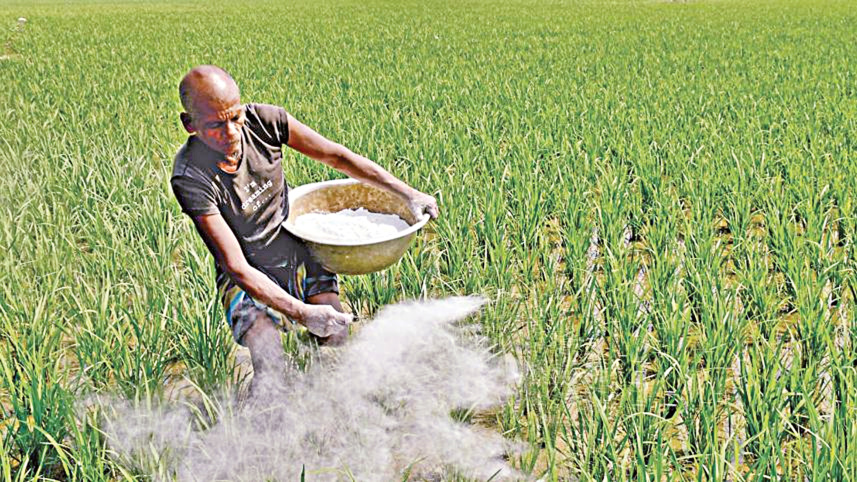
For farmers racing against the crop calendar, fertiliser is becoming a source of anxiety.
Across the country, they say they are struggling to obtain it from government-designated dealers, forcing many to turn to the open market and pay inflated prices even as the authorities insist supplies are adequate.

The Daily Star’s interviews with farmers in at least 10 districts found widespread complaints that fertiliser was either unavailable or rationed at dealer points.
Open-market prices were Tk 300-350 higher per 50kg sack, and some farmers said they still could not secure the quantities they needed even after being prepared to pay.
In Rajshahi’s Godagari upazila, farmer Mohammad Bablu said he needed 10 sacks for his 16 bighas of Aman. Unable to get fertiliser from the dealer in his area, he went to a market in neighbouring Kotchandpur upazila, only to be told he could buy 20kg.
“I returned home without buying it,” he recalled.
He later had to turn to the open market, where sacks priced at Tk 1,050–1,350 were selling for Tk 1,650-2,150.
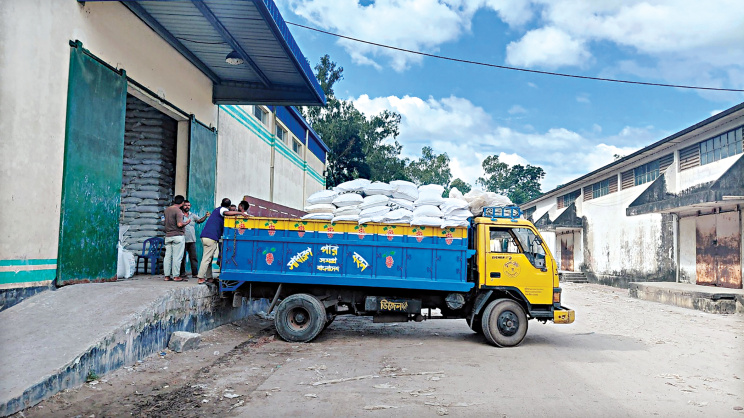
In Lalmonirhat’s Kaliganj upazila, farmer Latif Uddin said he needed five sacks for his 10 bighas of Aman but received only one from the dealer. He bought the rest from the open market, paying Tk 350 more per sack.
“Dealers are secretly selling fertiliser to retailers instead of farmers at government-fixed prices,” he alleged.
In Sirajganj’s Kazipur upazila, farmer Kabir Hossain, 40, said he had been unable to collect fertiliser from dealers for two days.
He alleged syndication by dealers at a time when fertiliser is crucial for Aman fields and for preparing land for early winter vegetables.
Similar complaints came from Kurigram, Jhenaidah and Rajshahi, with farmers saying dealers often told them fertiliser was out of stock.
Harun-or-Rashid, a farmer from Paba in Rajshahi, said, “I came to buy fertiliser with my own money, but even then, it is not available. If this situation continues, it will become difficult to cultivate our fields,” he said.
‘STOCKS ADEQUATE’
Agriculture ministry data show fertiliser demand for July-September at 13.21 lakh tonnes against current stocks of 13.65 lakh tonnes.
“There is no reason for a shortage given the current stock,” Agriculture Secretary Md Salim Khan told The Daily Star.
He said the government was closely monitoring imports of non-urea fertilisers, with shipments coordinated according to fixed lead times and arrival schedules from Morocco, Saudi Arabia, Tunisia, Russia and Canada.
Agriculture Minister Mohammed Aminur Rashid alleged the disorder in distribution despite adequate stocks was part of a “planned conspiracy”.
District agriculture officials echoed the government’s position, attributing pressure on supplies partly to farmers buying fertiliser in advance for maize and potato cultivation and, in some cases, using more than the recommended amount.
Jamil Ahmed, a fertiliser dealer from Mansurnagar union in Kazipur, Sirajganj, said farmers in char areas had been buying fertiliser in advance for maize cultivation after hearing about a possible shortage.
 For all latest news, follow The Daily Star's Google News channel.
 Omar Ali Rasel, manager of a dealer point in Sadhuhati union, Jhenaidah, said, “We are distributing all the fertiliser we receive as allocated among the farmers. No irregularities are taking place.”
The official assurances, however, have done little to ease farmers’ frustration.
On August 23, angry farmers in Kurigram’s Bhurungamari upazila broke into a dealer’s warehouse and took away 197 sacks of urea.
‘DEALERS BEHIND CRISIS’
Abu Saleh Md Shamim Alam Shibly, research fellow at the Centre for Policy Dialogue, said the apparent surplus was too small to assure the market of adequate reserves, while weak government oversight was allowing dealers to exploit the situation.
He said some individuals held multiple licences under different names. In some districts, he added, a few dealers controlled the maximum allocations, effectively creating local monopolies.
The absence of an effective database of dealers makes it difficult to identify individuals or families holding multiple licences, he said.
Ahmed Faisal Imam, additional secretary of the Fertilizer Management and Monitoring Branch at the agriculture ministry, said the current situation was highly unusual for this time of year.
Farmers normally face some difficulty obtaining fertiliser during the peak Boro season, he said.
Asked who might be responsible for the current disruption, Imam said he suspected a group of dealers of creating the crisis.
The ministry has already taken action against dealers, he said. Five dealership licences have been suspended and around 25 dealers fined in connection with the recent crisis.
Agricultural economist Jahangir Alam Khan said the immediate problem was one of distribution rather than a supply crunch.
“The government needs to address the management failure immediately, while reducing Bangladesh’s heavy dependence on imported fertiliser,” he said.
Bangladesh’s heavy reliance on imports also leaves the fertiliser market vulnerable to international disruptions, particularly amid the ongoing Middle East conflict and China’s export restrictions.
Bangladesh is projected to require 58 lakh tonnes of chemical fertiliser in 2026-27 fiscal year. But domestic production remains constrained by gas shortages.
The seven state-run fertiliser plants have a combined annual production capacity of more than 37 lakh tonnes, but produced only 11.06 lakh tonnes, or around 30 percent of capacity, in 2025-26 fiscal year.
To keep the stocks at a satisfactory level, the Cabinet Committee on Government Purchase yesterday approved the import of 3.65 lakh tonnes of fertiliser, following approval last week for another 1.15 lakh tonnes from Canada, Russia and Saudi Arabia.
[Our correspondents in Chattogram, Jhenaidah, Rajshahi, Bogura, Thakurgaon and Sirajganj contributed to this report]
Comments