


Allowing Hasina to speak from India contradicts 'friendly ties': Salahuddin
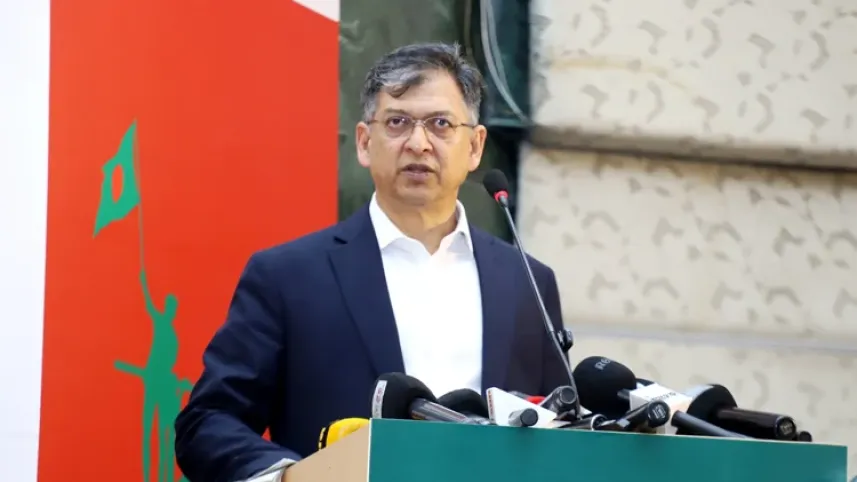
Home Minister Salahuddin Ahmed today said allowing ousted prime minister Sheikh Hasina to make political statements from India and speak to international media was inconsistent with India’s wishes to maintain friendly relations with Bangladesh.
“You [India] will play the Hasina card while seeking a friendly relationship with Bangladesh. Those two things are contradictory. I hope the Indian authorities and government understand this,” he said at a discussion at the Dhaka University Senate building today, marking the second anniversary of the July mass uprising.

The event titled, “Teachers’ Role in the Fall of the Fascist Government”, was organised by the white panel, a pro-BNP teachers association of Dhaka University, and the University Teachers’ Association of Bangladesh (UTAB).
The minister said Bangladesh recognised its relationship with India as one of interdependence and wanted to maintain friendly ties with its neighbour. Still, such relations must be based on mutual dignity and respect, sovereignty and equality.
“We want to maintain friendly relations with you. But we will never become Awami League. We will maintain relations with you while upholding Bangladesh’s interests, based on mutual dignity and respect and based on sovereignty and equality,” he said.
His remarks came amid Bangladesh-India tension over Hasina’s recent press conference from India.
Referring to a statement by Indian External Affairs Ministry spokesperson Randhir Jaiswal a day earlier that India did not endorse anything said at Hasina’s press conference, Salahuddin said, “That much we accept.”
“But we also do not support the fact that you repeatedly allow a convicted person, whom we consider responsible for fascism, mass killings and crimes against humanity, to speak to the world media while sitting there,” he said.
Salahuddin also rejected comparisons between Hasina’s presence in India and BNP Chairman Tarique Rahman’s political activities while in London.
“It is being said that Mr Tarique Rahman can conduct politics from London, so what is Hasina’s fault?... Yes, Hasina has faults. None of us were fascists. We fought for democracy, and we were forcibly exiled. This is the difference between us and Hasina,” he added.
The BNP leader then referred to Hasina’s past remarks regarding India’s support for her government.
“Everyone remembers she once said that India would remember forever what she had given India. India has given her shelter as it remembers what she has given to India. This is reciprocal," he said.
“Here lies the difference,” he added.
Salahuddin alleged that Hasina had neither expressed remorse nor apologised to the people of Bangladesh.
"Can India still recognise the fallen dictator -- accused of crimes against humanity, killing more than 1,400 people according to a UN report, and even shooting from helicopters -- as any kind of leader of democratic culture?” he asked.
He further alleged that Hasina was using her stay in India to make statements against Bangladesh’s democratic process and to create instability in the country.
“The statements she is making from Delhi against our democratic culture, democracy and the people of this country, as well as attempts to create instability, are matters we have raised as allegations. India cannot avoid responsibility for this,” he said.
 For all latest news, follow The Daily Star's Google News channel.
Comments