


‘Delhi didn’t like what our students did’
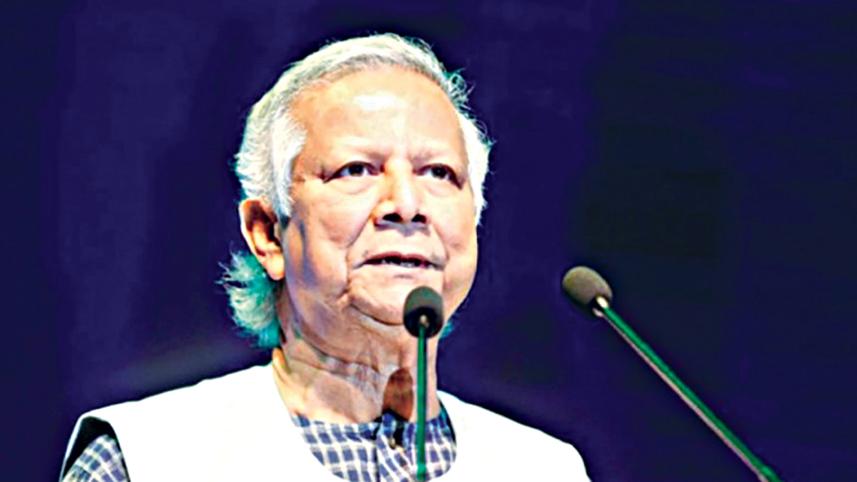
India has not been able to accept the change in Bangladesh because it "did not like" what the students did during the uprising last year, said Chief Adviser Prof Muhammad Yunus.
He said India's hosting of ousted prime minister Sheikh Hasina, who created all sorts of problems in the country and killed young people, is not helping bilateral ties between the neighbours.

"And that creates a lot of tension between India and Bangladesh. Also, lots of fake news is coming from the other side. This is a very bad thing," Yunus said at an event on the sidelines of the UN General Assembly in New York.
The event, arranged by Asia Society and the Asia Society Policy Institute in New York on Wednesday, was moderated by Dr Kyung-wha Kang, president and CEO of Asia Society.
He flagged a piece of fake news claiming that the youth who brought about change in Bangladesh are Taliban. "They even said I'm a Taliban too. I don't have a beard. I just left it at home," he quipped.
Talking about the regional economy, the chief adviser said cooperation is key to development.
Yunus said SAARC is supposed to be a bloc of very close family members, and the idea was born in Bangladesh.
"You can invest in Bangladesh. Bangladesh is going to invest in your territory. That's the whole idea of SAARC," he said. "All of us benefit from that… This is what we should be doing. We have problems with India right now because they did not like what the students have done."
Yunus said SAARC's idea was to bring all the countries in South Asia together so that young people can get in touch with each other.
He said it is important that they visit each other, make friends, study in colleges and universities across the region, and do business.
The chief adviser said, "Our history gave us the opportunity to make that happen, but somehow it didn't fit into the politics of some one country, so it had to stop. We feel very sorry for that."
However, Yunus said Dhaka is willing to make SAARC work. "We want to make sure that we open it up and bring people together. That is the only way to solve our issues."
While acknowledging limitations, he said a country's economic activities can extend beyond its boundaries and benefit the region.
"Look, Bangladesh's economy is defined by the boundaries of Bangladesh… This is a very narrow way of looking at yourself," Prof Yunus said.
"I said, why don't you look at neighbours, like Nepal, Bhutan, and also the seven states of India. In the eastern part of Bangladesh, there are seven states that don't have any access to the ocean. These are landlocked regions," he said, hinting at possible fields of cooperation.
On Asean membership, the chief adviser said Bangladesh can become an informal member of the bloc, and there is a provision supporting it.
"We can do that. Asean would be a good place to go, and you can build it up with regional harmony and regional interconnectivity," he said.
However, he acknowledged the challenges. "It is not easy to get everybody's 'yes' right away, particularly Myanmar, which has a problem with the Rohingyas."
"So they may not come forward, but we'll work on it. We don't see this will start a permanent trouble between Myanmar and Bangladesh," he said.
Yunus said they will have a good relationship with Myanmar. "Having this kind of conflict with each other doesn't help anybody. So, we have to resolve that."
 For all latest news, follow The Daily Star's Google News channel.
 He hoped that Rohingyas would be able to go back to their homes, businesses, and professions in Myanmar.
Comments