


15% journos face sexual harassment at work: survey
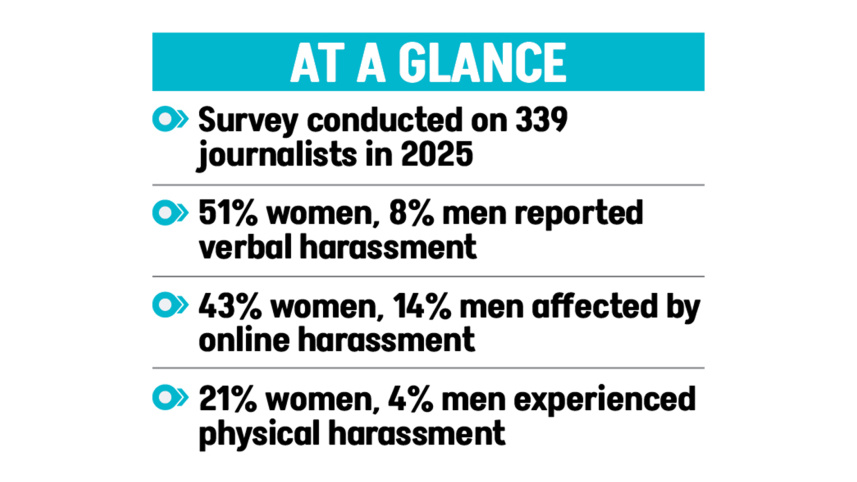
Fifteen percent of Bangladeshi journalists said they had experienced sexual harassment at work, with women reporting significantly higher rates of verbal, online and physical harassment than men, according to a survey of 339 journalists.
Among the 339 respondents, seven women and two men reported that they had experienced rape.

Among women respondents, 51 percent reported verbal harassment, compared with 8 percent of men.
Incidents of sexual harassment often remain hidden due to shame and social stigma. We feel uncomfortable and unsafe talking about it, but silence only allows the problem to continue.
Online harassment was reported by 43 percent of women and 14 percent of men, while 21 percent of women and 4 percent of men reported physical harassment.
The findings were shared yesterday at the launch of the Sexual Harassment Response Protocol for Media Professionals, unveiled by BBC Media Action Bangladesh in partnership with the Women Journalists’ Network Bangladesh at a hotel in Dhaka.
The survey, conducted in 2025 by the World Association of News Publishers in partnership with BBC Media Action, included 100 women and 190 men. Four respondents did not disclose their gender, while 45 preferred not to reveal their identity.
Arafat Siddique, senior media development officer at BBC Media Action, presented the findings, alongside the protocol.
The survey also highlighted weak institutional responses, particularly in cases of verbal harassment.
Arafat said institutional response was often weak. No action was taken in 43 percent cases of complaints by women and 60 percent of men regarding verbal harassment. Where action was taken, it was mostly limited to warnings.
The Sexual Harassment Response Protocol sets a zero-tolerance approach, awareness-building measures, clearer provisions on punishment, and steps to build an effective support network, he added.
The protocol was developed under BBC Media Action’s project titled “Strengthening Women Journalists’ Network to Tackle Sexual Harassment”, with support from the Foreign, Commonwealth and Development Office.
Speaking at the launch event, Matiur Rahman Chowdhury, president of the Newspaper Owners’ Association of Bangladesh, said sexual harassment has become a social ill, and the protocol would not work if it remained confined to paper.
“This cannot be addressed through documents alone. There must be discussions in every newsroom,” he said, adding that media owners and editors must be responsible and that efforts should gradually spread to the district level.
BBC Media Action Bangladesh Country Director Al Mamun said the protocol was developed to help ensure a safer working environment in the media and would serve as an accountability framework for media owners and management.
“We often say the media reflects society. But when women’s participation remains limited, we must question whether the environment is supportive,” he said.
He added that it would only work if institutions adopted a zero-tolerance approach.
Conducting the programme, Women Journalists’ Network Bangladesh Coordinator Angur Nahar Monty said incidents of sexual harassment often remain hidden due to shame and social stigma.
“We feel uncomfortable and unsafe talking about it, but silence only allows the problem to continue,” she said, adding that the protocol was developed through consultations with women and men in media and should be seen as a starting point for ensuring safer workplaces for all.
Suliman Niloy, who prepared the protocol, said organisations already have legal obligations under the High Court directive and existing labour laws. “This protocol does not create new obligations. It helps institutions carry out existing responsibilities in a structured way,” he said.
 For all latest news, follow The Daily Star's Google News channel.
 Shararat Islam, communications analyst at UN Women Bangladesh, said, “We have policies, but enforcement is weak. This protocol can help bridge that gap if organisations take it seriously.” Implementation by major media houses could encourage others to follow, she added.
Academics, senior journalists, development partners, and media professionals also spoke at the programme.
Comments