


Affordable care must be next govt’s focus: Say health experts

With the national election less than a month away, political parties are finalising their manifestos. The Daily Star spoke to experts to identify the pressing issues that should top the agenda for parties.
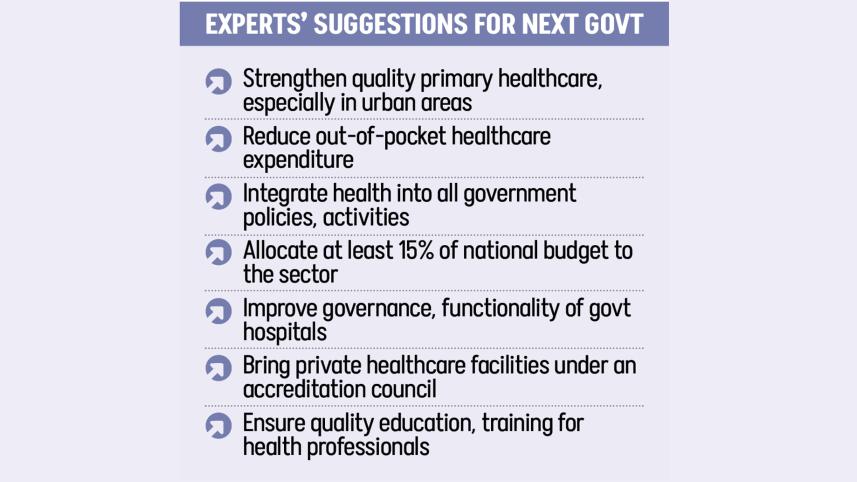
As major political parties prepare to roll out their election manifestos, health experts say that ensuring quality primary healthcare for all and reducing high out-of-pocket expenditure should be their top priority.

They note that primary healthcare remains weak and underfunded, particularly in urban areas, despite its critical role in preventing diseases and protecting people from falling into poverty due to high medical costs.
Health should not be treated as the sole responsibility of a single ministry; rather, it should be integrated into all government policies and activities, they observe.
To achieve these goals, the experts have called for an overhaul of health management, including restructuring the system under three separate directorates -- clinical, academic, and public and primary healthcare -- along with higher budgetary allocations to improve coordination, efficiency, and accountability.
The country goes to the polls at a time when the health sector faces major challenges, including inadequate funding, shortages of health workers, high out-of-pocket expenses, unequal access to services and weak governance.
As thousands of people continue to be deprived of quality treatment, the rise in the total fertility rate for the first time in 50 years has fuelled fresh concerns.
Public health expert Prof MA Faiz said that primary healthcare has not received due importance, particularly in urban areas, where services remain very poor. It should be given priority regardless of whether the area is rural or urban.
He suggested that a doctor-led team should provide services to a defined population size, ensuring that no one is left behind.
In Bangladesh, the universal service package exists only in name. It should be gradually expanded -- both in terms of the number of services and the population covered -- to ensure universal health coverage. Individuals should bear costs according to their financial capacity, said Prof Faiz, also former director general of Directorate General of Health Services (DGHS).
“This needs to be done to reduce people’s out-of-pocket expenditure that remains very high in the country. Excessive healthcare costs are pushing many people into poverty while depriving many others of services.”
He also stressed the need for skill-driven medical education to produce the required manpower capable of providing quality primary healthcare.
“The health budget must be increased to achieve these goals,” he added.
Outlining the major tasks for the next government, Prof Liaquat Ali, a member of the Health Sector Reform Commission, said it will need to review the commission’s report and set priorities for implementing the recommendations.
The first priority should be to enact a law declaring primary healthcare a constitutional obligation and provide these services free of cost, said Prof Liaquat, also a former vice chancellor of Bangladesh University of Health Sciences.
At least 15 percent of the national budget, or five percent of the country’s gross annual income, should be allocated to the health sector in phases, he said, adding that the allocated budget must be fully utilised.
He also recommended reorganising the healthcare system under three directorates -- clinical, academic, and public and primary healthcare -- to ensure better coordination and service delivery, with adequate manpower assigned accordingly.
Stressing the need to reduce out-of-pocket healthcare expenditure, Mohib Ullah Khondoker, a member of the executive management committee at Gonoshasthaya Kendra, said the next government must properly regulate the medicine market.
It must ensure that all stakeholders adhere to the updated National Essential Drug List once the prices of the 295 medicines on the list are fixed, he noted.
“Priority should be given to ensuring quality education for health professionals and strengthening primary healthcare services, particularly in view of the growing burden of non-communicable diseases, which involve high treatment costs,” he added.
 For all latest news, follow The Daily Star's Google News channel.
 Emphasising the importance of preventive and promotive healthcare, Prof Syed Abdul Hamid from the Institute of Health Economics at Dhaka University said these areas should be prioritised so that fewer people fall sick.
All ministries must play a role by giving priority to health issues, which means health should be integrated into all government policies and activities, he said.
The country has a large network of government hospitals to provide curative care, but these facilities are not functioning properly mainly due to poor governance and shortages of funds and manpower, he said, calling for effective measures to make them functional.
Private facilities, which charge higher fees but often fall short of quality service, must be brought under an accreditation council to ensure standards, said Prof Hamid, also convener of Alliance for Health Reforms Bangladesh.
Steps must be taken to improve the quality of medical education and promote professional development for doctors so that they stay aligned with global advancements in healthcare, he added.
Comments