


Gender justice: Pink toilet edition

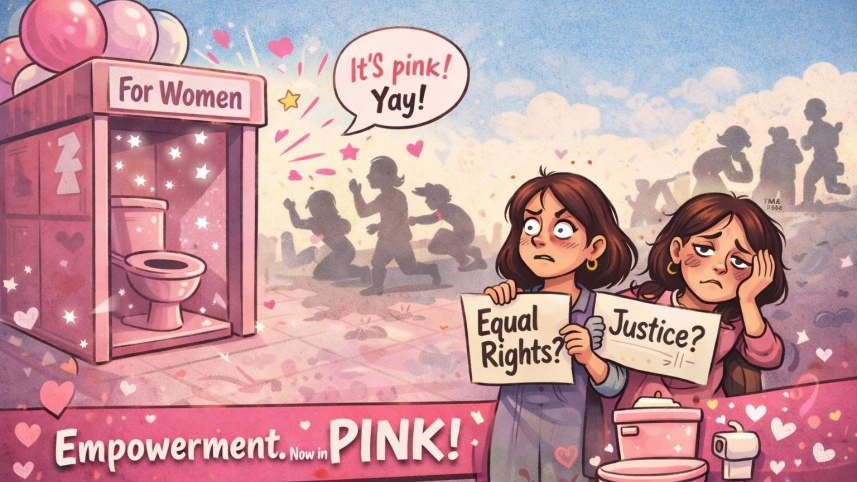
After centuries of oppression, discrimination, violence, erasure, and systemic neglect, the conclusion is finally in. The great national diagnosis has been made -- the root of women’s suffering has finally been identified. And the solution comes in the colour of pink.
Pink toilets.

Because when women think of fear, they are not thinking of acid attacks, rape, child marriage, domestic violence, workplace harassment, or being killed by husbands, brothers, fathers, lovers. No, what really keeps us women up at night is the tragic injustice of using a toilet that is not colour-coded to their gender.
Clearly, the biggest problem women face in this country is not safety, but the aesthetics surrounding as we eliminate waste from our bodies. That’s what really matters.
This revelation comes as a relief. It means all those women who have been protesting, screaming, bleeding, testifying, filing cases, getting buried quietly, were simply confused. They thought they wanted bodily autonomy, equal rights, justice, dignity but it turns out they just wanted pastel plumbing.
For years, women have asked for equal pay. What they really meant was rose-tinted commodes. They have asked not to be assaulted on the streets. What they were actually demanding was lavender tiles. They have asked not to be married off as a child. What they needed was a blush-pink signboard saying “For Women”.
Problem solved.
Let us applaud the brilliance of this solution. It takes a special kind of genius to look at a country where women are unsafe in their homes, streets, workplaces, classrooms, courtrooms and refugee camps, and decide that the real crisis is that the toilet is the wrong colour.
Pink toilets do not challenge power. They do not threaten patriarchy, they do not demand accountability, they do not require men to change behaviour, beliefs, or entitlement. They do not ask the state to prosecute rapists, protect survivors, or dismantle systems of violence -- that’s why they’re so great.
And pink is perfect. Pink is soft, pink is obedient, pink is non-threatening. Pink says, “We acknowledge your existence, but only within boundaries we control.” Pink says, “You may relieve yourself here, but do not ask to live freely out there.”
It is also deeply efficient. A can of paint is cheaper than reforming laws, a toilet block costs less than funding shelters, and a ribbon-cutting ceremony is easier than explaining why conviction rates for sexual violence remain abysmal. Pink toilets are visible and cute. Justice is messy.
Pink toilets also photograph well.
One can already imagine the speeches. “We care about women.” “We are addressing women’s needs.” “We have taken a historic step.” And if any woman dares to ask about rape, harassment, inheritance rights, custody laws, marital rape, or economic exclusion, she can be politely redirected to the nearest pink facility. Her concern has already been addressed -- she simply failed to notice.
There is something almost poetic about this logic.
Women are unsafe in public spaces, so instead of making public spaces safer, simply colour-code where they may sit. Women face violence at home, so instead of challenging violent homes, give them a pink place to cry quietly. Women are excluded from decision-making, so instead of handing them power, hand them pink commodes.
Naturally, this opens exciting new possibilities. Why stop at toilets? Pink bus stops, so women can wait nervously in style. Pink police stations, where complaints can be filed softly, gently, and preferably not at all. Perhaps even pink prisons, so we can finally incarcerate the colour rather than the criminals.
The beauty of the pink solution is that it asks nothing of men -- not reflection, not restraint, not reform, not consequences. Men may continue as usual, while women are efficiently redirected to facilities designed just for them. Everyone wins. Some more than others, obviously.
There will be inaugurations and photos. There will be captions about progress, and there may even be hashtags. And somewhere in the background, a woman will be assaulted, another married off, another silenced, another buried. But that is unrelated because we finally have our pink toilets now!
So let us celebrate. Let us admire the tiles. Let us appreciate the signage. Let us marvel at how neatly centuries of inequality can be reduced to interior design. Let us be grateful that when women asked for freedom, they were given fixtures. When they asked for justice, they were offered plumbing. When they asked to live, they were shown where to sit.
And always, thoughtfully, kindly, mercifully in pink.
 For all latest news, follow The Daily Star's Google News channel.
Comments